Introduction
Most people treat skin health as an outside job — serums, SPF, moisturizers. But what happens at the cellular level matters just as much. Free radical damage, collagen breakdown, and chronic low-grade inflammation all degrade skin from within, and no topical product addresses these processes.
That's where grape-derived polyphenols come in. These compounds — including trans-resveratrol, grape seed extract (OPCs), grape skin extract, and pterostilbene — have decades of peer-reviewed research behind them for antioxidant defense, collagen protection, and UV-induced oxidative stress reduction.
A landmark 1997 paper published in Science was among the first to demonstrate resveratrol's chemopreventive effects in a skin carcinogenesis model, launching an entire category of dermatology-focused polyphenol research.
The challenge is that these compounds aren't interchangeable. Bioavailability, purity thresholds, and mechanism of action differ meaningfully between them — and most supplement labels won't tell you which distinctions matter. This guide covers each compound, the evidence behind it, and what separates a product worth taking from one that isn't.
Key Takeaways
- Trans-resveratrol, grape seed extract, grape skin extract, and pterostilbene are the best-researched grape-derived compounds for skin health
- These compounds work through antioxidant defense, anti-inflammatory activity, collagen protection, and UV-stress reduction
- Purity, bioavailability, and third-party testing are the most critical quality factors when choosing a resveratrol supplement
- The 1997 Science study by Jang et al. established the scientific foundation for this supplement category
- Mega Resveratrol offers ≥99% pure, micronized, independently lab-certified trans-resveratrol with no excipients
Why Grape-Derived Compounds Lead the Skin Supplement Category
Grapes contain an unusually broad range of bioactive compounds — resveratrol, oligomeric proanthocyanidins (OPCs), anthocyanins, pterostilbene, quercetin, and flavonols, among others. Each has documented antioxidant or anti-inflammatory activity relevant to skin health.
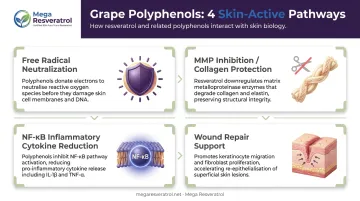
These compounds share several skin-specific mechanisms:
- Neutralizing free radicals that accelerate photoaging and UV-induced oxidative damage
- Inhibiting collagen-degrading enzymes (MMPs) that break down skin structure over time
- Reducing NF-κB-linked inflammatory cytokines (IL-6, IL-8, TNF-alpha) that damage the skin barrier
- Supporting wound repair processes through hydroxyproline synthesis and wound contraction
The scientific case for these compounds stretches back further than most people realize. Jang et al.'s 1997 study in Science showed that resveratrol acted as an antioxidant, antimutagen, and anti-inflammatory agent, and significantly inhibited skin tumor formation in a murine carcinogenesis model. That single publication triggered decades of dermatology-focused polyphenol research — meaning consumers today have a deeper, more replicated evidence base behind grape-derived skin supplements than behind most other natural health categories.
Top Skin Support Supplements
These four grape-derived supplements were selected based on peer-reviewed evidence for skin outcomes, bioavailability data, and manufacturing standards.
Trans-Resveratrol
Trans-resveratrol is the biologically active isomeric form of resveratrol, found primarily in grape skin at concentrations of 50–100 μg/g. It is one of the most extensively researched polyphenols for both skin protection and systemic anti-aging effects.
Trans-resveratrol acts through multiple skin-relevant pathways simultaneously:
- Antioxidant and antimutagen activity, as confirmed in the 1997 Jang et al. skin carcinogenesis model
- UV-induced oxidative stress reduction — studies in UVB-irradiated keratinocytes show resveratrol normalizes ROS, SOD, and GSH-Px markers, as reviewed by Wen et al. 2020
- Sirtuin (SIRT1) pathway activation — Ido et al. 2015 found resveratrol prevented oxidative-stress-induced senescence in primary human keratinocytes through AMPK-FOXO3, with SIRT1 inhibition attenuating the effect
- MMP downregulation — resveratrol reduces MMP-1 and MMP-9 activity while supporting type I collagen synthesis in skin-repair contexts
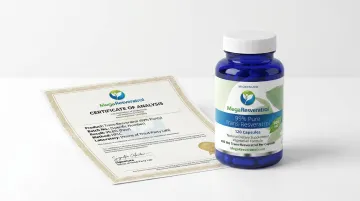
Purity is not a minor detail here. A 2012 analysis of 14 commercial resveratrol brands found that only 5 met label-content compliance; some contained as little as 8% of declared resveratrol, and 2 had no detectable resveratrol at all. Mega Resveratrol addresses this directly with pharmaceutical-grade trans-resveratrol purified to ≥99%, micronized to particles under 2 µm for enhanced absorption, and independently certified by a US laboratory for every batch — with no fillers, binders, or preservatives in the formulation.
| Feature | Detail |
|---|---|
| Purity Standard | ≥99% trans-resveratrol (pharmaceutical-grade) |
| Bioavailability | Micronized particles (<2 µm) for enhanced absorption |
| Primary Skin Benefits | Antioxidant defense, UV oxidative stress protection, collagen support, sirtuin pathway activation |
Grape Seed Extract (Oligomeric Proanthocyanidins / OPCs)
Grape seed extract (GSE) comes from dried, pulverized grape seeds and is one of the richest known sources of oligomeric proanthocyanidins (OPCs) — a subgroup of flavonoid tannins with potent antioxidant and anti-inflammatory properties.
The wound-healing evidence is among the most concrete in this category. Hemmati et al. published in Global Journal of Health Science found that a 2% GSE cream achieved full surgical wound healing in a mean of 8 days, compared to 14.4 days for placebo (p=0.0001). Beyond wound healing, OPCs protect skin structure through several interconnected mechanisms:
- Inhibiting ROS formation and suppressing MAPK/MMP signaling linked to collagen and elastin breakdown
- Reducing collagenase-mediated collagen degradation
- Supporting vascular health relevant to skin microcirculation (a 2024 randomized trial found Vitis vinifera seed extract comparable to micronized purified flavonoid fraction for chronic venous disease outcomes)
Clinical trials have used GSE at various doses — references in medical literature document studies at 150–2,000 mg/day for 2–24 weeks across different health outcomes. GSE is generally well-tolerated, though those on blood thinners or blood pressure medications should consult a healthcare provider before use (more on this below).
| Feature | Detail |
|---|---|
| Active Compounds | Proanthocyanidins (OPCs), phenolic acids, catechin/epicatechin oligomers |
| Clinically Studied Outcome | Wound healing acceleration (8 vs. 14.4 days in human RCT) |
| Collagen Protection | Suppresses MMP signaling and collagenase-mediated degradation |
Grape Skin Extract (Anthocyanins + Resveratrol Complex)
Grape skin extract is derived from the outer layers of red grapes, where the highest concentrations of anthocyanins and trans-resveratrol are found. Anthocyanins (the pigments responsible for red and purple grape color) carry much of the skin-relevant bioactivity in this extract.
Unlike single-compound supplements, grape skin extract delivers anthocyanins, phenolic compounds, resveratrol, and pterostilbene together, creating synergistic antioxidant activity. Sabra et al. 2021 confirmed that most grape phenolics — including anthocyanins, flavonols, hydroxycinnamic acids, and stilbenes — are concentrated in berry skin, not flesh or seed.
Skin-relevant research includes:
- Nayak et al. (Phytotherapy Research, 2010) demonstrated that grape-skin powder increased wound contraction, reduced epithelialization time, and elevated hydroxyproline levels in rats
- Guo et al. 2024 reviewed anthocyanins as reducing UV-induced ROS, DNA damage, inflammatory signaling, and MMP activity in photoaged skin contexts
- Grape anthocyanin constituent cyanidin-3-O-glucoside is specifically included in recent grape photodamage protection reviews
Extraction method matters significantly. Non-fermented, water-based extraction processes (such as those used by NZ Extracts for their Oxifend® line) preserve phenolic integrity — their specification confirms >350 mg/g phenolics from unfermented Pinot noir grape skin using 100% water extraction. Fermented or chemically processed extracts typically yield lower active compound concentrations.
| Feature | Detail |
|---|---|
| Key Active Components | Anthocyanins, trans-resveratrol, pterostilbene, phenolic compounds |
| Extraction Method | Water-based, non-fermented extraction preserves phenolic content |
| Primary Skin Relevance | UV and free radical defense, wound healing support, anti-inflammatory activity |
Pterostilbene
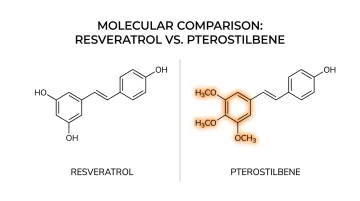
Pterostilbene is a naturally occurring stilbene compound found in grapes alongside resveratrol. Structurally similar but chemically distinct, two methoxy groups replace two hydroxyl groups compared to resveratrol — a change that increases lipophilicity and bioavailability considerably.
Kapetanovic et al. found oral bioavailability of pterostilbene at approximately 80% versus roughly 20% for resveratrol in rats, a practical advantage for sustained tissue-level effects. Pterostilbene was also identified alongside resveratrol in the traditional Ayurvedic grape tonic drakshasava, documented by Paul et al. in 1999.
For skin specifically, pterostilbene's research profile is building:
- Xie et al. 2021 found pterostilbene accelerated wound healing in diabetic burn injury models by reducing oxidative stress, restoring mitochondrial function, and suppressing inflammatory cytokines
- Ganesh et al. 2023 reported pterostilbene accelerated diabetic wound-healing response through Nrf2/macrophage-mediated mechanisms
- Recent studies (2024–2025) suggest pterostilbene may protect against UVB-induced photodamage and support skin anti-aging through antioxidant and anti-inflammatory activity
Its longer persistence in the body makes pterostilbene a practical complement to resveratrol rather than a direct substitute — the two compounds act through overlapping but not identical mechanisms.
| Feature | Detail |
|---|---|
| Structure vs. Resveratrol | Two methoxy groups increase lipophilicity vs. resveratrol's three hydroxyl groups |
| Bioavailability | ~80% (rat studies) vs. ~20% for resveratrol |
| Documented Skin Mechanisms | Wound healing acceleration, oxidative stress reduction, anti-inflammatory activity |
How to Choose Quality Skin Support Supplements
The research behind grape-derived polyphenols is solid — but the supplement market's execution of that research is inconsistent at best.
The evaluation framework used here:
- Quality and consistency of peer-reviewed evidence for specific skin outcomes
- Bioavailability and absorption data
- Established safety profiles and known drug interactions
- Manufacturing standards — GMP certification and independent third-party purity testing
The most common consumer mistake is choosing skin supplements based on label claims or price without verifying purity. As documented by Rossi et al. (2012), some resveratrol products contain as little as 8% of their declared active compound — or none at all.
That's the gap Mega Resveratrol was founded to close. After finding available products only 10–20% pure following his own cardiovascular diagnosis in 2003, founder Doron Efrat created a pharmaceutical-grade trans-resveratrol line with verifiable standards:
- Every batch independently certified by a US laboratory
- GMP-certified manufacturing facility
- FDA-registered facility
- New York State Board of Pharmacy Drug Manufacturer license
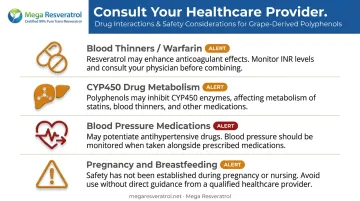
Drug interactions and cautions to know before starting:
- Grape seed extract and resveratrol can interact with blood thinners (warfarin), as GSE has demonstrated antiplatelet and anticoagulant effects in human plasma
- Both compounds may interact with CYP450-metabolized drugs — resveratrol has been shown to inhibit CYP3A4, CYP2D6, and CYP2C9 while inducing CYP1A2
- GSE and pterostilbene can have additive blood pressure-lowering effects — caution with antihypertensives
- Pregnant or breastfeeding individuals should avoid these supplements due to insufficient safety data
Conclusion
Trans-resveratrol, grape seed extract, grape skin extract, and pterostilbene represent a well-researched, complementary group of grape-derived compounds with distinct but overlapping mechanisms for skin health — antioxidant defense, anti-inflammatory activity, collagen protection, UV-stress reduction, and wound healing support.
For those prioritizing quality and transparency, Mega Resveratrol offers pharmaceutical-grade trans-resveratrol: 99% pure, micronized for optimal absorption, free of all excipients, and independently lab-certified with every batch.
Trusted by over 100 research institutions worldwide — including NYU, Columbia, Duke, and UCSF — the product has been used in more than 50 published studies, making it among the most thoroughly documented options available.
Learn more at megaresveratrol.com or call 1-877-368-3242.
Frequently Asked Questions
What is grape skin extract good for?
Grape skin extract is rich in anthocyanins, trans-resveratrol, and phenolic compounds that support antioxidant defense, skin wound healing, and UV protection. Its value comes from the synergistic combination of active components concentrated in the grape's outer layer — a profile distinct from either grape seed extract or isolated resveratrol.
Who should not take grape seed extract?
Pregnant or breastfeeding individuals should avoid grape seed extract due to insufficient safety data. Those taking blood thinners (warfarin), antihypertensives, or CYP450-metabolized medications should consult a healthcare provider, as GSE has demonstrated antiplatelet effects and may influence blood pressure.
Does resveratrol help with skin aging?
Trans-resveratrol has documented antioxidant, anti-inflammatory, and sirtuin-activating properties that protect against UV-induced oxidative damage and support collagen integrity. The 1997 Science study by Jang et al. established its skin chemopreventive effects, and active compound concentration varies widely between products — making purity an important factor when choosing a supplement.
What is the difference between grape seed extract and grape skin extract?
Grape seed extract comes from the seeds and is rich in OPCs (proanthocyanidins), which are potent antioxidants that protect collagen and elastin. Grape skin extract comes from the outer grape skin and is rich in anthocyanins and resveratrol. Both have antioxidant properties but differ in primary active compounds and specific applications.
How long does it take for skin support supplements to show results?
Early markers like wound healing and UV protection have shown measurable changes in as few as 8–14 days in clinical studies. For broader outcomes such as oxidative stress markers and skin elasticity, human trials typically run 8–16 weeks.
Can I take resveratrol and grape seed extract together?
Research has identified no major contraindications between the two, and some evidence suggests they may work better together than either alone. Consult a healthcare provider before combining them, particularly if you take medications affected by either compound.