Introduction
Resveratrol has been discussed as a longevity compound for decades, featured in headlines about red wine, aging, and heart health. Many people who try a supplement report nothing noticeable. Others swear by it. That gap isn't random.
The science on resveratrol is real, but it comes with conditions. Studies consistently show benefits for cardiovascular markers, inflammation, and cellular aging. Whether you experience those benefits depends on three things:
- Which form of resveratrol you're taking
- How pure it is
- Whether you stick with it long enough for effects to accumulate
This article focuses on the benefits that have genuine research support in human studies, who those benefits apply to most, and what it actually takes to experience them.
Key Takeaways
- Trans-resveratrol is the biologically active form — the cis isomer is far less stable and offers minimal benefit
- Cardiovascular, anti-inflammatory, and bone health benefits are the most research-supported outcomes in human trials
- Many commercial supplements contain little to no detectable trans-resveratrol, which explains why so many users see no results
- Micronized particles significantly improve plasma absorption over standard powder formulations
- Most clinical benefits require 8–24 weeks of consistent daily use to become measurable
What Is Resveratrol?
Resveratrol is a polyphenol produced by plants — particularly grapes, Japanese knotweed, and berries — as a defense response to stress, fungal infection, or UV exposure. Chemically, it belongs to the stilbene family, a class of compounds known for their antioxidant and anti-inflammatory activity in both plant and human tissue.
Trans vs. Cis: The Form That Actually Matters
Resveratrol exists as two isomers, and they are not interchangeable:
| Isomer | Stability | Bioactivity |
|---|---|---|
| Trans-resveratrol | Stable | Biologically active; the form studied in clinical research and absorbed by your bloodstream and tissues |
| Cis-resveratrol | Less stable | Far less bioactive; forms when trans-resveratrol is exposed to UV light or high pH |
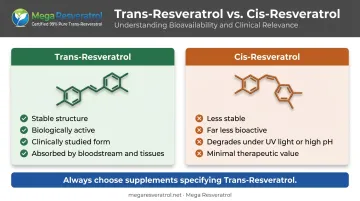
When choosing a supplement, the label needs to specify trans-resveratrol. A product that lists only "resveratrol" may contain a mix of both isomers — or worse, mostly the less active cis form.
Red Wine Isn't a Therapeutic Source
Red wine averages roughly 0.27 mg of resveratrol per 100 mL across hundreds of analyzed samples. Clinical trials studying resveratrol's effects use doses ranging from 75 mg to 1,000 mg daily — far beyond what any realistic wine consumption delivers. Red wine tells you where resveratrol comes from. It's not a supplementation strategy.
The Real Benefits of Resveratrol
The three benefit areas below are grounded in human clinical trials or well-replicated research. Theoretical mechanisms that haven't translated to measurable human outcomes are noted as such.
Cardiovascular and Blood Pressure Support
Resveratrol's most consistent cardiovascular effect works through nitric oxide. The compound promotes endothelial nitric oxide synthase (eNOS) activity, which relaxes blood vessel walls and reduces arterial pressure, a mechanism supported by multiple human studies.
The clinical data on blood pressure is dose-dependent. A 2015 meta-analysis of six RCTs found that high-dose resveratrol (≥150 mg/day) significantly reduced systolic blood pressure by 11.90 mmHg compared to placebo. Lower doses did not reach statistical significance. A 2019 meta-analysis of 17 trials extended this finding, with the strongest SBP reductions at ≥300 mg/day, particularly in people with diabetes.
Beyond blood pressure, resveratrol has shown effects on oxidized LDL (the form of LDL cholesterol most directly implicated in arterial plaque formation). In a six-month trial of high-cardiovascular-risk patients, a resveratrol-enriched grape extract reduced oxidized LDL by 20% and ApoB by 9%.
Biomarkers most affected:
- Systolic blood pressure
- Oxidized LDL and ApoB
- C-reactive protein (CRP)
- Flow-mediated dilation (arterial flexibility)
- Triglycerides (in metabolic syndrome populations)
Who benefits most: Adults over 45 managing elevated LDL, hypertension, metabolic syndrome, or conditions like LP(a), where even moderate improvements in these markers meaningfully reduce long-term cardiovascular event risk.
Anti-Inflammatory Action and Joint Relief
Chronic low-grade inflammation drives most age-related conditions, from joint degeneration to metabolic dysfunction. Resveratrol acts on several pro-inflammatory pathways, reducing circulating levels of cytokines like TNF-α, IL-6, and IL-1β. In human trials, this produces measurable drops in inflammatory biomarkers and, importantly, pain.
A 2025 systematic review and meta-analysis of 10 RCTs in 928 postmenopausal women found significant pain reductions, with a pain VAS weighted mean difference of -7.585 (P=0.005). A separate 2024 umbrella meta-analysis covering 19 meta-analyses and 81 RCTs confirmed that resveratrol significantly decreases both serum CRP and TNF-alpha.
In knee osteoarthritis specifically, a 90-day RCT using 500 mg/day found time-dependent VAS pain-score reductions (P<0.001), alongside significant drops in IL-1β, IL-6, TNF-α, and CRP compared to placebo.
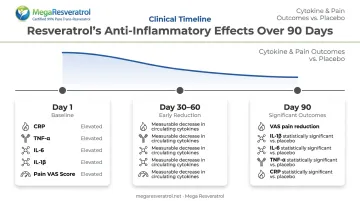
Biomarkers most affected:
- CRP and TNF-α (systemic inflammation)
- IL-6 and IL-1β
- Pain VAS scores
- Present Pain Intensity (PPI) scores
Duration matters here: Some pain relief appears within 30–90 days in osteoarthritis trials. Chronic musculoskeletal and postmenopausal pain outcomes are strongest in trials running 12–24 months.
Who benefits most: Adults with osteoarthritis, chronic joint pain, elevated CRP, or postmenopausal musculoskeletal vulnerability, where declining estrogen accelerates inflammatory sensitivity in connective tissue.
Cellular Protection, Anti-Aging, and Bone Health
Resveratrol activates SIRT1, a protein associated with DNA repair, cellular longevity, and mitochondrial efficiency. In a randomized crossover study of obese men, 150 mg/day for 30 days induced calorie-restriction-like metabolic changes through SIRT1/AMPK/PGC-1α pathways in muscle and adipose tissue.
This is mechanistic human evidence, not a confirmed anti-aging outcome. It does, however, give the longevity claims a credible biological foundation.
The bone health data is more concrete. The 2025 postmenopausal meta-analysis found that resveratrol significantly reduced CTX (C-terminal telopeptide of type I collagen), a direct marker of bone resorption, with a weighted mean difference of -0.137 (P<0.001). Lower CTX means bone is breaking down more slowly, which matters for women at risk of osteoporosis. The RESHAW 24-month bone trial, using 75 mg twice daily in postmenopausal women, found a 1.3% increase in lumbar spine bone mineral density versus placebo.
At the skin level, some evidence suggests oral resveratrol reduces cutaneous oxidative damage markers like MDA. A 2025 double-blind RCT combining oral and topical trans-resveratrol found reduced wrinkle scores, though the combined delivery route makes it difficult to attribute results to oral supplementation alone.
Biomarkers most affected:
- CTX (bone resorption)
- SIRT1 activity
- Lumbar spine BMD
- Oxidative stress markers (MDA)
Who benefits most: Adults over 50 with bone density concerns, postmenopausal women facing accelerated bone resorption, and individuals focused on longer-term preventive health strategies. These benefits operate on 6–24 month timelines.
What Happens When You Skip Quality or Consistency
Two problems undermine most people's resveratrol experience: poor product quality and inconsistent use.
The Quality Problem
Independent testing of commercial resveratrol supplements has revealed widespread label accuracy failures. A peer-reviewed analysis of 14 commercial brands found:
- Only 5 of 14 products met the 95–105% label accuracy threshold
- Some contained as little as 8% of the labeled amount
- Two had no detectable resveratrol at all
- ConsumerLab separately reported at least one product with less than 2% of its claimed dose
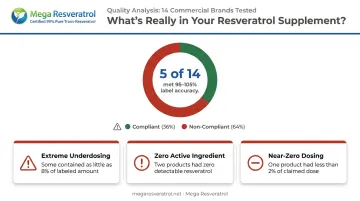
The practical consequence: if you're taking a product with severe label inaccuracy, you're not getting a therapeutic dose regardless of what the bottle says.
The Bioavailability Problem
Even assuming you have an accurately labeled, high-purity product, absorption presents a separate hurdle. After oral intake, free resveratrol is rapidly glucuronidated and sulfated in the gut and liver — one review estimated only about 2% free resveratrol circulates in plasma after a standard dose. This is why formulation matters beyond just purity.
Micronized trans-resveratrol — with particle size reduced to increase gut surface area exposure — measurably improves absorption. A phase I pharmacokinetic study found that micronized resveratrol (SRT501, particle size <5 µm) produced mean plasma levels 3.6-fold higher than equivalent non-micronized resveratrol.
The Consistency Problem
Resveratrol's benefits don't accumulate from a few doses. The clinical evidence for cardiovascular markers, anti-inflammatory outcomes, and bone health all comes from trials running 8 weeks to 24 months. Cycling on and off, or skipping doses irregularly, prevents the compound from reaching consistent tissue concentrations. If the trial evidence required 12–24 weeks to detect measurable changes, that's the minimum timeframe worth committing to.
How to Get the Most Out of Resveratrol
Prioritize Purity and Formulation
Purity determines how much active compound is actually available. Research institutions specify pharmaceutical-grade trans-resveratrol precisely because lower-purity products deliver inconsistent doses and unreliable results.
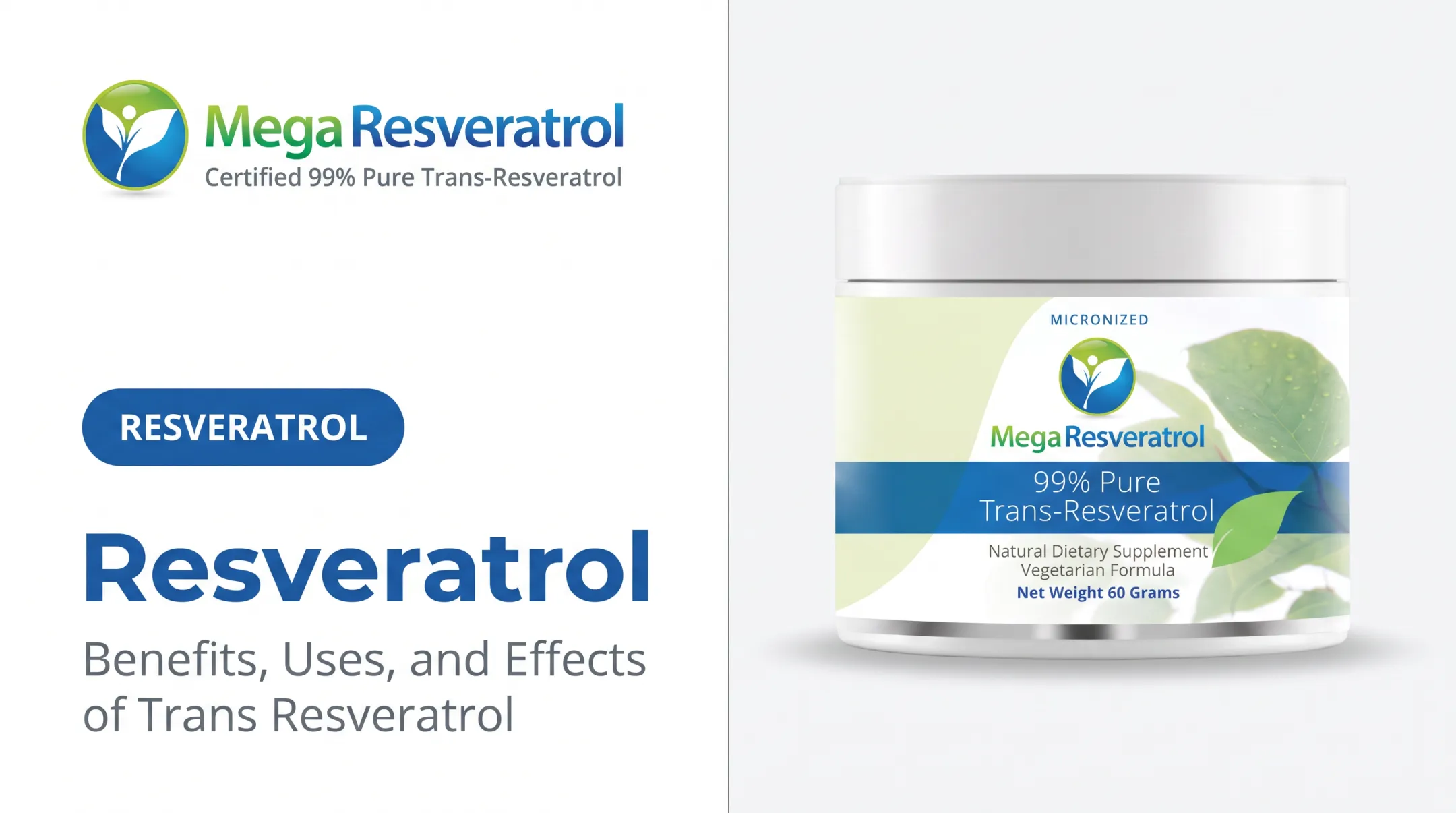
Mega Resveratrol's 99% pure, micronized trans-resveratrol capsules are manufactured in a GMP-certified, FDA-registered US facility and tested by independent US laboratories — built to the standard that clinical research uses. The company has supplied products to over 100 universities and research institutes worldwide, with those products cited in more than 50 published studies.
Practical Use Guidelines
- Take consistently, at the same time each day
- Food and absorption: Current research on fat-containing meals and resveratrol absorption is mixed — some studies show no effect, others suggest possible reduction. Take consistently regardless of meal timing; don't rely on dietary fat as an absorption strategy
- Timeline expectations:
- Anti-inflammatory and pain effects: may appear within 4–12 weeks
- Cardiovascular marker changes: typically 12+ weeks
- Bone health outcomes: 6–24 months
Interactions and Cautions
Resveratrol can interact with certain medications:
- Blood thinners (warfarin, heparin, aspirin): resveratrol may enhance anticoagulant effects
- CYP3A4-metabolized drugs: a human study of 42 participants found resveratrol modulated drug-metabolizing enzymes after 500 mg/day for 10 days, affecting CYP3A4 and CYP2C9 pathways
Anyone on prescription medications, pregnant, or managing hormone-sensitive conditions should consult a healthcare provider before starting supplementation.
Conclusion
Resveratrol has a legitimate body of evidence behind it — cardiovascular protection, anti-inflammatory relief, and cellular aging benefits have all been observed in human studies. But those outcomes were produced under specific conditions: the trans isomer, high purity, adequate dosing, and sustained use over months.
What the research actually studied matters. The studies producing real outcomes used high-purity trans-resveratrol — not generic blends or low-concentration extracts. Quality, purity, and consistency are what separate meaningful results from nothing at all. That's why Mega Resveratrol's products are purified to 99%+ purity, micronized for absorption, and independently lab-certified with every batch — meeting the same standards used by over 100 research institutions worldwide.
Frequently Asked Questions
What happens when you take resveratrol every day?
Daily supplementation lets trans-resveratrol build to consistent tissue concentrations where cardiovascular, inflammatory, and cellular benefits become measurable. Most clinical outcomes emerge after 8+ weeks of continuous use.
What should you not mix with resveratrol?
Resveratrol can amplify the effects of blood-thinning medications (warfarin, heparin, aspirin) and may alter the metabolism of drugs processed through the CYP3A4 enzyme pathway. If you're on any prescription medications, consult your doctor before combining them with resveratrol supplementation.
Can resveratrol make you look younger?
Resveratrol activates SIRT1 and reduces oxidative stress markers linked to cellular aging and skin health. Some evidence points to improvements in skin oxidative damage and wrinkle scores, though visible effects develop gradually over several months of consistent use.
What is the best form of resveratrol to take?
Trans-resveratrol is the biologically active, research-validated form. Beyond choosing the right isomer, formulation matters. Micronized trans-resveratrol produces significantly higher plasma concentrations than standard powder, making particle size and manufacturing quality as important as the compound itself.
How long does it take for resveratrol to work?
It depends on the benefit you're targeting. Anti-inflammatory and pain effects may appear in 4–12 weeks, while cardiovascular and bone health changes typically take hold over 6–24 months of consistent supplementation.
Is resveratrol safe for long-term use?
High-quality trans-resveratrol without fillers or toxic excipients is generally well-tolerated in long-term human studies, including trials running up to 24 months. The main cautions involve drug interactions and use during pregnancy — both situations require medical guidance before beginning supplementation.