Oxidative stress — the imbalance between free radicals and your body's defenses — is linked to accelerated aging, cardiovascular concerns, and cellular damage. According to NCCIH, this overproduction of reactive oxygen-containing substances can damage cells at the DNA, protein, and membrane level. Antioxidant supplements can help restore that balance, but only when chosen with the right criteria.
This guide covers seven of the best-researched antioxidant supplements, what makes each one distinct, and a practical framework for evaluating quality before you buy.
Key Takeaways
- Antioxidants neutralize free radicals; supplements fill gaps that diet alone may not cover
- No single supplement is universally "best" — different compounds protect different parts of the cell
- Seven compounds covered: glutathione, trans-resveratrol, vitamin C, vitamin E, CoQ10, alpha-lipoic acid, and NAC — each with a distinct protective role
- Form, purity, and bioavailability matter as much as the ingredient itself
- Independent third-party testing is the only reliable way to verify what's actually in the bottle
What Are Antioxidants and Why Do They Matter?
Free radicals are unstable molecules with unpaired electrons, produced during normal metabolism and from external sources like UV radiation, pollution, and chronic stress.
When free radical production outpaces your body's defenses, the result is oxidative stress — which damages lipids, proteins, and DNA. DNA lesions like 8-oxo-guanine (a marker of oxidative DNA damage) are mutagenic and linked to cardiovascular disease and accelerated aging.
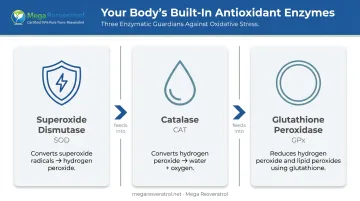
Your body runs its own internal defense network:
| Endogenous Enzyme | Role |
|---|---|
| Superoxide dismutase | Converts superoxide to hydrogen peroxide |
| Catalase | Converts hydrogen peroxide to water and oxygen |
| Glutathione peroxidase | Reduces hydrogen peroxide and lipid peroxides using glutathione |
Dietary and supplemental antioxidants support this system — they don't replace it. Keep these principles in mind:
- Excess supplementation can interfere with normal cell signaling and immune defense, per the National Center for Complementary and Integrative Health
- More is not automatically better — dose and compound matter
- Supplements add the most value when diet falls short or when specific polyphenols (such as resveratrol or pterostilbene) are difficult to obtain in effective amounts from food alone
The 7 Best Antioxidant Supplements
These supplements were selected based on research depth, distinct mechanisms of action, and the populations most likely to benefit.
Glutathione
Glutathione — synthesized internally from glycine, cysteine, and glutamic acid — is recognized as the body's master antioxidant. It directly neutralizes free radicals, recycles vitamins C and E back to their active forms, and supports detoxification. Levels decline with age; one 2011 study found erythrocyte glutathione was 46.2% lower in older adults compared to younger subjects, with synthesis 68.2% slower.
Oral absorption is a legitimate concern. A 2015 randomized controlled trial in 54 adults found that 1,000 mg/day raised erythrocyte glutathione levels by approximately 30–35% and buccal cell levels by up to 260% over six months — with levels returning toward baseline after washout. Liposomal forms have shown similar or higher increases in smaller pilot studies, though no direct head-to-head comparison exists.
Supporting precursors like NAC (see below) can also raise internal glutathione levels without the absorption question.
Trans-Resveratrol
Resveratrol is a polyphenol found naturally in grape skins and berries, with documented antioxidant, anti-inflammatory, and cardiovascular-supportive properties. Trans-resveratrol is the bioactive isomer — a 2011 cell study confirmed it is more potent than cis-resveratrol across tested concentration ranges.
Purity and particle size matter significantly. A phase I pharmacokinetic study found that micronized resveratrol achieved a plasma Cmax approximately 3.6 times higher than a comparable non-micronized dose — a meaningful formulation difference.
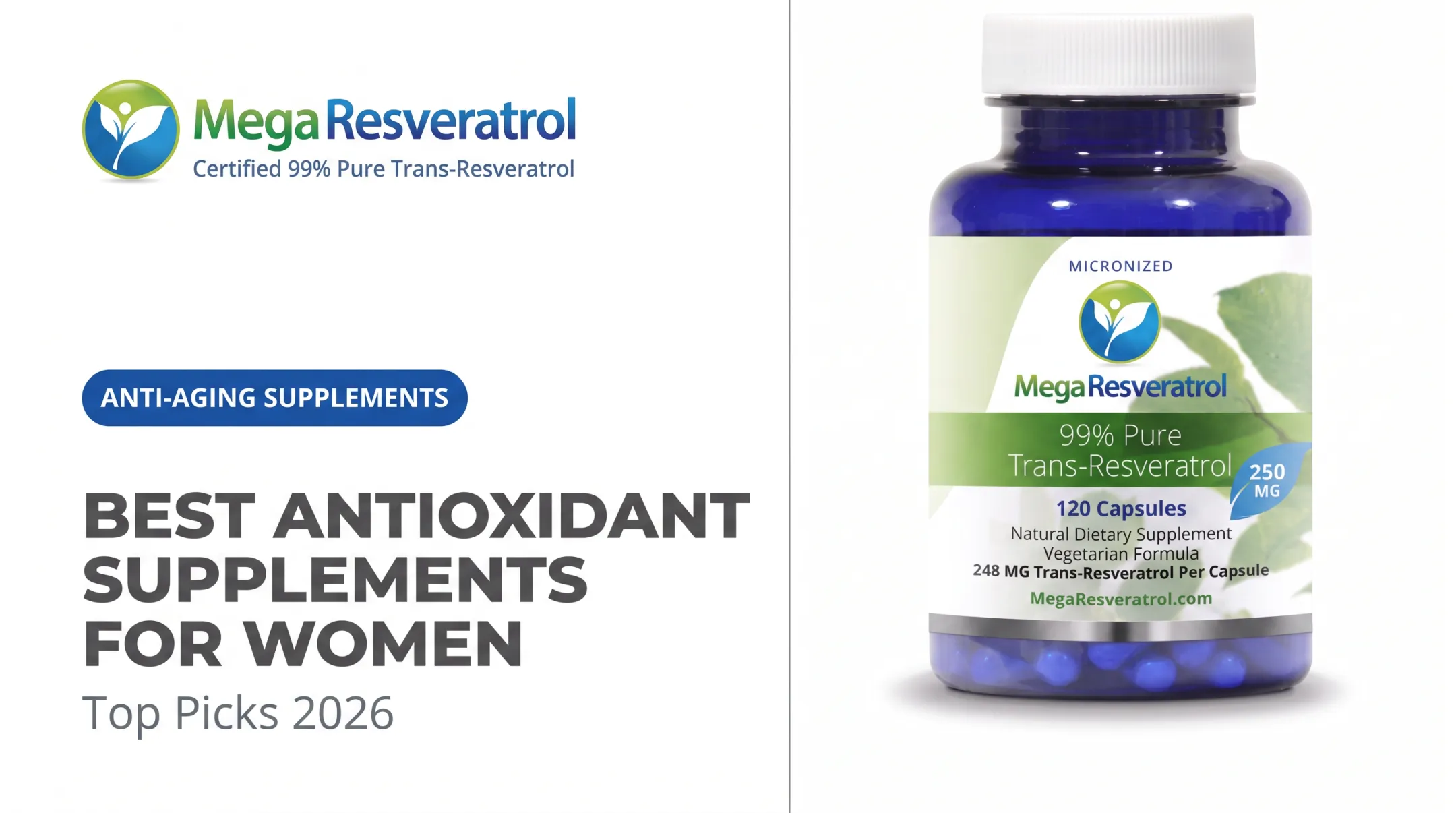
Mega Resveratrol's trans-resveratrol is purified to a minimum of 99% and micronized to particles under 2 µm — the same product independently third-party tested and used by over 100 universities and research institutes worldwide. The facility is GMP-certified and FDA-regulated.
Note: cardiovascular research on resveratrol shows heterogeneous results across meta-analyses. It is a compound with strong mechanistic evidence and ongoing clinical investigation, not a proven disease treatment.
Vitamin C
Vitamin C is a water-soluble antioxidant that circulates throughout the body, neutralizes free radicals in aqueous environments, and regenerates vitamin E at the membrane-water interface. Humans cannot synthesize it — making dietary or supplemental intake essential.
Key facts from NIH's Office of Dietary Supplements:
- RDA: 75 mg/day (women), 90 mg/day (men); smokers need 35 mg/day more
- Absorption: ~70–90% at doses of 30–180 mg/day; falls below 50% above 1 g/day
- Upper Limit: 2,000 mg/day
- High-dose risks: GI discomfort, potential interaction with certain cancer treatments, iron overload
Some vitamin C supplements are paired with bioflavonoids like quercetin. Current evidence does not confirm quercetin significantly improves vitamin C absorption in humans, though the combination may offer complementary antioxidant activity.
Vitamin E
Vitamin E — particularly the tocopherol and tocotrienol family — is fat-soluble. It embeds directly in cell membranes, interrupting lipid peroxidation chain reactions. This is a function water-soluble vitamin C cannot perform.
Two distinctions worth knowing:
- Natural vs. synthetic: Natural RRR-alpha-tocopherol is preferentially retained over synthetic stereoisomers, with an accepted biopotency ratio of approximately 1.36:1 favoring the natural form
- Prevention evidence: The 2022 USPSTF Grade D recommendation advises against vitamin E supplementation for preventing cardiovascular disease or cancer
The Physicians' Health Study II (14,641 men) found 400 IU every other day did not reduce major cardiovascular events and was associated with a 74% higher hemorrhagic stroke risk. Membrane antioxidant activity is real; disease prevention claims are not supported. Moderate, targeted dosing is the defensible approach.
Coenzyme Q10 (CoQ10)
CoQ10 plays a dual role: it is essential to mitochondrial ATP synthesis and simultaneously functions as an antioxidant that neutralizes free radicals generated during that same process. Levels decline with age and can be further reduced by statin medications — meta-analyses of placebo-controlled trials confirm statins significantly lower circulating CoQ10.
The strongest clinical evidence comes from Q-SYMBIO (2014), a randomized trial in 420 chronic heart failure patients:
- Major adverse cardiovascular events: 15% (CoQ10) vs. 26% (placebo)
- Cardiovascular mortality: 9% (CoQ10) vs. 16% (placebo) over two years
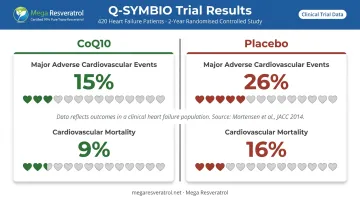
This is a clinical population — these outcomes should not be generalized to healthy adults.
Formulation also affects results: a crossover study in adults aged 65–74 found water-soluble ubiquinone achieved 2.4-fold the exposure of standard ubiquinone. Ubiquinol's advantage was not statistically significant in that study, meaning product formulation may matter more than redox-form labels alone.
Alpha-Lipoic Acid (ALA)
ALA is sometimes called the "universal antioxidant" because it functions in both aqueous and lipid environments, protecting different cellular compartments. It also regenerates glutathione, vitamin C, and vitamin E.
Beyond antioxidant activity, ALA serves as a cofactor for pyruvate dehydrogenase and alpha-ketoglutarate dehydrogenase — enzymes essential to energy production in mitochondrial metabolism.
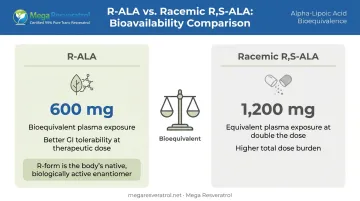
The R-form is native to the body and more bioavailable. A randomized crossover study found 600 mg R-ALA produced exposure considered bioequivalent to 1,200 mg of racemic R,S-ALA, with better gastrointestinal tolerability. That's not a universal claim about all formulations, but it's a meaningful practical distinction when reading labels.
Metabolic research shows some reductions in fasting insulin and HOMA-IR in human trials, though glucose and HbA1c findings remain inconsistent across studies.
N-Acetyl Cysteine (NAC)
NAC is a direct precursor to glutathione — it supplies cysteine, the rate-limiting amino acid in glutathione synthesis. A 2018 study found that 1,200 mg/day for 30 days restored erythrocyte glutathione and improved VO2max by 13.6% in participants with low baseline glutathione. Participants with adequate baseline levels showed no comparable benefit — depleted status appears to be the key variable.
NAC also has independent antioxidant activity and established liver-protective properties under acute glutathione-depleting toxicity. Its primary mechanisms in vivo are cysteine delivery and glutathione synthesis, not direct free radical scavenging. It is generally well-tolerated at standard doses; higher doses may cause nausea or GI discomfort.
It's most relevant for individuals under high oxidative load — heavy training, pollutant exposure, or chronic illness with documented low glutathione. Always consult a healthcare provider before use.
What to Look for in an Antioxidant Supplement
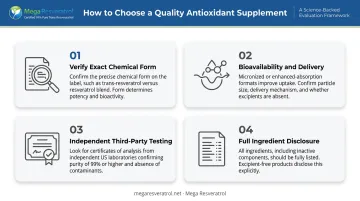
Not all supplements labeled "antioxidant" deliver equivalent results. Four criteria separate quality products from marketing-heavy ones:
1. Verify the exact chemical form The specific chemical form determines effectiveness. Trans-resveratrol vs. cis-resveratrol, ubiquinol vs. ubiquinone, R-ALA vs. S-ALA, natural vs. synthetic vitamin E: these distinctions rarely appear in front-of-label claims. Check the supplement facts panel for exact form names.
2. Bioavailability and delivery
- Fat-soluble compounds (vitamins E and K, CoQ10) need fat for absorption
- Particle size affects how much reaches systemic circulation — micronization meaningfully improves exposure for compounds like resveratrol
- Pairing with absorption enhancers can help, though evidence varies by compound
3. Confirm independent testing — not just in-house claims Look for:
- Certificates of analysis (CoA) from an independent laboratory, matched to the specific product lot
- GMP-certified manufacturing facility
- FDA-regulated production
Voluntary third-party testing provides stronger assurance than in-house quality claims. Note that FDA cGMP governs manufacturing controls, but compliance is not the same as FDA approval or proof of efficacy.
4. Demand full ingredient disclosure Avoid supplements listing undisclosed proprietary blends. Excipients — fillers, binders, magnesium stearate — can affect how quickly and completely a capsule breaks down and releases its contents. Clean-label formulas with clearly listed ingredients are a marker of quality, not just a marketing preference.
Conclusion
No single antioxidant supplement is universally best. The strongest approach combines compounds with complementary mechanisms — matched to your specific health goals:
No single antioxidant supplement is universally best. The strongest approach combines compounds with complementary mechanisms, selected for purity and bioavailability rather than sheer potency:
- Water-soluble: Vitamin C for plasma and tissue defense
- Fat-soluble: Vitamin E for membrane and lipid protection
- Intracellular: Glutathione and NAC for cellular redox balance
- Mitochondrial: CoQ10 and ALA for energy and metabolic support
For those prioritizing cardiovascular and cellular health, Mega Resveratrol's pharmaceutical-grade trans-resveratrol offers a documented quality benchmark: independently lab-certified to 99%+ purity, excipient-free, and used in over 50 published studies across 100+ universities worldwide. Consult your healthcare provider before starting any supplement program, and choose products backed by transparent, verifiable quality documentation.
Frequently Asked Questions
What's the most powerful antioxidant supplement?
No single supplement holds that title — antioxidants protect different parts of the cell. Glutathione is widely regarded as the body's most central antioxidant due to its role in recycling others, while trans-resveratrol and CoQ10 offer distinct cardiovascular and mitochondrial benefits that glutathione doesn't cover.
What are the "big 3" antioxidants?
The classic three dietary antioxidants identified by MedlinePlus are vitamins C, E, and beta-carotene (a vitamin A precursor) — covering water-soluble, fat-soluble membrane, and carotenoid activity respectively. Most research-backed protocols now include additional compounds like CoQ10, resveratrol, and glutathione alongside these foundational three.
Do antioxidant supplements really work?
Evidence varies by compound, dose, and population — high-dose beta-carotene has shown risks in certain groups. Well-researched options like CoQ10, glutathione, NAC, and trans-resveratrol show measurable effects in clinical studies when taken in bioavailable forms.
What antioxidant supplement is best for heart health?
Trans-resveratrol and CoQ10 are among the most extensively studied antioxidants for cardiovascular support, with roles in reducing oxidative damage to lipids and supporting mitochondrial energy production in cardiac cells. Consult a healthcare provider for personalized guidance.
Is it safe to take antioxidant supplements every day?
Most are safe at standard doses for healthy adults. That said, very high doses of beta-carotene and vitamin E have been linked to adverse outcomes in specific groups — stay within established upper limits and choose GMP-certified, independently tested products.
How do I know if an antioxidant supplement is high quality?
Four markers signal a trustworthy product:
- Certificate of analysis from an independent third-party lab
- Manufacturing in an FDA-regulated, GMP-certified facility
- Clear labeling of the exact form of each ingredient
- No proprietary blends or undisclosed excipients