If you're exploring healthy aging, energy support, or metabolic health, understanding NMN isn't optional. It's foundational.
This article covers what NMN powder is chemically, how it works inside cells, what clinical research actually shows about its benefits, where it naturally occurs in food, and what to look for when choosing a supplement.
Key Takeaways
- NMN is a naturally occurring nucleotide that converts directly into NAD+ inside cells
- NAD+ levels decline with age, affecting energy production, DNA repair, and metabolic function
- Human trials show endpoint-specific benefits in insulin sensitivity, fatigue, and physical performance
- Food sources deliver fractions of a milligram per 100g, nowhere near the 250–900mg doses used in clinical studies
- Look for verified purity, third-party testing, and GMP-certified manufacturing when choosing a supplement
What Is NMN Powder?
The Molecule Itself
Beta-NMN (β-nicotinamide mononucleotide) is a pyridine nucleotide with the molecular formula C₁₁H₁₅N₂O₈P and a molecular weight of 334.22 g/mol (CAS 1094-61-7). Its structure contains three components:
- A nicotinamide group derived from vitamin B3
- A ribose sugar
- A phosphate group
That phosphate is what distinguishes NMN from its close relative NR (nicotinamide riboside). NR is essentially NMN without the phosphate, meaning NMN is one enzymatic step closer to becoming NAD+. Plain niacin (B3) is structurally simpler still and follows a longer, less direct conversion pathway.
NMN occurs naturally inside cells as an intermediate in the NAMPT-dependent NAD+ salvage pathway. The body produces it, uses it, and continuously replenishes it — output decreases with age, which is where supplementation enters the picture.
What "Powder" Actually Means
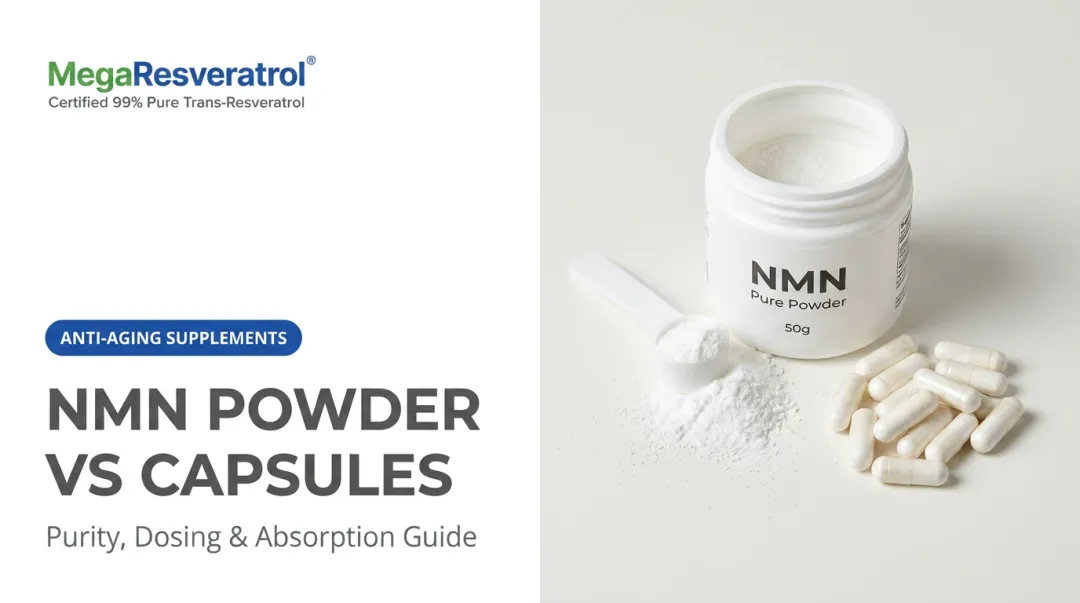
NMN powder is simply the raw, unencapsulated molecule in its solid form. The molecule itself is identical whether it comes in a capsule or a jar of powder — "powder" refers to the delivery format, not a different compound.
Powder format offers a few practical advantages:
- Flexible dosing — measure by weight to dial in exact amounts
- Dissolvable — can be stirred into water or other liquids
- Encapsulable — can be put into capsules at home if preferred
Why Supplement at All?
Since the body's own NMN production declines over time, food sources become the obvious alternative — but they fall short. NMN does occur in food, only in trace amounts. Supplemental powder provides concentrated doses that diet simply cannot replicate, a gap that becomes meaningful when you look at what clinical researchers actually use. More on those numbers in the food sources section below.
How NMN Powder Works in the Body
The Conversion Pathway
Once ingested, NMN enters cells through a transporter protein identified as Slc12a8 in a 2019 Nature Metabolism study — though its exact role remains debated in the literature. Once inside, cellular enzymes (NMN adenylyltransferases) convert NMN into NAD+.
NAD+ itself has no reliable mechanism for crossing cell membranes efficiently in humans — making precursors like NMN the practical route to raising intracellular NAD+ levels.
What NAD+ Does Once Produced
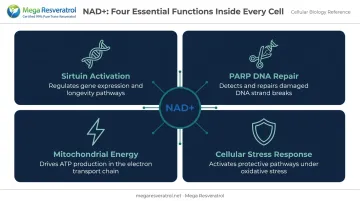
NAD+ is not a passive molecule. Once synthesized inside cells, it:
- Powers sirtuins — a family of proteins (SIRT1–SIRT7) that regulate DNA repair, gene expression, and stress response
- Fuels PARP enzymes — which consume NAD+ to fix DNA strand breaks
- Drives mitochondrial energy production — supporting the cellular machinery that generates ATP
- Manages cellular stress responses — helping cells adapt to oxidative damage
The Age-Related Decline Problem
Research consistently links aging with falling NAD+ levels, though the exact rate varies by tissue and individual. A 2012 PLOS ONE study measuring NAD+ in non-sun-exposed skin found mean NAD+ of 8.54 ng/mg protein in newborns, dropping to 2.74 ng/mg at ages 30–50, and 1.10 ng/mg in those over 70.
A separate 2015 PNAS study measuring brain NAD+ in 17 healthy adults found a significant negative correlation with age (r = -0.75). No single universal percentage decline applies across all tissues — but the direction is consistent.
Lower NAD+ means reduced energy production and slower DNA repair — two mechanisms that NMN supplementation directly aims to address.
Potential Benefits of NMN Powder
Human clinical trials for NMN are still relatively early-stage — most involve small groups over short durations. That said, several trials have produced specific, measurable findings worth understanding.
Energy and Fatigue
A 12-week randomized trial in 108 Japanese adults over age 65 found that afternoon NMN supplementation (250mg/day) reduced self-reported drowsiness compared to placebo. The same study showed improved five-times sit-to-stand performance in the NMN group — a marker of lower-body strength and functional mobility.
Metabolic Health and Insulin Sensitivity
A 2021 Science trial enrolled 25 postmenopausal women with prediabetes and overweight or obesity. Those taking 250mg/day for 10 weeks showed significantly improved skeletal-muscle insulin sensitivity compared to placebo, along with enhanced insulin-stimulated signaling pathways in muscle tissue.
Body weight and fasting glucose didn't change significantly. Still, improved insulin sensitivity is a meaningful outcome — insulin resistance compounds with age and is a key driver of metabolic disease.
Physical Performance
Two trials are relevant here:
- The same npj Aging 2022 trial (20 men over 65 after a dispensing error reduced the analysis group) showed nominal improvements in gait speed and grip strength with 250mg/day over 12 weeks
- An Indian randomized trial of 80 healthy middle-aged adults found that 600–900mg/day for 60 days increased six-minute walking distance, with stronger results at higher doses
Cognitive and Brain Health
The evidence here is weaker in humans. The npj Aging trial measured cognition and found no statistically significant benefit. Most supporting evidence comes from animal and cell studies. NAD+-dependent pathways do protect neurons from oxidative stress, and NAD+ depletion has been observed in Alzheimer's disease tissue — but NMN's specific role in human cognitive health remains unestablished.
Longevity and Sirtuin Activation
The same NAD+ biology that supports neurons also feeds into longevity pathways. NMN activates sirtuins by raising NAD+ levels, and sirtuins are strongly linked to lifespan extension in animal models. Human data is promising but early — animal longevity results have not yet been replicated in clinical trials, so translating these findings to human outcomes requires caution.
Natural Food Sources of NMN
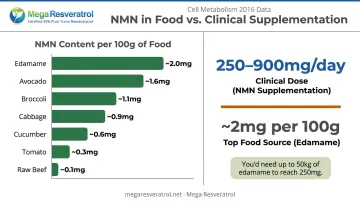
NMN occurs in a range of whole foods, measured by researchers at Cell Metabolism in 2016:
| Food | NMN per 100g |
|---|---|
| Edamame | 0.47–1.88 mg |
| Avocado | 0.36–1.60 mg |
| Broccoli | 0.25–1.12 mg |
| Cabbage | 0–0.90 mg |
| Cucumber | 0.25–0.66 mg |
| Tomato | 0.26–0.30 mg |
| Raw beef | 0.06–0.42 mg |
Even the richest sources top out under 2mg per 100g. Clinical efficacy trials use 250–900mg daily. To reach 250mg from edamame alone, you'd need to eat 13–50kg of it per day — a gap that makes dietary intake alone an impractical path to therapeutic NMN levels.
Choosing a High-Quality NMN Powder Supplement
Not all NMN powders are equal, and the supplement market has minimal enforced ingredient standards for NMN specifically. Here's what to evaluate:
Purity and Third-Party Testing
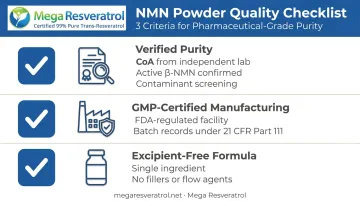
No FDA or USP rule currently establishes a minimum purity percentage for NMN supplements. That means purity claims are only meaningful when backed by independent laboratory testing. Look for:
- A published certificate of analysis (CoA) from an unaffiliated lab
- Purity testing that confirms the active β-NMN content
- Contaminant screening (heavy metals, microbial safety)
Manufacturing Standards
A GMP-certified, FDA-regulated facility is the baseline. Under 21 CFR Part 111, manufacturers must establish specifications for identity, purity, strength, and composition — and maintain batch records. This doesn't guarantee efficacy, but it does mean production controls exist.
Excipient-Free Formulas
Fillers, binders, flow agents, and preservatives add nothing to the active dose and can introduce variables for sensitive individuals. A clean, single-ingredient powder tells you exactly what you're consuming. When evaluating a product, confirm:
- No undisclosed excipients in the ingredient list
- Powder format with no capsule fillers or flow agents
- Confirmed active ingredient weight (not a blend weight)
These three criteria — verified purity, certified manufacturing, and a clean formula — are the minimum threshold for a supplement worth taking.
Mega Resveratrol's NMN powder meets all three standards: produced in a GMP-certified, FDA-regulated facility, independently lab-tested for purity, and formulated without excipients. The same approach applies across the company's product line — its supplements have been used by over 100 research institutions worldwide and cited in 50+ published studies. For researchers and consumers who require verified ingredient quality, the published CoA is available for every batch.
Safety, Side Effects, and Dosage
Current Safety Profile
Human trials have found NMN generally well-tolerated across a range of doses:
- A study of 10 healthy men found no significant adverse effects at single doses of 100mg, 250mg, or 500mg (Irie et al., Endocrine Journal, 2020)
- A trial of 48 healthy amateur runners found no adverse events at doses up to 1,200mg/day for 6 weeks (Liao et al., J Int Soc Sports Nutr, 2021) (note: not a formal maximum-tolerated-dose study)
Reported side effects in some individuals include nausea, abdominal discomfort, and diarrhea, typically at higher doses.
An Important Caveat
Long-term safety data in humans remains limited. One theoretical concern noted in research: NAD+ supports normal cell division, meaning elevated NAD+ could theoretically support the metabolic needs of existing tumor cells. A 2021 scoping review discussed this context-dependent concern.
Direct evidence that NMN supplementation causes cancer in humans is absent. A 2023 mouse study actually found high-dose NMN suppressed lung tumors via ferroptosis, but no scientific consensus exists on this question.
Anyone with a history of cancer or serious illness should consult a physician before starting NMN.
Dosage Guidance
| Context | Dose Range |
|---|---|
| Most efficacy trials | 250–500mg/day |
| Higher-dose trials | 600–900mg/day |
| Studied maximum (short-term) | 1,200mg/day (6 weeks) |
Start at the lower end and consult a healthcare professional for individualized guidance — no population-wide recommended dose has been established.
Frequently Asked Questions
Is it safe to take NMN powder every day?
Short-term human research suggests daily NMN use is generally well-tolerated at doses up to 1,200mg/day. Long-term safety data remains limited, so consulting a healthcare provider before establishing a daily routine is advisable, particularly for individuals with existing health conditions.
What are the benefits of NMN powder?
Researched benefits include improved skeletal-muscle insulin sensitivity, reduced fatigue, better physical performance, and support for NAD+-dependent cellular repair. Most findings come from small, short-duration trials, though results are promising, not yet conclusive.
Is NMN powder the same as vitamin B3?
No. NMN is derived from nicotinamide (a form of B3) and shares structural elements, but it's a more complex nucleotide with a phosphate group attached — one that converts directly into NAD+ inside cells, a distinct biological role plain B3 doesn't replicate.
How much NMN powder should you take per day?
Clinical studies have used 250–900mg daily, with 250–500mg being the most common starting range. Individual needs vary, so personalized guidance from a healthcare professional is recommended before beginning supplementation.
What foods naturally contain NMN?
Edamame, avocado, broccoli, cabbage, tomatoes, and cucumber all contain NMN. However, amounts are very small — typically under 2mg per 100g — making dietary intake alone insufficient to reach supplemental doses.
How does NMN powder differ from NMN capsules?
The active molecule is identical. Powder allows flexible dosing and faster dissolution but requires careful measuring, while capsules offer convenience with pre-measured doses. Either way, the same quality standards apply: look for purity verification and third-party testing.