That confusion costs shoppers real money. A product labeled "grapeseed resveratrol" might contain resveratrol, grape seed OPCs, or a blend of both — and the dose, purity, and form of each determines whether you're getting anything close to what the research supports.
This article breaks down what each compound actually is, why the terminology distinction matters, what the clinical evidence shows, and what to look for when choosing a supplement.
Key Takeaways
- "Grapeseed resveratrol extract" is a marketing umbrella term, not a standardized ingredient
- Resveratrol comes from grape skin; grape seed extract OPCs come from grape seeds — different chemistry, different mechanisms
- Trans-resveratrol is the biologically active isomer; cis-resveratrol has limited documented activity
- Both compounds show cardiovascular and antioxidant benefits, though research findings differ by specific health outcome
- When choosing a resveratrol supplement, purity level and micronization determine how much your body actually absorbs
What Exactly Is "Grapeseed Resveratrol Extract"?
The phrase is a marketing umbrella term. Supplement companies use it in two ways: to describe products that contain both resveratrol and grape seed extract together, or to signal a grape-derived origin when only one compound is present. Neither usage is standardized, which is why the same label can mean very different things across brands.
Where Each Compound Actually Comes From
The two compounds share a grape connection in name — but not in structure, location, or mechanism:
| Compound | Source | Key Components |
|---|---|---|
| Resveratrol | Grape skin and leaves (Vitis vinifera); also Japanese knotweed rhizome | Trans-3,5,4'-trihydroxystilbene; stilbene polyphenol family |
| Grape Seed Extract | Wine-grape seeds (winery by-product) | Oligomeric proanthocyanidins (OPCs), catechins, epicatechins; flavonoid family |
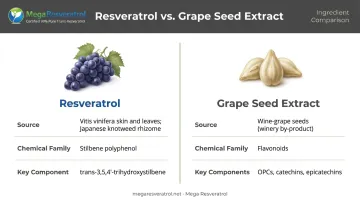
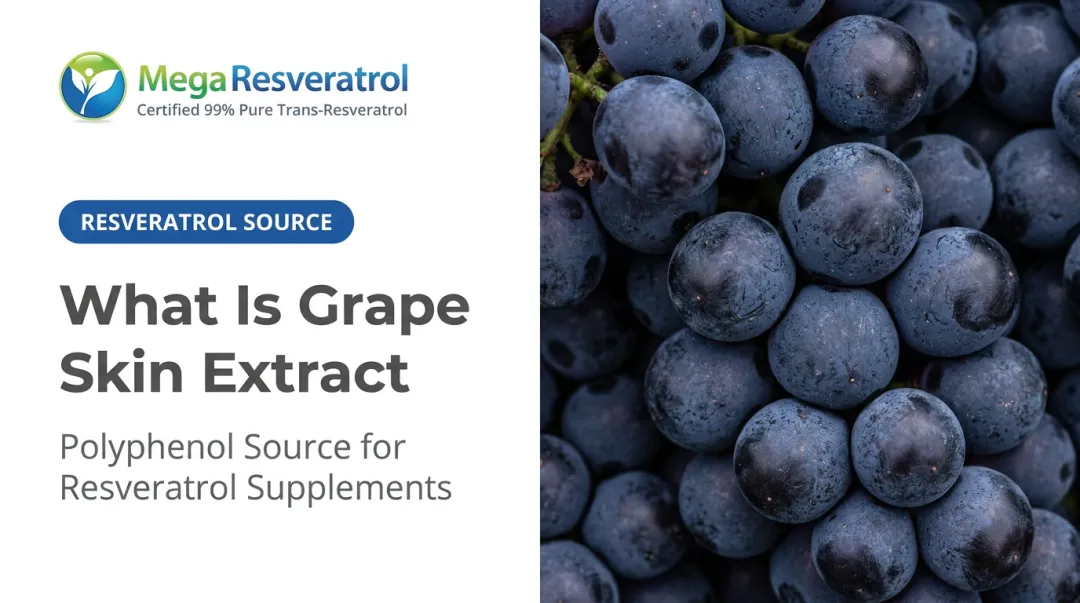
Resveratrol is a phytoalexin — a defensive compound that Vitis vinifera plants produce in response to stress, UV radiation, and pathogen attack. It is concentrated in the grape's skin and leaves, not the seed.
Grape seed extract is derived from wine-grape seeds recovered as a winery by-product. Its oligomeric proanthocyanidins (OPCs) have entirely different molecular structures and biological mechanisms than resveratrol.
Worth noting: a large share of commercial resveratrol is actually extracted from Japanese knotweed (Reynoutria japonica) rhizome — not grapes. The "grapeseed" branding can persist even when no grape-derived resveratrol is present.
That sourcing ambiguity is exactly why reading the label carefully matters.
What to Check on the Label
When a product says "grapeseed resveratrol extract," read the supplement facts panel carefully and ask:
- Does it specify trans-resveratrol (biologically active) or just "resveratrol"?
- Does it list OPCs or proanthocyanidins from grape seed separately?
- Are both compounds present, and at what doses?
- What is the stated purity percentage?
Without those answers, the label tells you nothing useful about what you're actually consuming.
Resveratrol vs. Grape Seed Extract: Key Chemical Differences
These two compounds are often grouped together, but treating them as interchangeable is a mistake.
Resveratrol: A Single, Defined Molecule
Resveratrol exists as two geometric isomers:
- Trans-resveratrol — the predominant clinically studied form, assessed by EFSA specifically at 150 mg/day for adult supplementation
- Cis-resveratrol — generally considered to have limited biological activity at the doses found in supplements
The distinction matters practically. A supplement that doesn't specify which isomer it contains may be delivering mostly the inactive form.
Resveratrol's primary documented mechanism is activation of SIRT1 sirtuin proteins, sometimes called longevity-associated genes. These same pathways activate during calorie restriction. The foundational work was conducted in yeast and cell models, which makes it mechanistically compelling — though not proof of human longevity outcomes.
Grape Seed Extract: A Complex Mixture
Unlike resveratrol's single-molecule profile, GSE is a variable mixture of proanthocyanidins at different molecular weights and polymerization levels. This matters for absorption: smaller OPC oligomers cross membranes more readily than larger polymeric proanthocyanidins, so the bioactivity of any GSE product depends on its molecular-weight distribution.
The primary mechanism for grape seed OPCs is enhancement of nitric oxide (NO) bioavailability in vascular endothelium, supporting blood vessel dilation and blood flow. This pathway is distinct from resveratrol's sirtuin activation and has more consistent clinical data for blood pressure outcomes specifically.
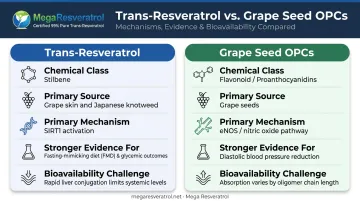
| Feature | Trans-Resveratrol | Grape Seed OPCs |
|---|---|---|
| Chemical class | Stilbene | Flavonoid (proanthocyanidins) |
| Source | Grape skin, knotweed | Grape seeds |
| Primary mechanism | SIRT1 activation | eNOS/nitric oxide pathway |
| Stronger human evidence | FMD, glycemic outcomes | Diastolic blood pressure |
| Bioavailability challenge | Rapid conjugation in liver | Varies by oligomer size |
Health Benefits: What the Research Actually Shows
Cardiovascular Support
Both compounds have cardiovascular research behind them, but the evidence is specific — not universal.
Grape seed extract: A 2022 meta-analysis published in Pharmacological Research covering 19 controlled trials found GSE produced a modest but significant reduction in diastolic blood pressure (-2.20 mmHg) and heart rate (-1.25 bpm). Systolic blood pressure and flow-mediated dilation (FMD) were not statistically significant — a nuance often lost in marketing copy.
Resveratrol: A 2019 meta-analysis of 28 RCTs in metabolic syndrome patients found improved FMD (SMD 1.77), but heterogeneity was extremely high (I² = 96.5%), making the pooled result difficult to interpret. Blood pressure effects were not significant.
Both compounds show promise for endothelial function, but neither delivers the dramatic cardiovascular results that supplement marketing often implies.
Antioxidant and Anti-Inflammatory Activity
A 2021 systematic review (Foshati et al.) screened 23 studies and pooled 19, finding that grape seed extract significantly reduced hs-CRP by -0.48 mg/L, along with reductions in malondialdehyde and oxidized LDL — meaningful markers of oxidative stress and inflammation. Standard CRP did not reach significance.
Resveratrol also demonstrates antioxidant activity, both through direct free radical scavenging and through SIRT1/Nrf2 regulation of endogenous antioxidant enzymes like SOD2 and catalase. The pathways are well-documented, but lab-level mechanisms don't always produce the same effects in human clinical trials.
Cognitive and Metabolic Health
Research across three areas shows distinct, population-specific effects:
- Cognition: Witte et al. (2014, Journal of Neuroscience) found 200 mg/day resveratrol for 26 weeks improved word retention and hippocampal connectivity in overweight adults aged 50–75. Grape seed extract showed some reaction-time changes in younger adults but no consistent cognitive enhancement pattern in controlled trials.
- Metabolic health: A meta-analysis of 11 RCTs (American Journal of Clinical Nutrition) found resveratrol reduced fasting glucose, insulin, HbA1c, and HOMA-IR in people with type 2 diabetes. These effects did not appear in non-diabetic participants.
- Cell and liver health: Grape seed proanthocyanidins have shown apoptosis-inducing effects in cancer cell lines in laboratory models. A 2024 RCT in NAFLD patients also reported improved oxidative stress markers after 500 mg/day GSE for two months. Both findings are early-stage and should not be interpreted as disease treatment claims.
Bioavailability: Why Form and Purity Matter
This is where many resveratrol products fail in practice.
The First-Pass Problem
Research by Walle et al. (2004) showed that at least 70% of an oral 25 mg resveratrol dose was absorbed — but parent compound concentrations in plasma remained below 5 ng/mL. The reason: the liver and intestinal wall rapidly convert resveratrol into sulfate and glucuronide conjugates through a process called first-pass metabolism. High absorption doesn't mean high circulating resveratrol.
How Micronization Helps
Reducing particle size increases surface area, improving dissolution rate and absorption for poorly water-soluble compounds like resveratrol. Mega Resveratrol's supplements use micronized trans-resveratrol with particle sizes under 2 µm, a formulation approach targeting the absorption limitations common in standard resveratrol powder.
Why Purity Percentage Determines Your Actual Dose
A supplement labeled "500 mg resveratrol" that is only 50% pure delivers 250 mg of active compound. A product purified to 99% delivers nearly the full stated dose. That's a 2x difference in actual intake from the same label claim.
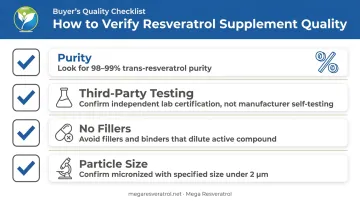
Before buying, verify these four things:
- Look for 98–99% trans-resveratrol purity on the label
- Confirm independent third-party lab testing — manufacturer claims alone aren't enough
- Avoid products with fillers or binders, which dilute the active compound
- Check that "micronized" includes a specified particle size, not just the word itself
Safety, Side Effects, and Drug Interactions
Both compounds are generally well-tolerated at moderate doses, but side effects become more likely as doses climb — and a few drug interactions deserve specific attention.
Common Side Effects
- Resveratrol: GI symptoms (nausea, diarrhea, abdominal discomfort) become more common at 1 g/day or more, and are frequently reported at 2–5 g/day
- Grape seed extract: Similar GI effects possible; occasional headache or skin reactions reported. One human safety assessment found up to 2,500 mg/day for four weeks generally tolerable — though that finding doesn't confirm long-term safety
- Individuals with known grape hypersensitivity should exercise caution with either supplement
Drug Interactions
Both compounds have antiplatelet properties that may increase bleeding risk. Consult a healthcare provider before use if you take:
- Anticoagulants (warfarin, DOACs)
- Antiplatelet agents (aspirin, clopidogrel)
- NSAIDs
- Other blood-thinning supplements (fish oil, ginkgo biloba)
Beyond direct antiplatelet overlap, resveratrol at 1 g/day for four weeks inhibited CYP3A4, CYP2D6, and CYP2C9 enzyme activity in healthy volunteers. Anyone on narrow-therapeutic-index medications should disclose resveratrol use to their prescriber — the clinical significance at typical supplemental doses remains unclear, but the interaction risk is real enough to flag.
Special Populations
- Pregnant or breastfeeding: Insufficient human safety data — use is generally not recommended
- Hormone-sensitive conditions: Resveratrol has mild estrogenic activity in cell models; caution is warranted
- Pre-surgery: Discontinue use 1–2 weeks before any scheduled procedure
- Always: Consult a healthcare provider before starting supplementation
How to Choose a High-Quality Resveratrol Supplement
The supplement market has no shortage of low-purity products dressed up in credible-sounding terminology. Here's what actually separates quality from noise:
- Confirm a stated minimum of 98–99% trans-resveratrol — not just "resveratrol extract," which can mean anything
- Require batch-level certification from an independent US laboratory; manufacturer self-testing isn't sufficient
- Avoid unnecessary excipients — fillers, binders, flow agents, and preservatives reduce active compound per capsule and can introduce unwanted substances
- Look for a particle size under 2 µm; "micronized" without a size specification is a marketing term, not a quality standard
- Check for GMP-certified manufacturing, an FDA-regulated facility, and state pharmacy board registration — these credentials indicate meaningful accountability, not just branding
Mega Resveratrol was founded in 2007 by Doron Efrat after he survived a heart attack in 2003 and was diagnosed with LP(a), a genetic cardiovascular condition. Unable to find products meeting his standards — most available resveratrol at the time was only 10–20% pure — he built the company around a single specification: pharmaceutical-grade trans-resveratrol, nothing less.
Every batch is purified to a minimum of 99%, micronized to under 2 µm, and independently tested by a US laboratory. The facility holds GMP certification, FDA registration, and a New York State Board of Pharmacy drug manufacturer license — and the products are now used by over 100 universities and research institutes worldwide.
Frequently Asked Questions
What is grapeseed resveratrol good for?
The most researched benefits include cardiovascular support (diastolic blood pressure, endothelial function), antioxidant and anti-inflammatory activity, and emerging evidence for cognitive and metabolic health in specific populations. Results vary by health goal, and neither compound substitutes for medical treatment.
What are the side effects or downsides of resveratrol?
At typical doses, side effects are minimal — GI symptoms like nausea or diarrhea appear more often above 1 g/day. The bigger challenge is bioavailability: rapid first-pass metabolism limits how much reaches circulation, which is why purity and micronization matter.
Who should not take grape seed extract?
People with grape hypersensitivity, pregnant or breastfeeding women, those with bleeding disorders, anyone on anticoagulant or antiplatelet medications, and individuals scheduled for surgery should all consult a healthcare provider before use.
What drugs or supplements should not be combined with resveratrol?
Avoid combining with blood thinners (warfarin, aspirin, clopidogrel), NSAIDs, antiplatelet supplements (fish oil, ginkgo biloba), and medications metabolized by CYP450 liver enzymes. Always disclose all supplement use to your prescribing physician or pharmacist.
Is "grapeseed resveratrol extract" the same as pure trans-resveratrol?
No — the terms are not interchangeable. "Grapeseed resveratrol extract" may mean a blend of grape seed OPCs and resveratrol, or simply grape-derived resveratrol of unspecified purity, while pure trans-resveratrol is the specific biologically active isomer. Always read the label to confirm exactly what — and how much — you're getting.
How do I know if a resveratrol supplement is high quality?
Look for 98–99% stated trans-resveratrol purity, third-party independent lab certification, no fillers or binders, a micronized formulation with a specified particle size, and manufacture in a GMP-certified, FDA-registered facility.