
Mistimed dosing can mean weaker NAD+ support, poor resveratrol absorption, or unnecessary stomach discomfort. Resveratrol's a fat-soluble compound; take it dry on an empty stomach and you're likely flushing a good portion of that dose straight through your system. NMN, meanwhile, works with your body's natural NAD+ rhythm, and taking it too late in the day can throw off sleep for some people.
This guide covers the best time to take each supplement, how that timing shifts based on age and goals, and the common mistakes that quietly undercut results.
Key Takeaways
- NMN works best in the morning on an empty or near-empty stomach, matching your natural NAD+ rise
- Resveratrol is fat-soluble and absorbs far better with a meal containing healthy fats
- Take both together early morning with a light, fat-containing breakfast
- Optimal timing may shift with age: younger and older adults often need different schedules
- Consistency over 8-12 weeks matters more than hitting an exact hour each day
Why Timing Matters for NMN and Resveratrol
Both compounds interact with your circadian clock. Dose them out of sync with that rhythm, and you blunt the benefits they're meant to deliver.
Here's the mechanism: NAD+ levels naturally rise and fall throughout the day, controlled in part by the enzyme NAMPT, which the circadian clock regulates directly. NAD+ then activates SIRT1, which feeds back into the clock itself, creating a loop.
This clock-NAD+ cycle drives mitochondrial function in mice. Disrupting that loop with supplements taken at random hours can work against you.
Absorption differs for each compound:
- Resveratrol is fat-soluble, so empty-stomach dosing sharply lowers how much gets absorbed
- NMN uses transporter-based uptake in the small intestine, so it is less dependent on food
- Both stay timing-sensitive to your circadian rhythm, with or without a meal
Poor timing habits also compound over time. Most human trials showing measurable benefits run 8-12 weeks. If you're forgetting doses or shifting your window randomly, you're not giving your body the steady-state exposure those trials actually tested.
A University of Waterloo mathematical model reinforces this: ideal timing for both NMN and resveratrol differs by age group. There's no single universal "best time"—context matters.

Best Time to Take NMN and Resveratrol Based on Different Scenarios
The right timing depends on which compound you're taking, your age, and what you're trying to achieve.
Based on Compound Type
- NMN — Morning, on an empty or near-empty stomach, to match the natural NAD+ rise and avoid food blocking intestinal uptake
- Resveratrol — With a meal that includes healthy fats (avocado, nuts, or olive oil); fat-soluble compounds absorb poorly without dietary fat
Based on Age Group
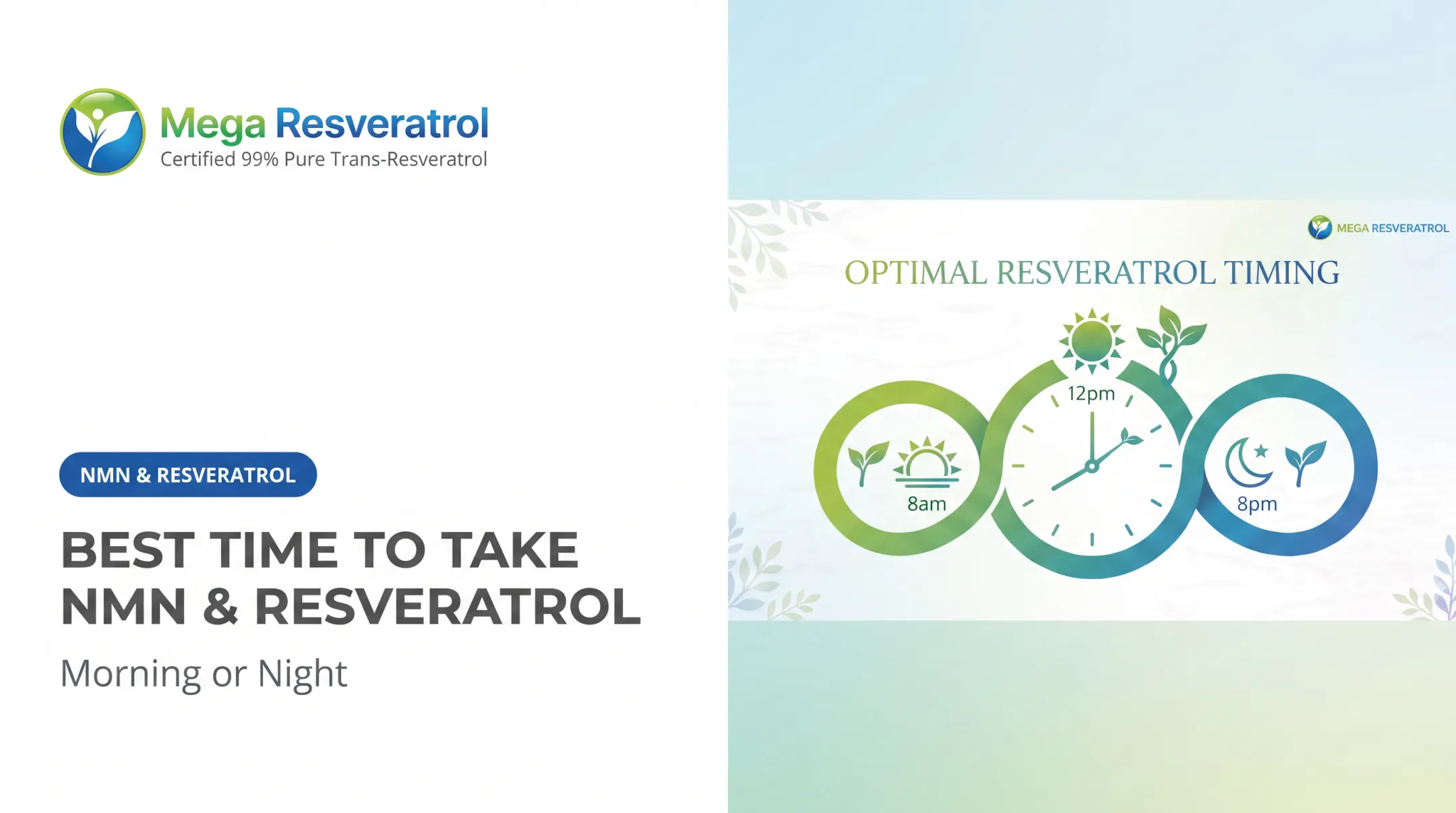
The Waterloo circadian model points to age-specific timing. Young adults may do better taking NMN about six hours after waking and resveratrol at night. Older adults showed stronger modeled outcomes with both compounds around midday.
A practical starting point from that research:
- Younger adults: morning NMN, evening resveratrol
- Older adults: shift resveratrol toward midday rather than evening

Based on Goal
- Cellular energy and healthy aging: Morning NMN with breakfast; resveratrol with the same meal or a later fat-containing meal
- Exercise recovery: Resveratrol reduced exercise-induced IL-6 in a short trial (480 mg/day for four days, dose 60 minutes pre-exercise), but it did not improve time to exhaustion—useful for recovery signaling, not as a performance booster
Based on Taking Them Together
Many longevity-focused users keep it simple: both supplements with a light, fat-containing breakfast. That single window lines NMN up with the circadian NAD+ rise and gives resveratrol the dietary fat it needs for absorption.
Timing Mistakes That Reduce Effectiveness
Most of these are habits that undercut the results you're paying for. One medication interaction is the exception—and it needs a doctor’s input.
- Taking resveratrol on a completely empty stomach with no fat source. That limits absorption. In one study, a high-fat breakfast cut resveratrol’s AUC and peak concentration by roughly 45–46% versus a standard meal. Fat helps; a heavy meal may not. Moderate fat is the sweet spot.
- Dosing NMN late in the day if it affects your sleep. Some users report a mild energizing effect, so a late dose can delay sleep onset.
- Skipping doses. Inconsistent use keeps you from reaching the steady-state levels tied to benefits in human trials.
- Taking resveratrol with blood thinners—or too close to surgery—without medical guidance. Resveratrol may affect platelet function and has enhanced warfarin’s anticoagulant activity in animal studies. Ask a doctor about timing if you use anticoagulants or antiplatelet drugs.

What Happens If You Take Them at the Wrong Time
Timing errors won't cause harm. They just blunt your results.
- Reduced resveratrol absorption without fat — much of the dose never reaches your bloodstream
- Weaker NAD+ support from NMN when doses are inconsistent or taken late against your circadian rhythm
In a 2008 pharmacokinetic crossover study, resveratrol reached peak plasma concentration in 2.0 hours with food versus 0.5 hours fasted. Food delayed the peak substantially, even when total absorption over time stayed similar.
That four-fold difference in onset matters if you time resveratrol around a workout or a set window in your day.

Best Practices for Timing NMN and Resveratrol Correctly
Getting timing right doesn't require obsessive tracking. A few habits make the difference:
- Anchor doses to an existing routine. Morning coffee or breakfast works well as a trigger, since it builds consistency without relying on memory alone.
- Pair resveratrol with a fat-containing meal every time. Yogurt, olive oil, or a handful of nuts all work.
- Prioritize product purity. A poorly purified supplement limits bioavailability no matter how well you time it. Mega Resveratrol's trans-resveratrol capsules, for example, are certified 99% pure by an independent U.S. laboratory and micronized below 1.90 microns.
- Track results over 8-12 weeks, not days. This mirrors the timeframes used in published human trials, whether measuring NAD+ levels, sleep quality, or physical performance.
- Reassess your routine if life changes significantly—new medications, travel across time zones, or a shift-work schedule can all throw off an established timing pattern.
For those taking both supplements together, a common approach is one 500 mg NMN capsule paired with one 500 mg resveratrol capsule each morning with breakfast, including a source of healthy fat.
Frequently Asked Questions
How can I tell if NMN is working?
Subtle changes in energy or recovery may appear within 2-4 weeks. Clearer, measurable benefits usually take 8-12 weeks of consistent daily use.
What should you not mix NMN with?
NMN is generally well-tolerated, but check with your doctor before combining it with strong blood thinners or using it before surgery. Avoid pairing it with alcohol, since alcohol metabolism actively depletes NAD+, working against what NMN is trying to support.
Should I take resveratrol in the morning or at night?
Timing can vary by age: younger adults often do better with evening doses, while older adults may get more from midday use. Consistency still matters more than the exact hour.
Can I take NMN and resveratrol at the same time?
Yes, the two are commonly taken together. Most people pair them in the morning with a light, fat-containing breakfast to support both circadian alignment and resveratrol absorption.
Does resveratrol need to be taken with food?
Yes. Resveratrol is fat-soluble and absorbs much better with a meal containing healthy fats than it does on an empty stomach, where much of the dose can go unused.
How long before I notice results from resveratrol?
Antioxidant and cardiovascular benefits tend to build gradually. Most human trials show meaningful change after 8-12 weeks of consistent daily use.