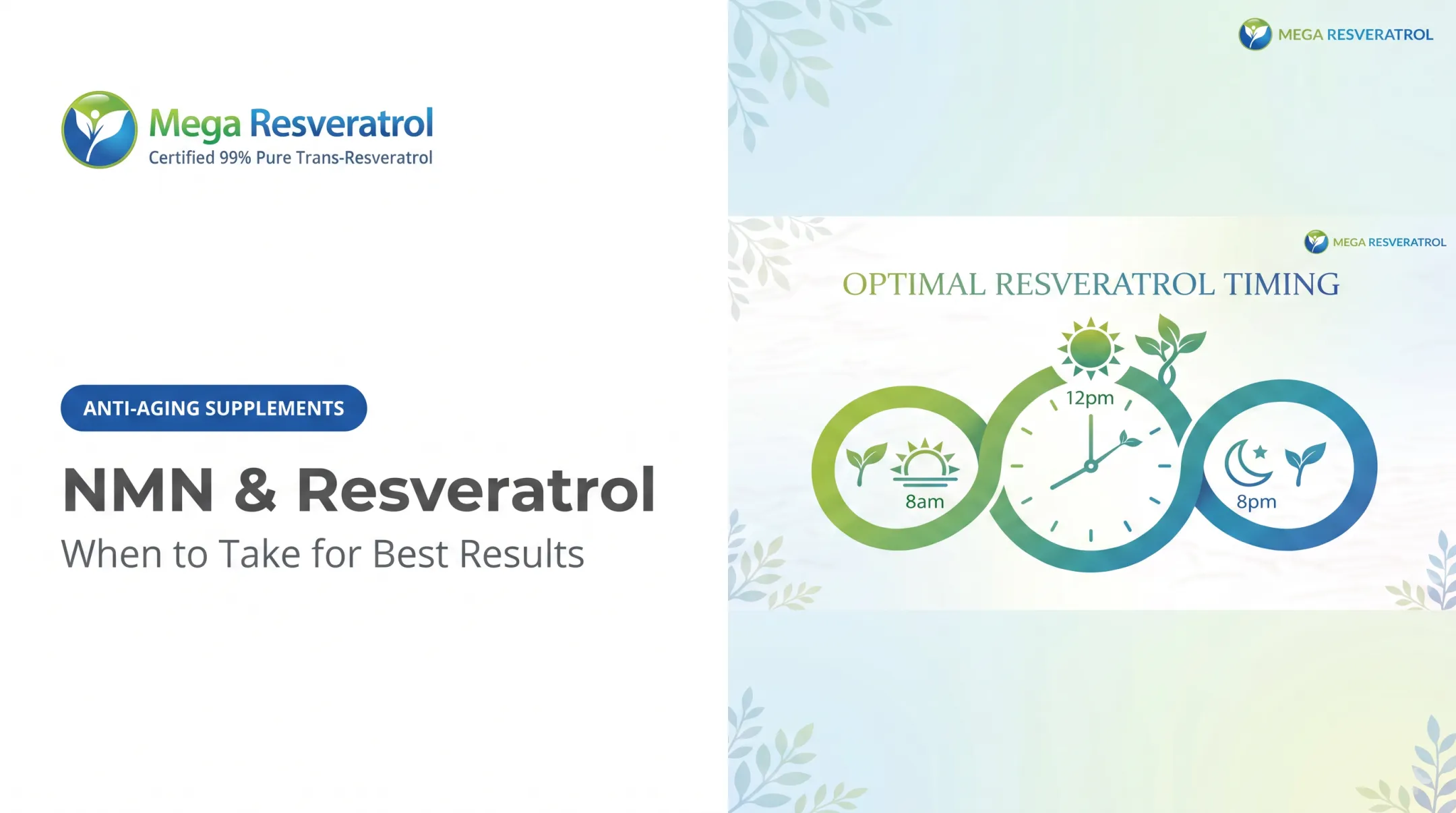

Timing affects how well your body absorbs these compounds and how they interact with your natural NAD+ production cycle. Many users struggle with figuring out whether morning or night makes more sense, and getting it wrong can mean mild sleep disruption, reduced absorption, or inconsistent results that make it hard to tell if the supplements are working at all.
This guide covers the best time for NMN, the best time for resveratrol, how to combine them, and common mistakes to avoid.
TL;DR
- Morning is generally best for NMN, aligning with the body's natural NAD+ rhythms
- Resveratrol absorbs better with a fat-containing meal, morning or midday
- Taking both together in the morning with a light, fat-inclusive breakfast is a simple, sensible routine
- Consistency over weeks matters more than the exact hour you choose
- High-purity, third-party tested formulations matter as much as timing itself
Why Timing Matters for NMN and Resveratrol
Timing affects how these compounds interact with your body's absorption pathways and NAD+ cycle. Get the timing wrong, and even a high-quality supplement won't perform as well as it should.
Circadian variation in NAD+ synthesis. Research using magnetic resonance spectroscopy in healthy men found that total brain NAD+ levels didn't shift dramatically between morning and afternoon. The NAD+/NADH ratio showed more variance in the morning hours, and lactate correlated with NAD+ only during that window (Frontiers in Physiology, 2023).
Morning metabolism behaves differently than afternoon metabolism. That difference is one reason morning dosing has become the default recommendation.
Absorption implications for resveratrol. Resveratrol has notoriously poor bioavailability. Human data shows only about 2% of free resveratrol is detectable in plasma after oral intake, largely due to rapid first-pass metabolism (Pharmaceutics review, 2021).

Because it's fat-soluble, pairing it with dietary fat changes how it's absorbed.
Consistency matters more than precision. A repeatable daily schedule builds a habit you'll actually stick to. That adherence, over months, likely matters more for outcomes than nailing the exact hour.
Best Time to Take NMN
Most published human NMN trials dosed participants in the morning, typically before breakfast. NAD+ naturally rises during active daytime hours, so morning dosing works with your body's rhythm instead of against an overnight decline.
What the Research Shows
A 60-day randomized, double-blind, placebo-controlled trial gave middle-aged adults 300, 600, or 900 mg of NMN daily, dosed once before breakfast. Blood NAD+ concentrations rose significantly versus baseline and placebo, in a dose-dependent manner (GeroScience, 2022). Another trial split 250 mg/day into morning and evening doses over 12 weeks and also saw significant NAD+ increases in immune cells (Frontiers in Nutrition, 2022). Empty stomach versus with food depends somewhat on formulation. Mega Resveratrol's NMN capsules and sublingual powder are water-soluble and don't use a delayed-release coating, so food isn't required. Some users still pair NMN with a light breakfast to avoid mild stomach discomfort when starting out. Timing research isn't only about morning protocols. A 12-week study in older Japanese adults found afternoon NMN improved lower limb function and reduced drowsiness more than morning dosing (Nutrients, 2022). Circadian-metabolism modeling also suggests aging can shift clock dynamics and change optimal dosing windows, though that work remains model-based rather than clinically confirmed in humans (iScience, 2021). Practical timing guidance:
- Default to morning for most adults, ideally before breakfast
- Older adults who feel better with afternoon dosing can stick with what works
- Avoid late-day doses if NMN feels mildly energizing and affects sleep

Best Time to Take Resveratrol
Resveratrol's absorption profile is different from NMN's because it's fat-soluble, not water-soluble. That single fact changes almost everything about when and how you should take it.
Why Fat Matters
A human pharmacokinetic study gave participants a single 400 mg dose of trans-resveratrol. Taken fasted, peak plasma concentration hit at a median of 0.5 hours. Taken with food, that peak shifted to 2.0 hours (J. Clin. Pharmacol., 2008). Food slows absorption, but it also improves how much of the compound your body can actually use. Resveratrol needs fat to dissolve properly before it crosses the gut wall. Practical food pairings that work:
- Avocado on toast
- A handful of nuts
- Eggs cooked in olive oil
- Whole-milk yogurt

Morning, Midday, or Evening?
Preclinical research suggests resveratrol can influence circadian clock components through SIRT1-linked pathways, including effects tied to sleep and overnight cellular repair (Molecular Biology Reports review, 2023). Two timing approaches follow from that work:
- Evening dosing may support repair processes during sleep
- Daytime dosing supports antioxidant activity during peak metabolic hours Neither timing is definitively correct based on human trial data.
Does Particle Size Change the Timing Equation?
Somewhat. A Phase I human trial compared micronized resveratrol against standard, non-micronized resveratrol. The micronized version achieved a 3.6-fold higher peak plasma concentration (1,942 ng/mL vs. 538.8 ng/mL), with the tradeoff of a slightly later peak time (Cancer Prevention Research, 2011). Mega Resveratrol's trans-resveratrol capsules are micronized to under 2 µm and certified at 99% purity, so a meaningful portion of the absorption problem is already addressed at the formulation level. That doesn't eliminate the value of pairing with fat, but it does mean timing nuances matter a bit less when you're starting from a higher-quality base.

Taking NMN and Resveratrol Together: Morning or Night?
Combining both means balancing NMN's circadian fit with resveratrol's fat-dependent absorption. The simplest solution: one morning routine.
The recommended approach: Take NMN close to waking, then take resveratrol alongside a light breakfast that includes some healthy fat. This satisfies NMN's circadian timing and gives resveratrol the fat it needs for absorption, all in a single, repeatable habit.
Signs the Timing Is Working for You
- Improved daytime energy or less afternoon fatigue within a few weeks
- Stable or improved sleep quality, suggesting the dose isn't too close to bedtime
- No digestive discomfort after taking both with breakfast
When to Reconsider Your Schedule
- Trouble falling asleep — shift your dose earlier in the day
- Combining with other supplements or medications — space doses out to avoid interactions
- Blood thinners or hormone-sensitive conditions — talk to your doctor first
A mouse study found higher resveratrol doses can enhance warfarin's anticoagulant effect (Journal of Atherosclerosis and Thrombosis, 2016). The human dose threshold isn't well established, so caution is warranted.
What Happens If You Take Them at the Wrong Time
Wrong timing rarely ruins a dose outright, but it can blunt results or make them harder to read:
- Late-day NMN may cause mild sleep disruption in people sensitive to its energizing effects. Some users notice enough of a lift that evening doses interfere with wind-down.
- Resveratrol without fat passes through with minimal absorption. Even a high-quality capsule delivers only a fraction of its benefit on an empty stomach.
- Inconsistent timing — skipping days or taking it at random hours — makes it nearly impossible to tell whether the supplement is working, which delays any informed change to dose or product.
Best Practices for Timing NMN and Resveratrol Correctly
- Set a consistent daily anchor by pairing your dose with breakfast or morning coffee so the habit becomes automatic.
- Choose high-purity, tested products so your timing strategy is built on accurate doses. Mega Resveratrol's trans-resveratrol capsules are 99% pure, third-party lab-tested, and made in a GMP-certified, FDA-registered US facility—timing won't help much if the product is low-quality or under-dosed.
- Track results over 8–12 weeks. Energy, sleep, and recovery don't shift overnight, so give your routine a fair trial before changing timing or dosage.
If you take NMN and resveratrol together, a simple morning protocol is one 500 mg NMN capsule with one 500 mg trans-resveratrol capsule at breakfast, plus a source of healthy fat such as nuts, eggs, or avocado.

Conclusion
There's no single universal "best time" that works for everyone. Age, sensitivity, and daily routine all play a role. Still, morning dosing with a light, fat-containing breakfast is the evidence-informed default for most adults.
Consistency and product purity matter just as much as the exact hour you choose. A well-timed dose of a low-purity product won't outperform a slightly-off-schedule dose of a pharmaceutical-grade one. Mega Resveratrol supplies 99%+ pure, micronized NMN and trans-resveratrol—independently lab-certified and excipient-free—so timing and quality work together.
Frequently Asked Questions
What time of day should I take NMN and resveratrol?
Morning, with a light breakfast containing some healthy fat, is the most commonly recommended timing. This aligns with circadian NAD+ research and gives resveratrol the fat it needs for absorption.
How long does it take for resveratrol to kick in?
Peak plasma levels appear within 30 minutes to 2 hours, depending on whether you've eaten. Noticeable benefits like steadier energy typically take several weeks of consistent use.
Does NMN affect sleep?
NMN isn't a stimulant, but some users report mild energizing effects. Taking it late in the day could interfere with falling asleep if you're sensitive to this.
How can I tell if NMN is working?
Track your energy, recovery, and sleep quality over 8-12 weeks rather than expecting immediate changes. NAD+ support tends to show up gradually, not overnight.
What should I not mix NMN with?
Be cautious with alcohol, which depletes NAD+ and undercuts the benefits you're after. Space out other supplements or medications, and consult a doctor if you're on blood thinners or other prescriptions.