Introduction
NAD+ has become one of the most talked-about molecules in longevity research. This coenzyme sits at the center of energy metabolism, DNA repair, and cellular aging, yet its levels drop significantly as we get older. Nicotinamide riboside (NR), a form of vitamin B3, has emerged as one of the most studied ways to restore those levels.
The challenge is separating genuine science from wellness hype. Human clinical trials on NR consistently show one thing: NR raises blood NAD+ levels. But the jump from "raises NAD+" to "reverses aging" requires more scrutiny than most supplement marketing applies.
Here's what the research actually shows — and what to consider before choosing a supplement.
Key Takeaways
- NR is a vitamin B3 derivative that the body converts to NAD+, a coenzyme central to energy metabolism and DNA repair
- NAD+ declines with age — one review estimated a drop of at least 50% across adult aging based on human skin tissue data
- In a randomized trial of 140 adults, 300 mg/day of NR raised whole-blood NAD+ by 51% after two weeks
- Brain health and cardiovascular benefits look promising, though human trial evidence is still early-stage
- Purity, independent lab verification, and consistent daily use matter as much as the NR itself
What Is Nicotinamide Riboside?
NR is a naturally occurring compound found in small amounts in foods like cow's milk and beer. Analytical studies have measured roughly 12 micromol/L of NAD+ precursor vitamins in cow's milk (about 40% as NR) and between 0.48 and 3.25 micromol/L of NR in craft beers. Those concentrations are nowhere near what clinical trials use — clinical doses typically start at 100 mg/day and reach 1,000 mg/day or more.
How the Body Converts NR to NAD+
The conversion pathway is well-established biochemically:
- NR → NMN — enzymes called NRK1 and NRK2 phosphorylate NR into nicotinamide mononucleotide
- NMN → NAD+ — NMNAT enzymes complete the conversion, producing active NAD+
- NAD+ fuels cellular processes: it serves as a redox substrate in mitochondrial energy production and a required cofactor for DNA repair enzymes
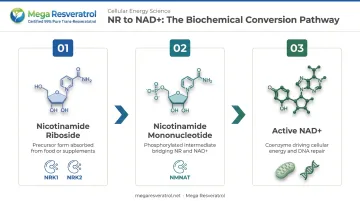
NR is best understood as a precursor (a building block), not a supplement with direct effects. Its entire value depends on what cells do with it after conversion.
That distinction also matters when comparing NR to other forms of vitamin B3. Niacin, niacinamide, and NR all eventually produce NAD+, but through different pathways with different side effect profiles. Niacin causes skin flushing at standard doses; NR does not — a meaningful difference for anyone taking supplements daily.
Key Benefits of Nicotinamide Riboside and NAD+ Supplementation
The benefits below reflect areas where clinical and preclinical research has shown the most consistent signals. The strength of evidence varies considerably between them.
Raises NAD+ Levels to Support Energy Metabolism
The most well-documented effect of NR supplementation is measurable: it raises blood NAD+ levels in humans. A 2019 randomized, double-blind, placebo-controlled trial of 140 overweight adults found that 100, 300, and 1,000 mg/day of NR increased whole-blood NAD+ by 22%, 51%, and 142%, respectively, after just two weeks. Those elevations persisted through the full eight-week study period.
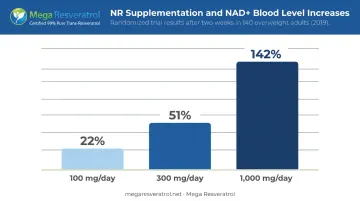
Why does this matter? NAD+ acts as a redox substrate in the mitochondrial electron transport chain — it accepts electrons during metabolism and transfers them to support ATP synthesis. Higher NAD+ availability means the machinery that converts food into cellular energy has more of what it needs to run efficiently.
Raising NAD+ doesn't automatically improve how you feel or perform. A separate randomized crossover study of 12 older men found that 1,000 mg/day for 21 days increased NAD+-related metabolites in muscle but did not improve mitochondrial respiration, muscle strength, or physical performance. Sample sizes were small and study periods short — a pattern that runs through NR research generally.
People most likely to notice a difference from NR-driven NAD+ restoration:
- Adults over 50, where baseline NAD+ levels are measurably lower
- Individuals experiencing age-related fatigue or poor post-exertion recovery
- Those with metabolic conditions affecting mitochondrial efficiency
Activates Sirtuin Pathways Linked to Healthy Aging
NAD+ is a required cofactor for sirtuins — a family of seven proteins (SIRT1–SIRT7) that participate in DNA repair, inflammatory signaling, and circadian rhythm regulation. Without adequate NAD+, sirtuins simply cannot function. That biochemical dependency is well established.
Whether oral NR produces meaningful sirtuin activation in humans is harder to confirm. Most trials measure blood NAD+ levels, not sirtuin activity directly. The mechanistic chain makes biological sense — more NR raises NAD+, which enables sirtuin function, which influences health outcomes — but human evidence for the downstream steps remains mostly indirect.
What cell and animal studies have found about activated sirtuins:
- SIRT1, SIRT6, and SIRT7 participate in genomic maintenance and DNA strand repair
- SIRT1 modulates NF-κB-related inflammatory responses
- NAD+-dependent SIRT1 activity oscillates with circadian rhythm, regulating clock gene expression
Some researchers and formulations pair NR with pterostilbene, a polyphenol that activates sirtuins through a complementary pathway. A 2017 randomized trial of 120 adults aged 60–80 found the combination raised whole-blood NAD+ by approximately 40–90% at day 30 (depending on dose), confirming the NAD+-raising effect even if sirtuin activation wasn't measured directly. Resveratrol works similarly, and pairing it with NR — one supplying the NAD+ fuel, the other activating the enzymes — underpins several longevity stacking protocols.
May Support Brain and Cardiovascular Health
This is the area where the science is most promising and most preliminary.
Brain health: NAD+ availability influences SIRT1, which can activate PGC-1α — a protein involved in mitochondrial biogenesis and neuronal antioxidant defense. Preclinical work shows SIRT1-activating compounds reduce oxidative stress and cell death in neurons. In humans, a 2022 phase I trial (NADPARK) of 30 people with Parkinson's disease found that 1,000 mg/day for 30 days was tolerable, raised NAD+ metabolites, and showed early signs of brain target engagement. A 2024 pilot study of 20 adults with mild cognitive impairment found NR increased circulating NAD+ but did not significantly improve cognition, cerebral blood flow, or brain volume. Both trials were small and exploratory.
Cardiovascular health: A randomized crossover study of 24 healthy adults aged 55–79 found that 500 mg twice daily for six weeks raised blood-cell NAD+ by approximately 60%. Systolic blood pressure and aortic stiffness signals trended in a favorable direction in some subgroups, but the trial was not powered to establish cardiovascular efficacy.
Neither area has sufficient human evidence to support claims of treatment or prevention. The signals are real — but they're early, and larger trials are needed before drawing firm conclusions.
What Happens When NAD+ Levels Decline with Age
NAD+ decline isn't a side effect of aging — researchers now view it as a driver. A 2020 review drawing on human skin tissue data estimated that NAD+ drops by at least 50% across adult aging, though this figure comes from cross-sectional skin samples and doesn't apply uniformly to every tissue.
The downstream effects of chronically low NAD+:
- Mitochondria produce less ATP, contributing to fatigue and slower recovery
- PARP enzymes and sirtuins lose function, slowing repair of damaged DNA strands
- Reduced sirtuin activity accelerates aging signals and increases inflammation
- Metabolic vulnerability compounds, raising risk for conditions tied to mitochondrial dysfunction
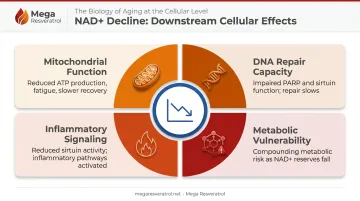
These effects accumulate over years — and diet alone won't reverse them. Food sources deliver NAD+ precursors in micromol/L concentrations; clinical trials use doses measured in hundreds of milligrams. That's the practical case for supplementation — not that food is unhealthy, but that the quantities available through ordinary eating don't come close to restoring NAD+ to levels associated with younger tissue.
How to Get the Most from NR Supplementation
Dosage
Most human studies and supplement labels use 250–300 mg/day as a starting point. Trials have examined doses up to 1,000 mg/day over six to twelve weeks without serious adverse events. A phase I safety trial tested 3,000 mg/day for 30 days in Parkinson's patients with no moderate or severe adverse events, though that evidence covers only one month in a specific population.
Optimal long-term dosing hasn't been established for the general population. Key reference points:
- 250–300 mg/day: Standard starting dose used in most human trials
- 1,000 mg/day: Upper range examined in multi-week safety studies
- 3,000 mg/day: Tested short-term in one Parkinson's population only
Consult a healthcare provider before exceeding standard doses, particularly if taking other medications.
Supplement Quality
The FDA does not pre-approve dietary supplements for safety or efficacy before they reach the market. That places the burden of quality verification on manufacturers, and standards vary widely across brands. NR chloride holds FDA GRAS status (GRN 635) as a recognized source of vitamin B3, but GRAS recognition doesn't validate anti-aging or cardiovascular claims.
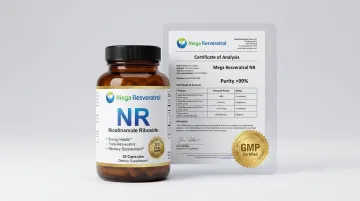
Third-party independent lab testing for purity and potency is the most reliable signal that what's on the label is actually in the capsule. Mega Resveratrol's NR supplements are certified by independent US laboratories and manufactured in a GMP-certified, FDA-registered facility — a meaningful standard in a market where label accuracy is not guaranteed.
Stacking with Resveratrol or Pterostilbene
NR and resveratrol work on related but distinct pathways: NR elevates the NAD+ that sirtuin enzymes require as a fuel source, while resveratrol directly activates those enzymes. That makes the combination mechanistically complementary. The NR-plus-pterostilbene trial cited earlier shows the NAD+-raising effect holds with a polyphenol companion. No serious interactions have been identified, though no head-to-head human trial has yet confirmed synergistic outcomes beyond what NR alone produces.
Consistency
NR's effects operate at the cellular level over time. Human trials show measurable NAD+ increases within two to four weeks of daily supplementation, but subjective benefits, when they occur, may take longer and vary by individual. What the published evidence actually reflects is consistent daily use over weeks to months — not short-term bursts.
Frequently Asked Questions
What is nicotinamide riboside chloride used for?
Nicotinamide riboside chloride is the stable salt form of NR used in clinical trials and most commercial supplements. It's taken primarily to raise NAD+ levels in the body, supporting energy metabolism, DNA repair, and processes linked to healthy aging.
Is nicotinamide riboside chloride the same as vitamin B3?
NR chloride is a specific form of vitamin B3, but it's chemically distinct from niacin and niacinamide. All three can raise NAD+ levels through different pathways, but NR is more bioavailable and doesn't cause the skin-flushing side effect associated with niacin at standard doses.
Which is better, nicotinamide riboside or NAD+ supplements?
Oral NAD+ faces absorption challenges: the molecule is large and may be degraded before reaching cells, though some membrane transport of NAD+ has been demonstrated in mammalian cells. NR, as a precursor, is readily absorbed and converted to NAD+ intracellularly, making it a practical and well-studied delivery method.
How long does it take for nicotinamide riboside to work?
Human studies show measurable increases in blood NAD+ within two to four weeks of consistent daily supplementation. Subjective benefits — such as improved energy or focus — may take longer to notice and vary considerably between individuals.
What is the typical recommended dosage for nicotinamide riboside?
Most clinical studies use 250–300 mg per day. Some trials have examined doses up to 1,000 mg/day without serious adverse effects over study periods of six to twelve weeks. Consult a healthcare provider before exceeding standard dosing.
Can nicotinamide riboside be taken alongside resveratrol?
NR and resveratrol are commonly combined because they target complementary sirtuin-related pathways. NR elevates NAD+ to fuel sirtuin enzymes; resveratrol activates them directly. No serious interactions have been identified, but consult a healthcare provider if you're on other medications.