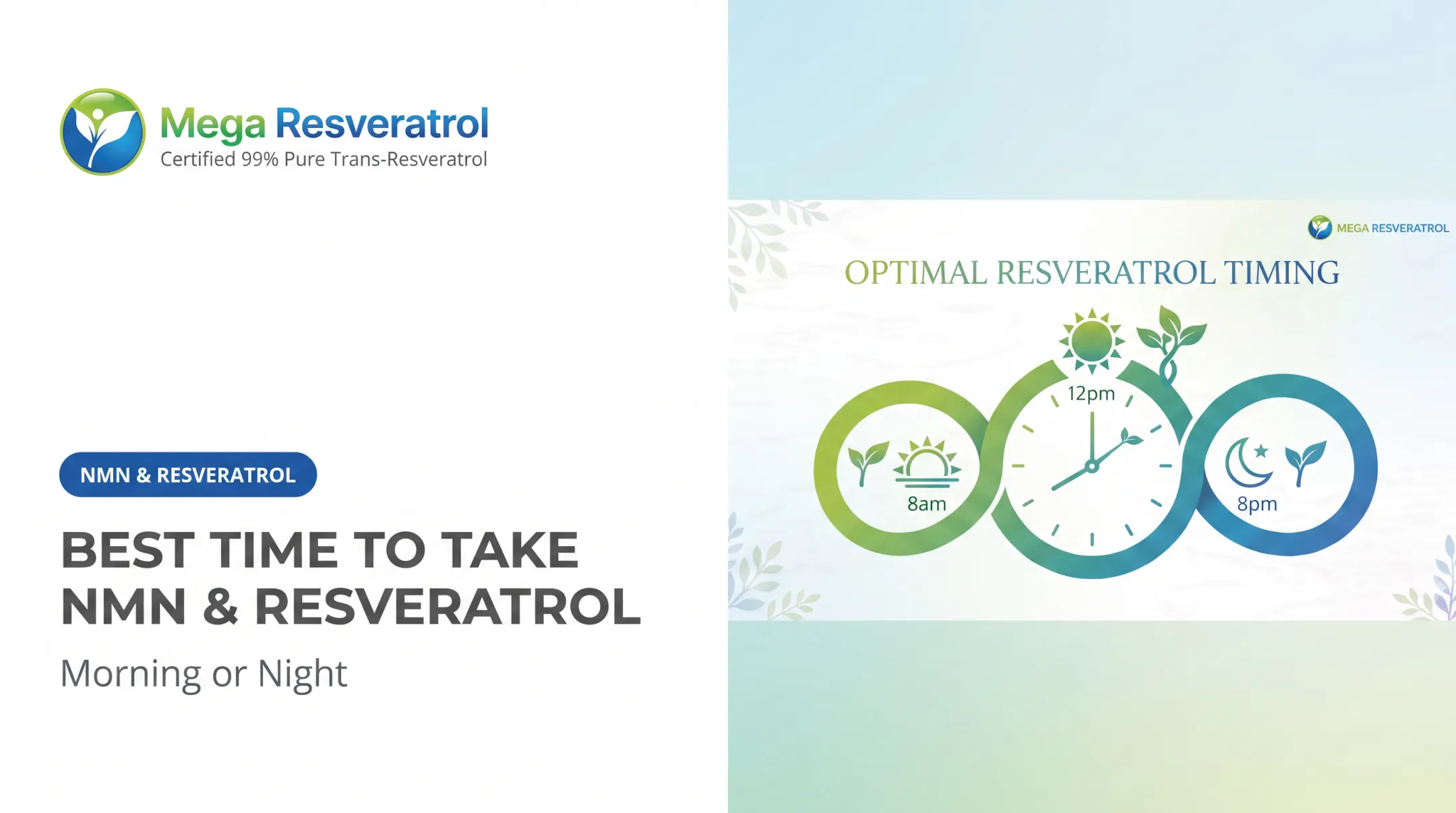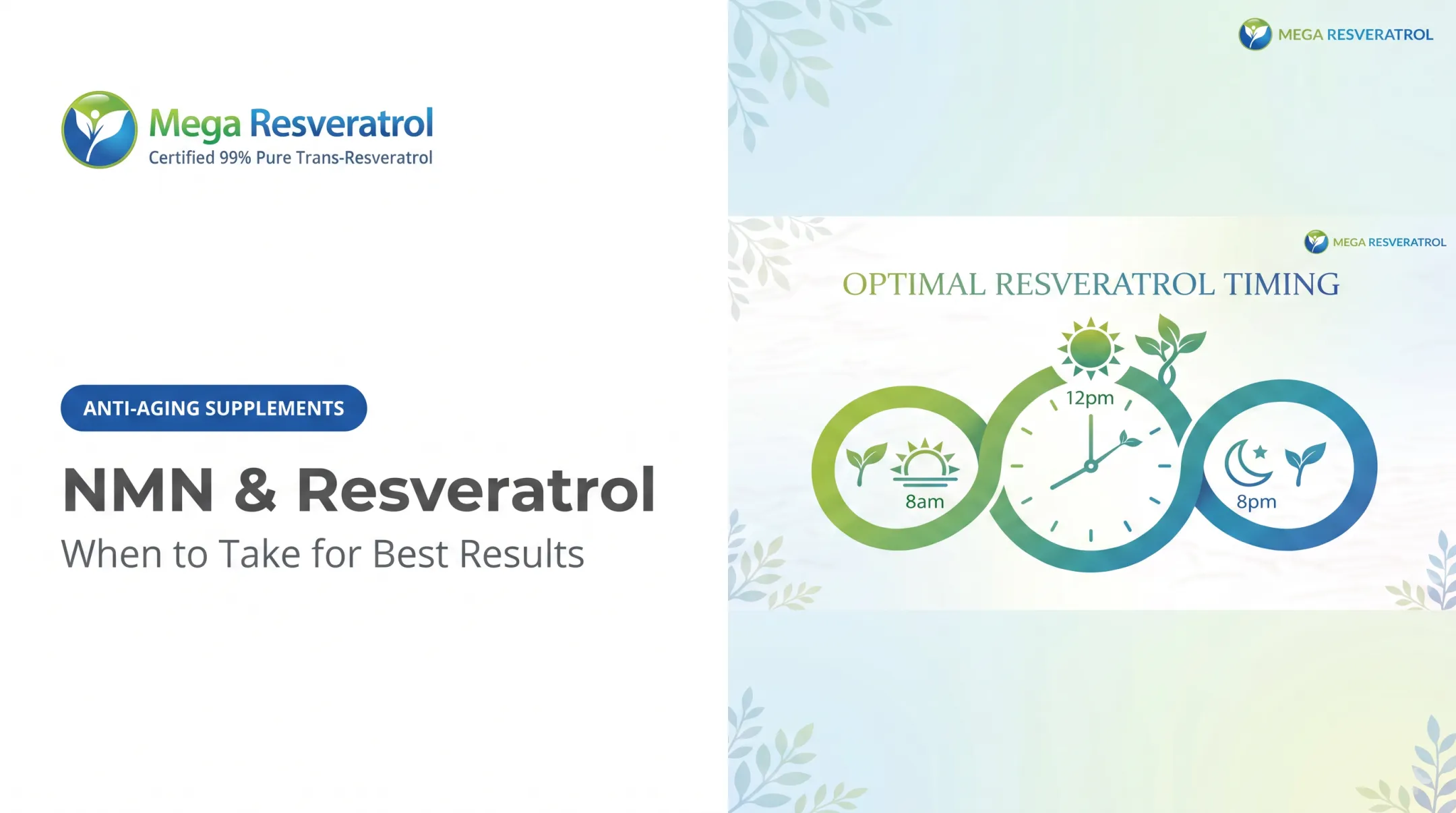

But confusion runs deep here. Should NMN be taken with food or without? Does resveratrol actually need fat to absorb? Can you take them at the same time?
This guide breaks down exactly how to take both compounds for the best absorption, based on how each one actually behaves in your body.
TL;DR
- NMN: Take in the morning, on an empty or near-empty stomach
- Resveratrol: Take with a meal that includes healthy fats (it's fat-soluble)
- Together: Take both with a light, fat-inclusive breakfast to align with your morning rhythm
- Consistency: Daily use for 8–12 weeks before judging results beats on-and-off cycling
- Purity: Choose third-party lab-tested, micronized products for better absorption
Why Absorption Matters for NMN and Resveratrol
NMN and resveratrol hit different absorption bottlenecks, so the same dosing habit will not optimize both.
Where each compound struggles:
- NMN depends on reaching a gut transporter quickly enough to enter circulation
- Resveratrol is fat-soluble, poorly water-soluble, and heavily altered on first pass through the liver
NMN relies on a dedicated transporter called Slc12a8 in the small intestine. Research on this transporter found fast, minute-order kinetics: once NMN reaches the gut, it moves into the bloodstream quickly (Grozio et al., 2019).
Resveratrol’s problem is metabolic loss. Your liver converts much of an oral dose to glucuronide and sulfate metabolites before it reaches tissues. Studies put oral bioavailability at roughly 20% in comparative models (Kapetanovic et al., 2010).
Product quality widens both gaps. Low-purity resveratrol products can deliver far less active trans-resveratrol than the label claims, so a large share of what you swallow never had a chance to absorb.
Particle size matters as well. Smaller particles dissolve faster and expose more surface area, which is why micronized resveratrol is widely used to improve dissolution and uptake.

How to Take NMN for Best Absorption
NMN is best taken first thing in the morning. This aligns with your body's natural circadian NAD+ cycle, which peaks during your active hours.
Timing and Food
Take NMN on an empty or near-empty stomach, roughly 20-30 minutes before eating. Food — especially fat — can slow uptake by competing for absorption pathways in the small intestine.
One exception: sublingual NMN powder. Hold it under the tongue for 1-2 minutes before swallowing — it bypasses much of the digestive process and is less sensitive to meal timing.
Dosage Guidance
Human trials have tested a wide dosage range safely:
- 250-500mg — common starting range for most users
- 600-900mg — tested in a 60-day trial of 80 adults with no serious adverse events (Yi et al., 2022)
- Up to 1,250mg — highest published human dose, tested for 4 weeks with no causal adverse events
Consistency matters more than hitting an exact clock time each day. Mega Resveratrol's Super NMN capsules provide 500mg per capsule, with a label recommendation of 1–2 capsules daily.
Common Mistakes
- Don't split your dose into multiple small servings — unnecessary and not supported by absorption data
- Don't pair NMN with a high-fat breakfast, which can blunt uptake through the same transporter pathway
- Don't take it right before bed; morning dosing matches the circadian NAD+ window

How to Take Resveratrol for Best Absorption
Resveratrol needs to be taken with a meal containing healthy fats (avocado, nuts, olive oil, or full-fat yogurt). As a fat-soluble compound, it's poorly absorbed without dietary fat to help dissolve it.
Timing and Food
A crossover pharmacokinetic study compared 400mg of trans-resveratrol with a high-fat meal versus fasted:
- Time to peak concentration: 2.0 hours fed vs. 0.5 hours fasted
- Total absorption (AUC): essentially unchanged between the two conditions
In plain terms: fat slows the rate of absorption but doesn't reduce the total amount absorbed for standard formulations. Taking it with breakfast simply makes for a smoother, more sustained uptake.
Why Purity and Micronization Matter
Not all trans-resveratrol is created equal. Purity percentage directly determines how much active compound you're actually getting, and particle size determines how efficiently your body can dissolve and absorb what's there.
Compare typical powder to a micronized option:
- Standard powder: 170-220 microns particle size
- Mega Resveratrol micronized: D-50 under 1.90 microns (roughly 100× smaller)
- Purity: minimum 99%, certified by an independent US laboratory
Smaller particles mean more surface area, which improves dissolution of poorly water-soluble compounds.

Dosage Guidance
Common dosage ranges run 150-500mg per day, with some products offering 250mg or 500mg capsule strengths. Megadosing without dietary fat largely wastes the extra dose. A moderate amount taken consistently with a fat-containing meal beats a large dose on an empty stomach.
Taking NMN and Resveratrol Together
The logic behind pairing these two is straightforward. NMN raises your NAD+ substrate. Resveratrol activates sirtuins — the enzymes that consume NAD+ to drive cellular repair processes. One builds the fuel supply; the other switches on the engine that burns it (Bonkowski & Sinclair, 2016).
Practical routine:
- Take NMN on a near-empty stomach first thing in the morning
- Wait 20-30 minutes, then eat breakfast with a small amount of healthy fat
- Take resveratrol alongside that breakfast

A common combined approach uses 250-500mg of NMN paired with 300-500mg of trans-resveratrol each morning.
This routine has been popularized by longevity researchers. No published human trial has tested NMN and resveratrol taken together for a combined clinical outcome. The synergy is mechanistically sound and supported by preclinical work, but individual results vary. Consistency over 8-12 weeks matters far more than perfect timing.
One more tip: space other supplements or medications away from this routine to avoid competing for the same absorption pathways.
Safety, Side Effects, and When to Talk to a Doctor
Both compounds have solid safety track records at studied doses. The most common side effect is mild digestive upset, and serious adverse events are rare across published trials.
Interaction warning: Resveratrol may interact with blood-thinning medications, including warfarin and daily aspirin. Preclinical research found that resveratrol enhanced warfarin's anticoagulant activity (Chiba et al., 2016). It can also affect how your liver clears certain medications.
Talk to your doctor before starting either supplement if you:
- Take blood thinners or antiplatelet medication
- Have an upcoming surgery
- Are pregnant or breastfeeding
- Take other daily prescription medications
Independently lab-tested products without unnecessary fillers lower unknown-interaction risk and help confirm the purity on the label matches what’s inside.
Frequently Asked Questions
When is the best time to take NMN and resveratrol?
Morning works best for both. Take NMN on a near-empty stomach, then have resveratrol with breakfast alongside a small amount of healthy fat.
What should you not mix NMN with?
Avoid pairing NMN with a high-fat meal, since fat can slow its uptake. Space it apart from other supplements that might compete for the same intestinal transporter.
Are there any side effects or safety concerns with taking NMN?
NMN is well-tolerated at doses up to 1,250 mg in published trials. Mild digestive discomfort is the most common issue. Anyone pregnant, breastfeeding, or on medication should consult a doctor first.
Should resveratrol be taken with food?
Yes. Take it with a source of healthy fat, such as avocado or olive oil, since resveratrol is fat-soluble and poorly absorbed on an empty stomach.
Do I need to cycle NMN or resveratrol?
No clinical evidence supports cycling. Published trials use continuous daily dosing for months with sustained results and no loss of tolerability. A short pause can help you gauge ongoing benefit if you want to reassess how you feel without it.
How do I know if my resveratrol supplement is high enough purity to absorb well?
Check the label for independent third-party lab certification, the trans-resveratrol purity percentage (aim for 99%+), and micronized particle size (ideally under 2 microns).