
But hype doesn't equal results. Many consumers struggle to separate real mechanisms from marketing noise, and product quality varies wildly across brands. This article breaks down how NMN and resveratrol work, what clinical and preclinical research actually shows, and how to choose a supplement that delivers what the label promises.
TL;DR
- NMN replenishes NAD+, a coenzyme essential for cellular energy and DNA repair that declines with age
- Resveratrol activates SIRT1, a longevity-linked protein that depends on NAD+ to function
- Together, they can complement each other: NMN supplies the fuel, resveratrol provides the spark
- Purity and micronization determine whether a supplement actually gets absorbed
- Both are well-tolerated when pure; choose 99%+ tested, micronized forms over low-purity powders
What Are NMN and Resveratrol?
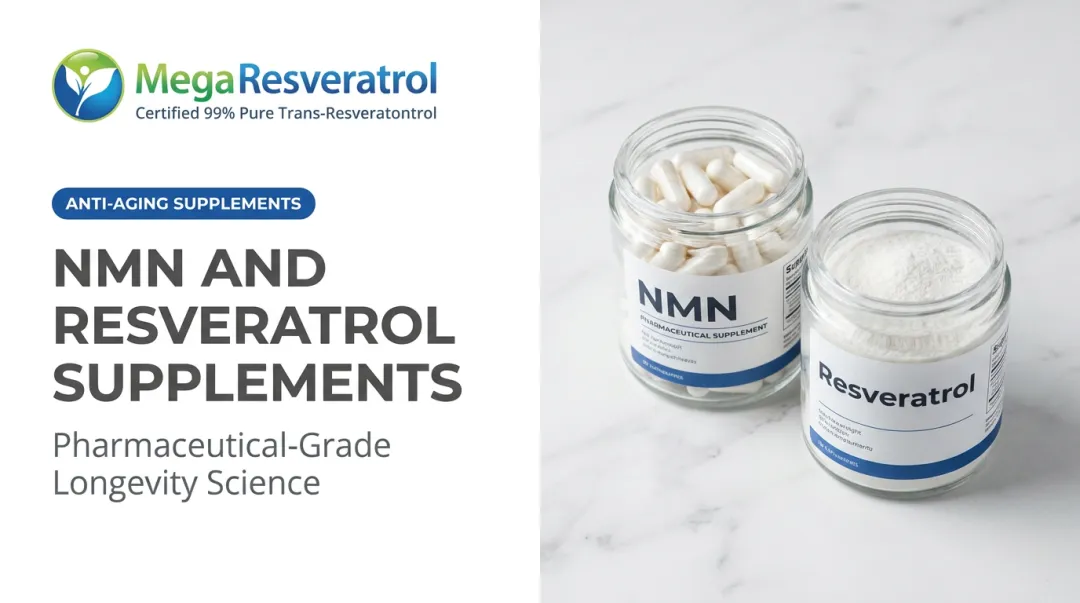
NMN is a direct precursor to NAD+, meaning your body converts it in a single enzymatic step. Resveratrol is a plant-based polyphenol antioxidant found in red grape skins, berries, and peanuts.
Both also appear in food, though only in small amounts:
- NMN: Broccoli and green beans hold meaningful levels (reported as high as 13,000 micrograms per 100 grams in some analyses)
- Resveratrol: Peanuts carry roughly 2.3–4.5 micrograms per gram, rising after germination
A 2025 CyTA - Journal of Food analysis documents these food concentrations. Neither compound cures aging. Treat them as tools that support your body's cellular repair and energy systems.
Key Advantages of NMN and Resveratrol for Longevity
The benefits below aren't vague anti-aging claims. They're tied to measurable markers: NAD+ blood levels, sirtuin activity, and inflammatory biomarkers documented in human and preclinical research.
Advantage 1: Cellular Energy and NAD+ Restoration
NAD+ fuels mitochondrial ATP production, and levels decline substantially with age. NMN restores that supply in a single enzymatic step, unlike precursors that need multiple conversions.
A 60-day, randomized, double-blind, placebo-controlled trial in healthy middle-aged adults found statistically significant, dose-dependent increases in blood NAD+ across all NMN groups, with efficacy peaking at 600 mg/day [source: GeroScience, 2022].

Why this matters:
- Restored NAD+ supports metabolism, energy production, and cellular repair
- Daily outcomes may include reduced fatigue and improved exercise capacity
- Most relevant for adults over 40, when NAD+ decline accelerates
Markers to watch: blood NAD+ levels, ATP production, self-reported energy and endurance.
Advantage 2: Sirtuin Activation and DNA Repair
Resveratrol activates SIRT1, a protein linked to DNA repair, stress resistance, and metabolic regulation. Sirtuins still need adequate NAD+ to function, which is why NMN and resveratrol are complementary rather than redundant.
A 90-day trial in older adults found that 1,000 mg/day of resveratrol improved psychomotor speed on cognitive testing compared to placebo and lower doses [source: PMC, 2018]. Separately, a single 270 mg dose significantly improved flow-mediated dilation, a marker of blood vessel function.
Why this matters:
- Supports long-term cognitive and cardiovascular health
- Highest relevance for people managing cardiovascular risk factors or seeking cognitive support
Markers to watch: cognitive performance scores, flow-mediated dilation, inflammatory markers.
Advantage 3: Synergistic Cardiovascular and Metabolic Support
Combining NMN and resveratrol may amplify benefits beyond either compound alone. In a mouse study, adding resveratrol to NMN raised tissue NAD+ significantly more than NMN alone: 1.59x higher in heart tissue and 1.72x higher in skeletal muscle compared to NMN by itself [source: Pharmacology Research & Perspectives, 2022].

NMN increases NAD+ supply while resveratrol helps the body use that NAD+ more efficiently. Together, the pair targets pathways tied to cholesterol, blood pressure, and circulatory function.
Markers to watch: cardiovascular biomarkers, insulin sensitivity, mitochondrial function.
This advantage is personal territory for Mega Resveratrol founder Doron Efrat. After a heart attack in 2003 and an LP(a) diagnosis — a genetic cardiovascular condition with no direct cure — he spent a year looking past statins and found resveratrol in 2004.
That search became the foundation of the company, and it still shapes how people with a family history of heart disease evaluate NMN and resveratrol for long-term cardiovascular support.
What Happens When Quality and Purity Are Ignored
Not all supplements deliver what's on the label. Independent testing has repeatedly exposed the gap between claims and reality.
A 2012 peer-reviewed analysis of 14 resveratrol products found only 5 matched their label claims within 95-105% accuracy. Three products contained just 8-64% of stated content, and two showed no detectable resveratrol at all.
Common problems include:
- Diluted purity: low-grade extracts can hold as little as 3-5% actual resveratrol once fillers are counted
- Contaminants such as emodin from buckthorn and knotweed making up 5-20% of low-grade extracts
- Poor absorption from standard particles measuring 170-220 µm, far too large for efficient uptake
- Hidden fillers like rice flour, silicon dioxide, and magnesium stearate that dilute the active dose
- No measurable effect on NAD+ or sirtuin activity, regardless of label claims

Without independent lab verification, you're trusting marketing copy over chemistry.
How to Choose a High-Quality NMN or Resveratrol Supplement
Value comes down to four factors: purity, absorption, manufacturing standards, and clean formulation.
- Check purity — look for 98–99%+ trans-resveratrol or 99%+ NMN on a Certificate of Analysis. Lower-grade extracts, and products relying on cis-resveratrol, dilute effectiveness.
- Prioritize micronization — particles under 2 µm absorb far better than standard powder. Micronized formulations have shown up to 3.6x higher plasma resveratrol levels than non-micronized equivalents, according to a 2011 study in the British Journal of Clinical Pharmacology.
- Confirm GMP certification — manufacturing should happen in an FDA-registered, GMP-certified US facility.
- Avoid unnecessary excipients — fillers like rice flour or silicon dioxide add no benefit and can make up 50–80% of some cheap products.

Mega Resveratrol's trans-resveratrol is micronized to a D-50 particle size below 1.90 µm and independently lab-tested for purity. More than 100 university and research institutions—including NYU, UCSF, Columbia, and Duke—use it as the standard against which their own studies are measured. That's the level of transparency worth expecting from any brand you choose.
Conclusion
NMN and resveratrol target complementary pathways: NAD+ replenishment and sirtuin activation. Both NAD+ levels and sirtuin activity decline with age. The science only translates into real benefits if the product you take actually contains what it claims.
Purity, dosage, and absorption matter more than ingredient names on a label. Longevity support is a consistent, quality-focused practice that starts with knowing exactly what you're putting in your body.
Frequently Asked Questions
Can you take resveratrol and NMN together?
Yes. You can take them together, and they may offer complementary benefits because sirtuins need NAD+ to function. Consult a healthcare provider before starting any new supplement regimen.
What is the recommended dosage for resveratrol?
Most products suggest 250–500 mg per serving, with daily intake commonly ranging from 500–1,500 mg. Start at the low end and adjust only with guidance from your healthcare provider.
Which works faster, NMN or resveratrol?
NMN often shows measurable NAD+ increases within weeks, based on clinical trial data. Resveratrol's benefits, particularly cognitive and cardiovascular effects, tend to build more gradually over months.
Are there side effects of taking resveratrol daily?
Most people tolerate resveratrol well at standard servings. Higher doses can cause mild digestive upset, so reduce your dose or pause use if that occurs.
How do I know if a resveratrol supplement is high quality?
Look for third-party lab certification, 99% pure trans-resveratrol, and micronized particles under 2 µm for absorption. A publicly available Certificate of Analysis is a strong signal of transparency.
Does resveratrol interact with medications?
Resveratrol may interact with blood thinners like warfarin, since research shows it can enhance anticoagulant effects at higher doses. Talk to your doctor before combining it with any prescription medication.