NMN (Nicotinamide Mononucleotide) is a naturally occurring NAD+ precursor that's attracted serious scientific attention for its role in cellular energy metabolism. NAD+ levels decline with age, and supplementation has become a growing focus in longevity research. The global NMN market is estimated at $210.64 million in 2024, with capsules and pills representing more than 50% of that volume.
So which format deserves your money? This guide breaks down the real differences.
Key Takeaways
- NMN capsules are the format used in all major human clinical trials measuring NAD+ outcomes
- Powder offers dosing flexibility but requires precise measuring tools and careful storage
- No head-to-head study has proven one format absorbs better than the other
- Purity matters more than format; choose third-party lab-tested, excipient-free NMN
- For most users, capsules deliver better consistency, convenience, and research alignment
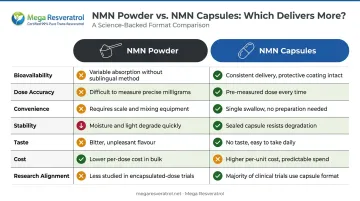
NMN Powder vs Capsules: Quick Comparison
| Factor | NMN Powder | NMN Capsules |
|---|---|---|
| Bioavailability | Limited human data on NAD+ outcomes | Multiple trials show blood NAD+ increases |
| Dose accuracy | Requires milligram-accurate scale | Pre-measured per capsule |
| Convenience | Measuring and mixing required | Portable, no preparation needed |
| Stability | Hygroscopic; sensitive to moisture and heat | Capsule shell reduces handling exposure |
| Taste | Bitter, slightly umami | Tasteless |
| Cost | Lower cost per gram in bulk | Slightly higher per serving |
| Research alignment | One major human trial (no NAD+ endpoint) | Primary format across human NAD+ studies |
What Is NMN Powder?
NMN is a molecule your body produces naturally. It serves as a direct precursor to NAD+, a coenzyme that powers cellular energy production, DNA repair, and metabolic function. As NAD+ levels decline with age, supplementation is a direct way to support healthy aging.
In powder form, NMN is sold as a loose crystalline or fine powder, typically in bulk quantities. Users measure each dose with a milligram-accurate scale and dissolve it into water, juice, or another beverage.
The Appeal of Powder
- Titrate doses up or down precisely — useful for anyone experimenting with different protocols
- Costs less per gram in bulk, making it practical for high-dose regimens
- Accommodates custom dosing requirements in research settings
The clearest human example of loose powder use is Liao et al., 2021, which gave 48 runners 300–1,200 mg/day of oral NMN powder for six weeks. Notably, that study assessed exercise performance — it did not measure blood NAD+ or pharmacokinetics. So while powder has been used in humans, it hasn't generated the same NAD+ endpoint data that encapsulated forms have.
The Drawbacks You Need to Know
- Absorbs moisture from the air (hygroscopic), which accelerates degradation without airtight, dry, cool storage
- Tastes bitter with a faint umami quality — noticeable when dissolved in water
- Measuring errors are common without a calibrated milligram scale, leading to inconsistent intake
- Requires equipment and prep that make it impractical for travel
Powder makes sense for experienced users and researchers who already have the storage setup for it — and who need dose flexibility that pre-filled capsules can't provide.
What Are NMN Capsules?
NMN capsules are pre-measured doses of NMN enclosed in a gelatin or vegetarian capsule shell. This is the format used in every major human clinical trial that has measured NMN's effect on NAD+ levels.
What the Research Actually Shows
Three of the most-cited human trials used oral capsules and found meaningful NAD+ increases:
- Yoshino et al., 2021 (Science) — 250 mg/day capsules for 10 weeks increased PBMC NAD+ in prediabetic postmenopausal women
- Huang et al., 2022 (Frontiers in Aging) — 300 mg/day (two 150 mg capsules) raised serum NAD+/NADH by 11.3% at day 30 and 38% at day 60
- Yi et al., 2023 (GeroScience) — 300–900 mg/day capsules increased serum total NAD+/NADH at both 30 and 60 days
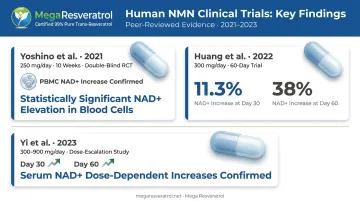
No leading human trial has used loose dissolved powder as its primary format and measured NAD+ outcomes. If you want your supplement routine grounded in clinical evidence, capsules are the format that has actually been tested.
Why Capsules Work for Most People
- Delivers a fixed, consistent dose without any measuring or preparation
- Protects NMN from air and moisture during daily handling
- Tasteless and portable — no mixing, no cleanup
- Preferred by clinicians and compounding pharmacies because consistent dosing makes patient compliance straightforward
A Note on Quality
Not all capsules are equal. Some manufacturers add fillers, binders, or flow agents that dilute the active ingredient — a problem you can't detect from the label alone.
Mega Resveratrol's NMN capsules contain no excipients and are independently tested for purity. Every batch is manufactured in a GMP-certified, FDA-regulated US facility, with third-party lab certification confirming what's actually in each capsule. That transparency matters more than the format itself.
NMN Powder vs Capsules: Which Should You Choose?
The honest answer depends on who you are and what you're optimizing for.
Choose NMN Powder If:
- You're an experienced user or researcher who needs precise, adjustable dosing
- You already own a milligram-accurate scale and airtight storage containers
- Cost savings on bulk quantities is a genuine priority
- You're comfortable with the storage discipline required to maintain potency
Choose NMN Capsules If:
- You want your routine to mirror the format used in published human clinical research
- You prefer consistent, no-prep daily supplementation
- You travel frequently or need portability
- You want protection against dosing errors and degradation from improper handling
Purity Matters More Than Format
An independent 2024 analysis of 18 NMN supplements found wide variation between label claims and actual measured content, with consumer costs ranging dramatically per gram. A high-dose capsule with low-purity NMN and unnecessary fillers delivers less value than a smaller dose of pharmaceutical-grade, third-party-tested NMN. Format is the last decision you make — purity is the first.
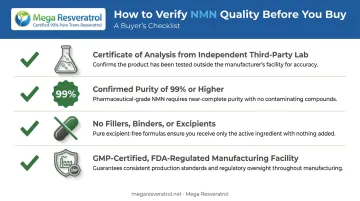
Before purchasing either format, verify:
- A Certificate of Analysis (COA) from an independent third-party lab
- Confirmed purity of 99% or higher
- No fillers, binders, or excipients diluting the active content
- Manufacturing in a GMP-certified, FDA-regulated facility
Conclusion
NMN powder suits a specific profile: experienced users who need dosing flexibility and have the tools and discipline to handle raw powder correctly. For everyone else, capsules are the more practical choice, and the format used in virtually all human NMN clinical research to date.
Whichever format you choose, the real differentiator is what's inside. Pharmaceutical-grade NMN with lot-specific, independent lab certification will consistently outperform a cheaper, unverified alternative in either form. Confirm the purity documentation before you commit to a brand — then let the powder-versus-capsule decision follow from there.
Frequently Asked Questions
What is the best form of NMN to take?
Oral NMN capsules are currently the most research-supported format — every major human trial measuring NAD+ outcomes has used encapsulated delivery. Look for independently lab-tested NMN with a confirmed certificate of analysis and a verified purity percentage.
Do NMN powders work?
NMN powder contains the same active molecule as capsules, but the human research supporting NAD+ increases has been conducted primarily with encapsulated forms. Powder also poses greater challenges for accurate dosing and potency maintenance during storage.
Does NMN get destroyed in the stomach?
Trials like Yoshino 2021 and Huang 2022 show that oral capsule NMN raises blood NAD-related measures, confirming biological exposure. Whether intact NMN survives gastric transit or is first converted before absorption, however, remains an open question.
Can I mix NMN powder into food or drinks?
Yes — NMN powder can be dissolved in water or cold beverages. Avoid hot liquids, as heat accelerates degradation. The taste is noticeably bitter with a mild umami quality, which some users find off-putting over time.
How do I know if my NMN supplement is high quality?
Look for third-party independent lab testing with a published COA, a confirmed purity of 99% or higher, an excipient-free formulation, and manufacturing in a GMP-certified, FDA-regulated US facility.
What dose of NMN should I take daily?
Human clinical studies have used doses ranging from 250 to 1,000 mg per day. Most trials showing NAD+ increases used 250–900 mg/day over 60–90 days. Consult a healthcare provider for personalized guidance, and start at a lower dose to assess tolerance.