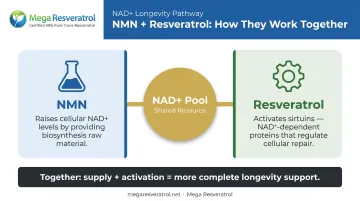
The reason is simple: these two compounds target the same biological pathway from opposite ends. NMN increases the raw material your cells need to produce NAD+, while resveratrol activates the proteins that depend on NAD+ to regulate aging. Together, they address both the supply and the demand side of cellular longevity.
This article covers how each compound works, what the research actually shows about their combination, health benefits supported by preclinical and human studies, dosage ranges studied in clinical trials, and what to look for when choosing quality supplements.
Key Takeaways
- NMN is a direct precursor to NAD+, a coenzyme that powers cellular energy and repair — and declines with age
- Resveratrol activates sirtuins, longevity-regulating proteins that require NAD+ to function
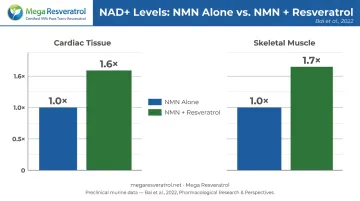
- A 2022 mouse study found combining NMN and resveratrol raised NAD+ 1.6x in cardiac tissue and 1.7x in skeletal muscle vs. NMN alone
- Most synergy evidence is preclinical; human combination trials have not yet been conducted
- Purity matters — low-purity resveratrol products may not deliver enough active trans-resveratrol for meaningful effects
What Are NMN and Resveratrol?
NMN: A Direct NAD+ Precursor
Nicotinamide Mononucleotide (NMN) is a naturally occurring molecule found in small amounts in foods like edamame, broccoli, and avocado. As a supplement, it works as a precursor to NAD+ (Nicotinamide Adenine Dinucleotide) — a coenzyme involved in hundreds of metabolic processes, from energy production to DNA repair.
The problem: NAD+ levels decline measurably with age. A human tissue study found a significant negative correlation between tissue NAD+ and age in both men (r = -0.706) and women (r = -0.537). NMN supplementation is designed to replenish this decline by giving cells the building blocks to synthesize NAD+ more efficiently.
Resveratrol: The Sirtuin Activator
Resveratrol is a polyphenol antioxidant found naturally in grape skins, red wine, berries, and peanuts. It's studied primarily for its antioxidant, anti-inflammatory, and sirtuin-activating properties.
One distinction matters here: trans-resveratrol is the biologically active form supported by research. The cis isomer exists but is not the focus of most studied biological activity. Light exposure can convert trans to cis, which makes isomer identity and product stability important when choosing a supplement.
Here's how the two compounds differ at a glance:
- NMN raises NAD+ levels directly by providing cellular raw material for synthesis
- Resveratrol activates sirtuins — the NAD+-dependent proteins that regulate cellular repair and longevity
- Together, NMN fuels the NAD+ pool while resveratrol puts that NAD+ to work through sirtuin activation
That division of roles is what makes the combination more than the sum of its parts.
How NMN and Resveratrol Work Together
The NAD+ and Sirtuin Connection
Sirtuins (SIRT1–SIRT7) are NAD+-dependent proteins involved in stress response, metabolism, and aging biology. The key word is dependent: sirtuins require NAD+ to carry out their functions. Without adequate NAD+, they're largely inactive regardless of what else you take.
This is where NMN comes in. By supplying a direct precursor to NAD+ biosynthesis, NMN helps maintain the cellular NAD+ levels that sirtuins need to operate.
The CD38 Problem
As the body ages, an enzyme called CD38 increases in activity and becomes the dominant consumer of NAD+ in the body. Research in mice showed that CD38 expression and NADase activity rise with age, driving NAD+ decline and contributing to mitochondrial dysfunction. This creates a real challenge: even if you're boosting NAD+ production through NMN, CD38 can deplete it faster than it's replenished.
The Synergy Mechanism
The combination works by addressing both the supply and the degradation of NAD+:
- NMN provides raw material for NAD+ biosynthesis, raising cellular NAD+ levels
- Resveratrol activates sirtuins that use NAD+ for repair and regulatory functions
- Together, they support a more complete approach to NAD+ metabolism than either compound alone
The most direct evidence for this synergy comes from a 2022 murine study by Bai et al. published in Pharmacological Research & Perspectives. Combination treatment with NMN and resveratrol raised NAD+ approximately 1.6x in cardiac tissue and 1.7x in skeletal muscle compared to NMN alone. This is a tissue-specific biomarker result in mice — no human combination trial has been published yet — but it provides meaningful mechanistic support for the stack.
Mitochondrial Effects
Those NAD+ gains matter because both compounds also independently support mitochondrial function. The evidence comes from two directions:
- Animal models: NMN alters mitochondrial dynamics through SIRT3-dependent mechanisms
- Human data: Resveratrol at 150 mg/day for 30 days produced calorie-restriction-like metabolic and mitochondrial changes in a small crossover trial of 11 obese men
Mitochondrial function affects energy output, organ health, and cellular aging. Whether combining NMN and resveratrol produces additive mitochondrial benefits in humans remains an open question — but the mechanistic case is coherent.
Key Health Benefits of the NMN and Resveratrol Combination
Cardiovascular Health
Resveratrol has shown cardiovascular effects in human studies, though results are mixed. An acute dosing study found that 30, 90, and 270 mg of trans-resveratrol increased flow-mediated dilation dose-dependently in 19 participants — with 270 mg producing 7.7% versus 4.1% with placebo. A separate 4-week RCT in 45 subjects found no improvement in endothelial function at 150 mg/day, so the picture isn't straightforward.
On the NMN side, preclinical research found that NMN restored cardiac function and energy metabolism through SIRT3 in a mouse cardiomyopathy model. The 2022 Bai et al. combination study showed increased cardiac NAD+ levels with the NMN-resveratrol stack, though this did not establish improved cardiac function directly.
What the cardiovascular data suggests overall: resveratrol may support vascular function at higher doses, while NMN's role appears to be in restoring the cellular energy infrastructure the heart depends on. Human data confirming the combination's cardiac effects directly is still limited.
Brain Health and Cognitive Function
Both compounds show promise in cognitive research, though most evidence remains preclinical:
- NMN: In aged mice, two weeks of NMN supplementation improved neurovascular coupling, mitochondrial bioenergetics, and several cognitive measures
- Resveratrol: Acute doses of 250 and 500 mg increased cerebral blood flow variables in healthy adults, though without improving cognitive task performance in that study
The neurological effects observed in animal models are encouraging, but human trials specifically targeting cognition with either compound (and especially the combination) remain limited.
Cellular Repair and Healthy Aging
PARP1, a key enzyme in DNA damage response, uses NAD+ to form poly(ADP-ribose) during repair processes. Adequate NAD+ availability — maintained through NMN supplementation — directly supports the cell's ability to respond to DNA damage.
Each compound targets a different layer of cellular aging:
- NMN fuels PARP-mediated DNA repair by maintaining NAD+ levels, which decline with age
- Resveratrol reduces oxidative stress load — in preclinical research, it increased hepatic antioxidant markers (GSH/GSSG ratio, a measure of oxidative stress balance) and reduced oxidative damage indicators
Together, they address both the repair capacity and the oxidative burden that accumulate as cells age.
Metabolic and Blood Sugar Support
The metabolic evidence is the strongest human data available for NMN:
- NMN: A randomized controlled trial of 250 mg/day for 10 weeks significantly improved muscle insulin sensitivity in 25 overweight/obese postmenopausal women with prediabetes — though it did not improve hepatic or adipose insulin sensitivity
- Resveratrol: A 30-day trial in 11 obese men found calorie-restriction-like metabolic changes at 150 mg/day
Both signals are meaningful. The NMN trial in particular is notable because it targeted a specific, high-risk population and used validated insulin clamp methodology. That said, both studies involved small, narrow groups — so the metabolic benefits most likely apply to people with already-impaired metabolic function rather than healthy adults across the board.
How Much NMN and Resveratrol Should You Take?
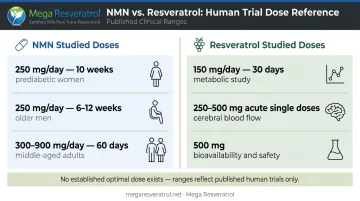
Neither compound has an established optimal dose — what exists are the ranges studied in published trials.
NMN studied doses:
- 250 mg/day for 10 weeks (prediabetic women)
- 250 mg/day for 6–12 weeks (older men)
- 300, 600, and 900 mg/day for 60 days in 80 middle-aged adults
Resveratrol studied doses:
- 150 mg/day for 30 days (metabolic study in obese men)
- 250–500 mg acute single doses (cerebral blood flow study)
- 500 mg studied for bioavailability and safety
A 2010 review found a non-linear dose-response pattern: lower doses showed cytoprotective effects, while very high doses (2–5 g/day) were associated with GI side effects including nausea and diarrhea. Most human trials used 150–500 mg/day for resveratrol — a practical reference when considering where to start.
How you take resveratrol also matters. A randomized food-effect study found that a high-fat meal delayed trans-resveratrol absorption and reduced its rate compared to fasting conditions. Taking it with a heavy, fat-rich meal may reduce — not improve — absorption. Consult your physician before starting any new supplement regimen.
How to Choose Quality NMN and Resveratrol Supplements
The research on NMN and resveratrol assumes you're working with compounds at or near the purity levels used in the studies. In practice, the retail supplement market doesn't guarantee that.
Why Purity Determines Whether You Get the Benefit
A 2012 HPLC analysis of 14 resveratrol brands found that only 5 of 14 products came within 95–105% of their label claim. Three products measured just 8–64% of claimed content, and two were below detection. That variability makes third-party verification essential.
For resveratrol specifically, the relevant active form is trans-resveratrol. To deliver what the research studied, a product needs to confirm isomer identity, provide independent purity data, and measure trans content directly.
What to Look for in a Quality Supplement
For resveratrol:
- Minimum 99% pure trans-resveratrol confirmed by independent testing
- Micronized particle size (under 2 µm) to support absorption
- No fillers, binders, or excipients
- Third-party Certificate of Analysis from an accredited, independent laboratory
- GMP-certified, FDA-regulated manufacturing facility
For NMN:
- High purity verified by independent testing (not just manufacturer claims)
- Reputable, traceable manufacturing practices
- No unnecessary additives
One benchmark worth knowing: Mega Resveratrol has supplied 99%+ pure, independently lab-certified, excipient-free, micronized trans-resveratrol to over 100 universities and research institutes worldwide since 2007. Those products appear in more than 50 published studies. For consumers, that institutional track record offers a concrete signal about consistency — the kind that's hard to assess from a label alone.
Red Flags to Avoid
Watch for these warning signs when evaluating any NMN or resveratrol supplement:
- Proprietary blends that don't disclose individual ingredient amounts
- No third-party testing or only vague references to "quality testing"
- No isomer specification on resveratrol products (trans vs. cis)
- Exaggerated claims with no citations or study references
- No Certificate of Analysis available from an independent, accredited lab
When in doubt, ask the manufacturer for a lot-specific COA from a named, accredited third-party laboratory. Reputable companies can provide this readily.
Frequently Asked Questions
Should I take NMN and resveratrol together?
The research supports a logical rationale for combining them: NMN raises NAD+ levels while resveratrol activates the sirtuins that use NAD+ for cellular repair and regulation. The 2022 murine study showed greater NAD+ distribution in cardiac and muscle tissue with the combination versus NMN alone. No human combination trials have been published yet, so consult your physician to assess whether this stack fits your health profile.
What happens if you take NMN every day?
Daily NMN supplementation maintains elevated NAD+ levels, which decline naturally with age. Human trials up to 12 weeks have found it generally well tolerated, though NAD+ levels return to baseline without ongoing use. Long-term safety data beyond 12 weeks is still developing.
Is there a downside to taking NMN?
NMN is considered safe in human studies at doses up to 900 mg/day. Some users report mild GI discomfort at higher doses. Starting low and checking with a healthcare provider is advisable, particularly if you have existing conditions or take medications.
Why does NMN make me feel so good?
Many users report improved energy, sharper focus, and better sleep. This likely connects to NMN's role in boosting NAD+, which drives mitochondrial energy production and DNA repair — two processes that directly affect how you feel day to day. Responses vary widely between individuals.
What is the best form of resveratrol to take with NMN?
Trans-resveratrol is the biologically active form studied in research. For use alongside NMN, look for 99%+ purity, micronized particle size for absorption, independent laboratory verification, and no unnecessary excipients. Those four criteria separate a product that can genuinely complement NMN from one that falls short on active compound delivery.