Biohacking supplements are compounds used to optimize specific biological functions: cellular energy, inflammatory response, cognitive performance, and longevity-related pathways. The challenge isn't finding supplements — it's knowing which ones are worth taking and which are marketing noise.
This guide breaks down five of the most research-supported biohacking supplements, explains what makes resveratrol a serious longevity compound, and gives you a practical framework for evaluating product quality before you buy.
Key Takeaways
- The strongest biohacking stacks focus on 3–5 well-studied compounds, not 20 overlapping pills
- NMN, omega-3s, creatine, curcumin, and magnesium each target distinct biological pathways with human trial support
- Trans-resveratrol is the biologically active form — generic "resveratrol" labels often miss this distinction, and molecular form directly determines what your body actually absorbs
- Supplement quality comes down to four factors: ingredient form, independent lab testing, excipient-free formulation, and GMP-certified manufacturing
- Track biomarkers before and after 8–12 weeks to separate real results from placebo
What Is Biohacking and Why Do Supplements Matter?
Biohacking is the practice of using data, science, and lifestyle interventions to optimize how your body and mind perform. Researchers in Trends in Biotechnology characterize it as citizen science — merging personal data acquisition with evidence-based self-experimentation.
Supplements are one of the most accessible tools in that toolkit. They're not replacements for sleep, diet, or exercise — those come first. But for people who've already built a solid foundation, targeted compounds can address specific biological gaps that lifestyle alone can't fully close.
What separates effective biohacking from wellness theater:
- Choosing compounds that target distinct, well-characterized pathways
- Using research-backed doses, not what fits on a label
- Prioritizing formulation quality — the same molecule in a poorly absorbed form may deliver far less of the intended effect
- Tracking measurable outcomes, not subjective feelings
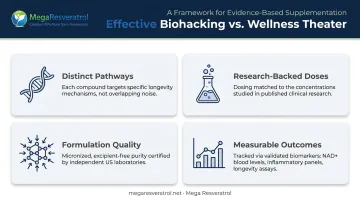
The most effective protocols stay focused — a small number of compounds with strong evidence, used consistently and tracked against real outcomes.
Top Biohacking Supplements Backed by Science
These compounds appear consistently across longevity and performance research. Each targets a distinct biological mechanism — cellular energy, inflammation, structural repair, and sirtuin activation — which is why researchers study them in combination rather than isolation.
NMN (Nicotinamide Mononucleotide)
NMN is a direct precursor to NAD+, a coenzyme essential for cellular energy production, DNA repair, and sirtuin activation. NAD+ levels decline with age, though the rate and extent varies by tissue — this isn't a simple "half by 40" situation, and anyone claiming otherwise is oversimplifying the research.
What human trials do show is meaningful: a 2023 randomized controlled trial in GeroScience gave 80 healthy middle-aged adults 300, 600, or 900 mg/day of NMN for 60 days. All NMN groups showed significantly higher blood NAD+ at days 30 and 60 versus both baseline and placebo. That's a clear, measurable biomarker effect.
What the research supports:
- Studied doses range from 150–1,200 mg/day across randomized trials
- Mitochondrial support and sirtuin pathway activation are the primary mechanisms
- A 2026 crossover study found sublingual NMN produced earlier metabolite increases, but did not show higher overall blood NAD+ than oral capsules — the delivery-method debate is unsettled
For biohackers interested in tracking actual results, pairing NMN supplementation with an at-home NAD+ blood test before and after a supplementation period gives you real data rather than guesswork.
Resveratrol (Trans-Resveratrol)
Trans-resveratrol is a polyphenol found in grape skins that activates sirtuins — particularly SIRT1 — and mimics aspects of caloric restriction at the cellular level. It's one of the most studied longevity compounds in preclinical research, and human trials have followed.
A 2012 randomized trial published in Cell Metabolism found that resveratrol supplementation in obese men improved mitochondrial function and reduced inflammatory and metabolic markers. More recent research has focused on cardiovascular applications, particularly for individuals with elevated LP(a) or systemic inflammation.
What the research supports:
- Doses in human trials typically range from 150–1,000 mg/day; higher doses used in metabolic studies
- Bioavailability is highly dependent on formulation — micronized trans-resveratrol (particle size under 2 µm) absorbs substantially better than standard powder
- SIRT1 activation and NF-κB inhibition are the primary studied mechanisms, with overlap in the inflammatory pathways targeted by curcumin
Purity matters here more than in most supplement categories. Studies cited in the literature use trans-resveratrol at 99%+ purity — products in the 10–50% range common in retail won't replicate those results.
Omega-3 Fatty Acids (EPA & DHA)
EPA and DHA are structural components of cell membranes — especially in brain and cardiovascular tissue — and they regulate inflammatory response through pro-resolving pathways. This isn't a supplement category you want to underdose or buy carelessly.
The VITAL trial published in the New England Journal of Medicine followed 25,871 adults on 1 g/day marine omega-3 for over five years. The primary cardiovascular event endpoint wasn't significantly reduced, but the secondary endpoint — total myocardial infarction — showed a meaningful reduction (HR 0.72). Mixed results, but not dismissible.
Two buying factors matter more than the label claim:
- EPA+DHA content, not total fish oil weight: A standard 1,000 mg capsule typically delivers only 300 mg of active fatty acids (180 mg EPA + 120 mg DHA)
- Oxidation status: A New Zealand survey found 83% of tested products exceeded recommended peroxide limits — rancid oil is both ineffective and potentially harmful
Creatine Monohydrate
Creatine replenishes ATP in high-energy tissues throughout the body — including the brain — making it relevant for cognitive performance, not only physical output.
With over 500 peer-reviewed publications, creatine has the most mature evidence base of any compound in this list. A 2024 meta-analysis found improved memory (SMD 0.31) and faster processing-time measures in supplemented groups.
Standard protocol:
- 3–5 g/day maintenance dose; loading phase is optional
- Consistency and total daily dose matter more than timing relative to workouts
Curcumin
Curcumin, the active compound in turmeric, blocks multiple inflammatory pathways including NF-κB and provides antioxidant protection. A GRADE-assessed meta-analysis of 66 RCTs found reductions in CRP, TNF-alpha, and IL-6 in supplemented groups, though effect sizes varied by condition and formulation.
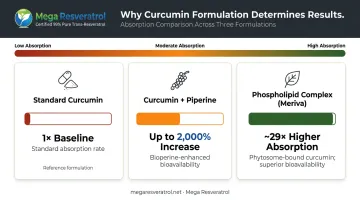
The absorption problem is significant: Curcumin alone is poorly absorbed — rapid metabolism and elimination limit how much actually reaches systemic circulation. Two formulation approaches with documented evidence:
- Piperine (black pepper extract): A foundational study found up to a 2,000% increase in bioavailability when 2 g curcumin was combined with 20 mg piperine
- Phospholipid complexes (e.g., Meriva): Research showed approximately 29-fold higher total curcuminoid absorption compared to unformulated curcumin
If the label just says "curcumin" with no mention of formulation, it's likely the low-absorption version.
Magnesium
Magnesium participates in hundreds of enzymatic reactions — ATP production, DNA repair, protein synthesis, and nervous system signaling among them. According to NIH ODS, 48% of Americans consume less magnesium than their estimated average requirement. That's an intake gap, not necessarily clinical deficiency — but it's meaningful at a population level.
A 2017 meta-analysis found magnesium supplementation reduced CRP in participants whose baseline inflammation was elevated. Sleep evidence from supplementation trials is more mixed, though observational data links magnesium status to sleep quality.
On form: Magnesium glycinate and malate are commonly recommended over oxide, but robust human data directly comparing absorption across healthy adults is limited. What's clear is that magnesium oxide has lower solubility, and for sensitive individuals, glycinate tends to be better tolerated.
Resveratrol: A Biohacker's Longevity Staple
Resveratrol is a polyphenol found in grape skins, red wine, and Japanese knotweed. It's attracted serious scientific attention not because of wine's reputation, but because of what it does at the molecular level. And to be direct: red wine contains roughly 1.9 mg of trans-resveratrol per liter on average — a negligible amount compared to the hundreds of milligrams used in research. A supplement is the only practical delivery route.
What Resveratrol Does Biologically
Resveratrol's primary mechanisms make it relevant across multiple longevity pathways:
- Sirtuin activation: Activates SIRT1, the same longevity gene pathway triggered by caloric restriction — animal research in Cell showed activation of SIRT1/PGC-1alpha, improved mitochondrial function, and protection against diet-induced metabolic disease
- Oxidative stress reduction: Acts as an antioxidant across multiple cell types
- Cardiovascular support: A human trial in Cell Metabolism (11 obese men, 150 mg/day for 30 days) showed reduced blood pressure, insulin, triglycerides, and liver fat — though the small sample size limits generalizability
- Improved insulin sensitivity has also been observed, though results across larger trials remain mixed
Why Trans-Resveratrol Specifically Matters
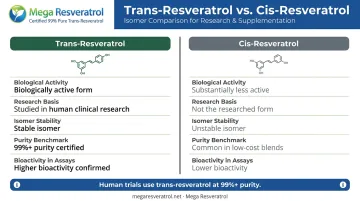
Resveratrol exists in two isomers: trans and cis. Trans-resveratrol is the biologically active form studied in research — more stable, more potent in bioactivity assays. Cis-resveratrol isn't completely inert, but it's substantially less active. Many lower-cost supplements contain a mixture, or are predominantly cis without disclosing it.
This is where purity percentage becomes a real number, not marketing language. Mega Resveratrol's pharmaceutical-grade trans-resveratrol is certified at 99%+ purity by independent US laboratories — which means what's on the label is what's in the capsule, with essentially no cis-resveratrol contamination.
The Bioavailability Challenge
Purity is only half the equation. Even high-purity resveratrol faces a known absorption hurdle: the liver converts it to glucuronide and sulfate conjugates quickly after dosing, leaving very low concentrations of unchanged resveratrol in systemic circulation. Studies suggest at least 70% is absorbed from the gut — the bottleneck is what happens next.
Micronization addresses this partially. A clinical study of micronized resveratrol (SRT501) in cancer patients found a 3.6-fold higher peak concentration compared to non-micronized powder at the same dose. Mega Resveratrol uses pharmaceutical-grade micronized trans-resveratrol with particle sizes under 2 microns — a specification that has supported more than 50 published studies across over 100 research universities and institutes worldwide, including Columbia, Duke, and NYU.
The cardiovascular focus behind this formulation is personal. Founder Doron Efrat started the company in 2007 after surviving a heart attack in 2003 and being diagnosed with LP(a) — a genetic cardiovascular condition with no direct cure.
Finding only 10–20% pure resveratrol on the market, he built Mega Resveratrol around one principle: never compromise on quality. His own stress tests continue to come back excellent.
How to Choose a High-Quality Biohacking Supplement
Four criteria separate genuinely high-quality supplements from the majority of the market:
1. Purity and Molecular Form
The specific form of each ingredient determines whether it actually works. Magnesium oxide vs. glycinate, cis vs. trans-resveratrol, unformulated curcumin vs. a phospholipid complex — these aren't interchangeable. Look for products that explicitly disclose the molecular form and the amount of each active ingredient, not just the compound name.
2. Independent Third-Party Lab Testing
The FDA does not require dietary supplements to prove potency or purity before going to market. Manufacturers are responsible for their own safety claims. This makes voluntary third-party testing the most meaningful quality signal available.
Look for brands that test each batch through an independent US laboratory and make those results accessible — either publicly or upon request. Mega Resveratrol, for instance, publishes per-batch certificates of analysis as standard practice, not an exception.
3. Excipient-Free Formulation
Many supplements contain fillers, binders, flow agents, and preservatives that add no health value. In some cases, these additives interfere with absorption or trigger reactions in sensitive individuals. Common offenders include:
- Magnesium stearate (flow agent linked to reduced absorption)
- Silicon dioxide (anti-caking filler with no nutritional role)
- Titanium dioxide (whitening agent flagged in some safety reviews)
A genuinely clean supplement contains only the active ingredient and a capsule. That's a baseline standard, not a premium feature.
4. GMP-Certified, FDA-Regulated Manufacturing
Look for supplements produced in facilities operating under 21 CFR Part 111 Good Manufacturing Practices — the FDA's regulatory framework covering identity, purity, strength, composition, and quality control. GMP certification from an independent certifying body (not just self-declared compliance) adds meaningful accountability.
Building a Simple, Sustainable Biohacking Stack
More is rarely better. A focused stack of three to five well-chosen compounds targeting your specific goals will outperform a disorganized collection of 20 pills with redundant effects and questionable dosing.
Before you start, establish a baseline:
- Run relevant blood work (inflammation markers, NAD+ levels, lipid panel, metabolic markers)
- Note current sleep quality and energy patterns
- Reassess after 8–12 weeks of consistent use
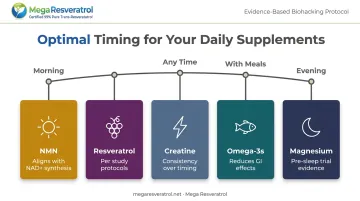
Practical timing considerations:
| Supplement | Timing | Rationale |
|---|---|---|
| NMN | Morning | Aligns with natural NAD+ synthesis cycles |
| Creatine | Any time (consistency > timing) | Total daily dose matters more than timing |
| Magnesium | Evening | Some trial evidence for pre-sleep use |
| Omega-3s | With meals | Reduces GI effects, may improve absorption |
| Resveratrol | Morning or with meals | Per standard study protocols |
Storage matters more than most people realize. Keep supplements away from heat and light, seal lids tightly after each use, and avoid buying more than a 3–4 month supply if storage conditions aren't ideal. Potency degrades with poor storage — even a high-purity product loses effectiveness when handled carelessly.
That same attention to detail applies to your protocol as a whole. Baseline biomarkers tell you where you started; consistent dosing gives you something to measure; and reassessment at 8–12 weeks tells you whether the stack is actually working. Skip any of those steps and you're spending money, not investing it.
Frequently Asked Questions
What supplements do biohackers take?
The most evidence-backed biohacking supplements include NMN, resveratrol, omega-3 fatty acids, creatine, curcumin, and magnesium. Each targets a distinct biological pathway — covering cellular energy and NAD+ production, inflammation, cognitive function, and longevity gene activation.
Is resveratrol a good biohacking supplement?
Yes — resveratrol is among the most studied longevity compounds, with research showing it activates sirtuin pathways, reduces oxidative stress, and supports cardiovascular and metabolic health. Effectiveness depends heavily on whether you're taking the trans-resveratrol form at 99%+ purity.
What is the difference between trans-resveratrol and regular resveratrol?
Resveratrol exists as two isomers: trans-resveratrol is the biologically active form studied in virtually all research, while cis-resveratrol is substantially less active. Many low-cost supplements contain a mixture — so verify the specific form and purity percentage on the label before buying.
How do I know if a biohacking supplement is high quality?
Four markers matter: independent third-party purity verification, the specific molecular form of each ingredient on the label, no fillers or excipients, and manufacturing in a GMP-certified, FDA-regulated facility. Mega Resveratrol, for instance, meets all four — every batch is tested by an independent US lab and produced excipient-free in a certified US facility.
Can biohacking supplements replace a healthy lifestyle?
No. Supplements work as targeted complements to solid sleep, nutrition, and movement habits — not shortcuts around them. The best results come from adding evidence-backed compounds to an already functional foundation.
How long does it take to see results from biohacking supplements?
It depends on the compound. Energy and cognitive effects from creatine or NMN can appear within weeks; longevity-focused cellular changes typically require several months of consistent use. Tracking measurable biomarkers gives you a more reliable read than subjective impressions alone.