Introduction
Walk into any supplement aisle — or scroll through Amazon — and you'll find dozens of resveratrol products that look nearly identical on the outside. The real difference is inside: purity ranges from 10% to 99%, and most labels won't tell you which you're getting. For anyone seriously managing cardiovascular health, inflammation, or longevity, that gap isn't trivial. A 50% standardized extract in a 500 mg capsule delivers just 250 mg of active compound. A 10% product delivers even less.
The core problem: most resveratrol supplements contain low-purity extracts, unnecessary fillers, and zero independent verification. You could spend months taking a product that delivers minimal therapeutic benefit because the label was misleading.
This guide evaluates the top resveratrol supplements of 2026 across four criteria: trans-resveratrol purity, bioavailability, third-party testing, and overall value — so you can make a genuinely informed decision.
Key Takeaways
- Trans-resveratrol is the biologically active isomer — your label must say this specifically
- Purity percentage is critical — look for at least 98% standardization
- Independent third-party testing is the only way to verify what's actually in the bottle
- Micronization improves absorption by reducing particle size for greater surface area uptake
- Mega Resveratrol leads the 2026 field with 99% pharmaceutical-grade purity, no excipients, and independent batch certification
What Is Resveratrol and Why Can't You Get Enough From Food?
Resveratrol is a plant compound (stilbenoid polyphenol) produced by plants under stress — fungal attack, UV exposure, physical damage. It occurs naturally in red grapes, blueberries, peanuts, and Japanese knotweed. Two isomers exist: trans-resveratrol and cis-resveratrol. Trans is the more stable form and is the basis for virtually all clinical research on resveratrol's biological effects.
Why Food Sources Fall Short
The concentration in natural sources is too low to reach clinically relevant doses without supplementation. A peer-reviewed analysis of red wine trans-resveratrol concentrations found an average of approximately 1.9 mg/L (a standard 150 mL glass contains roughly 0.285 mg). Reaching a single 250 mg supplement dose from wine alone would require somewhere around 877 glasses, depending on the wine. Food simply isn't a viable delivery mechanism at therapeutic dose levels.
Where the Research Points
Human clinical evidence for resveratrol is strongest in two domains:
- Cardiovascular function: A 2013 crossover trial reported a 23% increase in brachial flow-mediated dilation after six weeks, a direct marker of endothelial health. Blood pressure effects across meta-analyses remain mixed.
- Inflammation and oxidative stress: Human trials show favorable changes in some biomarkers, though findings vary by dose, population, and duration.
Beyond those two areas, the mechanistic picture extends further. Sirtuin (SIRT1) activation, AMPK pathway signaling, metabolic health effects, and neuroprotection are well-documented in cell and animal models. Human clinical validation for these pathways is still developing — an important caveat for anyone weighing longevity claims.
Best Resveratrol Supplements of 2026
Products were evaluated on trans-resveratrol purity, third-party testing credibility, absence of harmful fillers, bioavailability features, dose transparency, and value.
Mega Resveratrol — Best Overall
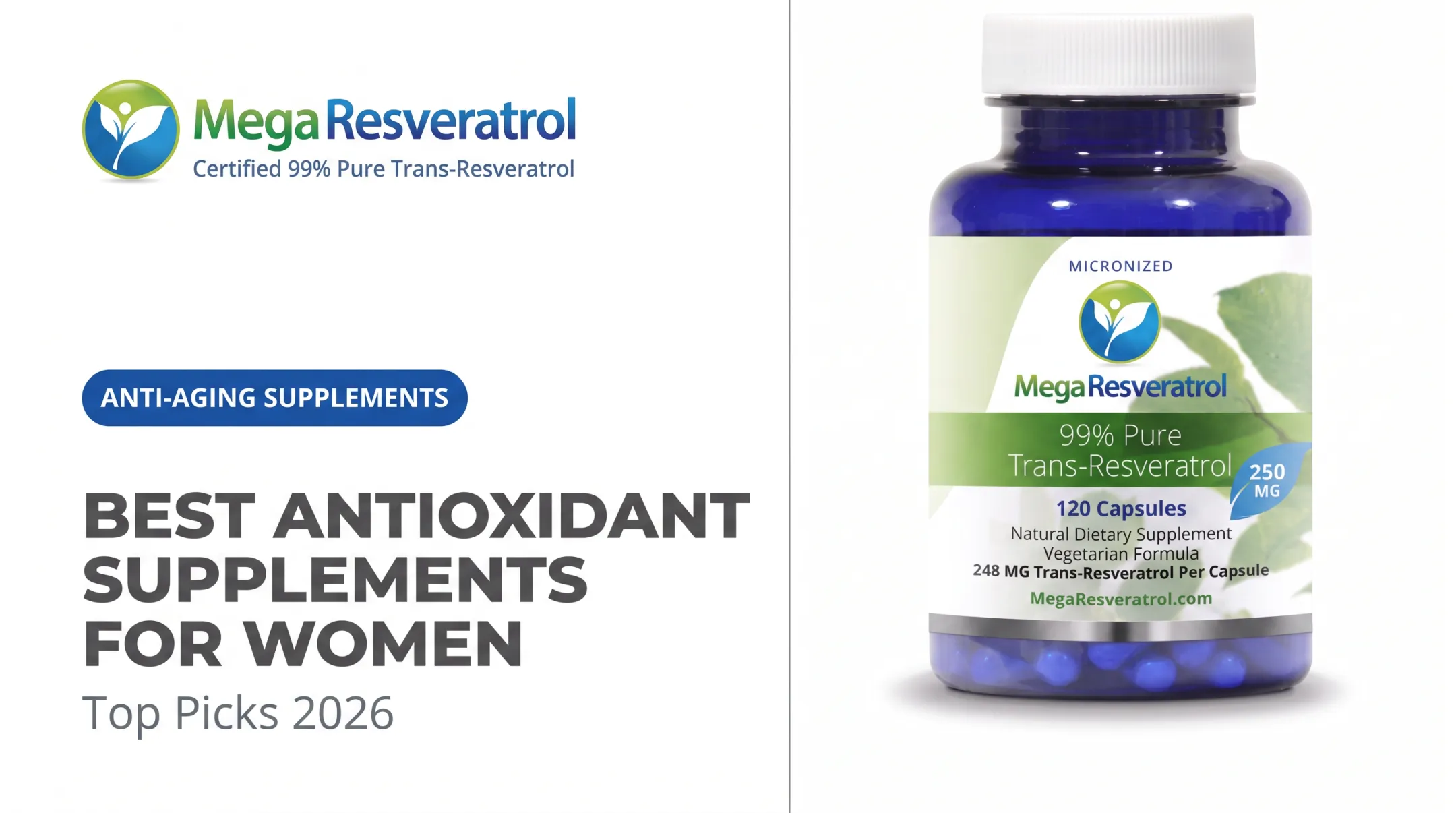
Founded in 2007 by Doron Efrat following a 2003 heart attack and LP(a) diagnosis, Mega Resveratrol was built specifically to address the purity problem Efrat encountered firsthand — products on the market were only 10–20% pure. The company has since become a trusted supplier to over 100 universities and research institutions worldwide, including NYU, Columbia, Duke, UCSF, and the University of Pennsylvania, with 50+ published studies using its products.
| Criteria | Detail |
|---|---|
| Purity | Minimum 99% trans-resveratrol, pharmaceutical-grade |
| Testing | Every batch independently certified by a US third-party laboratory |
| Key Features | Micronized (<2 µm), zero excipients, non-GMO, gluten-free, pesticide-free |
| Facility | GMP-certified, FDA-regulated; New York State Board of Pharmacy licensed |
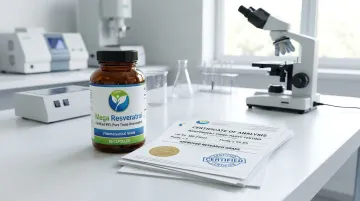
No other consumer product in this category matches the combination of 99% purity, batch-level independent certification, and zero-excipient formulation. For buyers who need to verify what they're taking — not just trust a label — that level of documented research adoption is a concrete differentiator.
Premium pricing relative to budget options. No public subscription discount was confirmed during research.
Toniiq Resveratrol 1000 — Best for High-Dose Flexibility
Toniiq positions itself as a high-standardization single-ingredient brand. Its Resveratrol 1000 delivers 500 mg per capsule at 98% standardized trans-resveratrol, allowing users to dose at 500 mg or 1,000 mg daily — the range most commonly studied in human trials.
| Criteria | Detail |
|---|---|
| Purity | 98% trans-resveratrol |
| Testing | In-house lab testing; no verified independent third-party COA publicly available |
| Key Features | 500 mg/capsule; flexible dosing; subscription savings (~15%); 60-day guarantee |
| Price | ~$33.30 one-time; ~$28.31 on subscription (as of July 2026) |
Dose flexibility matters here — the 500 mg/capsule format lets users match dosing to their protocol without splitting capsules. Subscription pricing makes it competitive at scale. The 98% purity claim is strong.
Lab testing is described as in-house with third-party microbiology elements, but no independently verified lot-specific COA was confirmed as publicly downloadable. Buyers who require documented batch-level verification before purchasing should factor this in.
Thorne ResveraCel — Best NMN + Resveratrol Combination
Thorne is a clinically recognized brand with partnerships including Mayo Clinic and the NIH. ResveraCel combines trans-resveratrol with nicotinamide riboside (NR) — a NAD+ precursor — and quercetin phytosome, targeting both antioxidant pathways and cellular energy production.
| Criteria | Detail |
|---|---|
| Purity | Trans-resveratrol; no standardization percentage disclosed |
| Testing | Rigorously third-party tested; NSF Certified for Sport status not verified for this specific product |
| Key Features | 150 mg resveratrol per 2-capsule serving; includes 300 mg NR and 250 mg quercetin phytosome |
| Price | ~$60/60 capsules |
The phytosome delivery system applies to the quercetin component, not the resveratrol. At 150 mg per serving, the resveratrol dose is lower than every single-ingredient option on this list. ResveraCel makes sense for users building a combined NAD+/resveratrol anti-aging stack — not for those who need resveratrol as a standalone therapeutic dose.
Garden of Life RAW Resveratrol — Best Clean/Organic Option
Garden of Life brings strong third-party certification credentials: Non-GMO Project Verified, Certified Vegan, and NSF Certified Gluten-Free. Its RAW Resveratrol delivers 350 mg per capsule from a knotweed and red-wine-grape blend, alongside a probiotic/enzyme complex.
| Criteria | Detail |
|---|---|
| Purity | RAW resveratrol blend; no standardization % disclosed |
| Testing | Non-GMO Project Verified; NSF Certified Gluten-Free |
| Key Features | 350 mg/capsule; vegan; includes 500M CFU probiotics and digestive enzymes |
| Price | ~$41.59/60 capsules |
The certification stack is genuine, and the digestive enzyme inclusion is a practical formulation choice for users with absorption concerns. That said, no trans-resveratrol standardization percentage is disclosed — making it impossible to calculate actual active compound delivery per capsule. Standard capsule form without micronization or liposomal technology means absorption is likely moderate. Best suited for buyers who prioritize certified-clean sourcing over verified potency.
NOW Foods Resveratrol — Best Budget Option
NOW Foods is a widely distributed, GMP-certified brand with a long track record. Its Resveratrol delivers 200 mg trans-resveratrol per capsule from Japanese knotweed extract at one of the lowest price points in the category.
| Criteria | Detail |
|---|---|
| Purity | Trans-resveratrol with polyphenols; standardization % not specified |
| Testing | Intertek GMP Quality Assured; Non-GMO certified |
| Key Features | 200 mg/capsule; vegetarian capsule; highly affordable |
| Price | ~$29.99/60 capsules |
A reasonable starting point for first-time resveratrol users or those on a tight budget. No absorption-enhancing technology, standard excipients present, and no standardization percentage disclosed — factors that limit its value as a long-term therapeutic choice against higher-purity options.
What to Look for When Choosing a Resveratrol Supplement
Verify the Exact Form
The label must say "trans-resveratrol" — not "resveratrol," "resveratrol extract," or "Japanese knotweed extract." Cis-resveratrol is less stable, and virtually all human research on resveratrol's health effects uses the trans isomer. A label that doesn't specify is a red flag.
Understand Purity Standardization
This is where most buyers get misled. Consider:
- A product labeled "500 mg Japanese knotweed extract standardized to 50% resveratrol" contains only 250 mg of active compound
- A 99% pure product in a 250 mg capsule delivers approximately 247.5 mg of active trans-resveratrol
Products can be standardized anywhere from 10% to 99%. Always calculate the actual trans-resveratrol dose, not the extract weight.
Bioavailability and Delivery Format
Research confirms that oral resveratrol is substantially absorbed but rapidly converted to sulfate and glucuronide metabolites, leaving systemic free-resveratrol bioavailability below 1%. Delivery format matters:
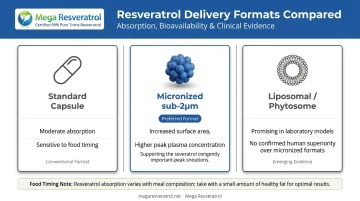
- Micronization (reducing particle size to sub-2 µm) increases surface area for uptake; a study on micronized SRT501 showed higher peak plasma concentration versus a historical non-micronized comparator
- Liposomal and phytosome formats show promise in laboratory models, but no direct human head-to-head trial has confirmed superiority over micronization
- Food can blunt absorption — specifically, food delays and reduces peak concentration. Contrary to common advice for fat-soluble supplements, taking standard trans-resveratrol on an empty stomach or with a light meal is preferable
Demand Independent Third-Party Testing
GMP certification is often misunderstood. Per FDA cGMP guidance, GMP requires manufacturers to establish internal specifications — not that an outside lab tested every marketed lot or published a batch-specific COA.
Only genuine third-party laboratory certification does that.
The critical distinction:
- In-house testing = the company tests its own product
- Independent third-party COA = an external lab verifies purity, potency, and contaminant absence for each batch
Check for Excipients
Many resveratrol capsules contain magnesium stearate, silicon dioxide, or microcrystalline cellulose. These "inactive" ingredients affect tolerability and overall product purity. Excipient-free products are the cleaner choice for anyone prioritizing pharmaceutical-grade purity.
Conclusion
After reviewing what's available in 2026, four variables determine whether a resveratrol supplement actually works: purity, isomer form, delivery mechanism, and independent verification. A product at 10% extract purity delivers a fraction of the active compound compared to a 99% pure formulation — and at typical dosing levels, that gap renders the lower-purity option therapeutically inert.
For those managing cardiovascular health, inflammatory conditions, or seeking research-backed longevity support, Mega Resveratrol meets every benchmark that matters. It's the only consumer product on this list with batch-level third-party certification and sub-2 µm micronization.
That combination — pharmaceutical-grade purity, excipient-free formulation, and a 19-year track record trusted by over 100 research institutions worldwide — is what sets it apart from the rest of the category.
Visit megaresveratrol.net to review independent lab certifications, explore product options, and make an informed decision for your long-term health.
Frequently Asked Questions
What is the most effective form of resveratrol?
Trans-resveratrol is the biologically active isomer used in virtually all human clinical research. Your supplement label should explicitly state "trans-resveratrol." Micronized trans-resveratrol offers improved absorption compared to standard powder forms due to greater surface area for uptake.
What is the best brand of resveratrol?
No single answer fits everyone, but key differentiators are purity percentage (99% is pharmaceutical-grade), independent third-party batch certification, zero excipients, and research institution credibility. Mega Resveratrol is the standout on all these criteria.
What supplements should not be taken with resveratrol?
Resveratrol has antiplatelet activity, warranting caution with blood thinners like warfarin. It may also have additive glucose-lowering effects with diabetes medications. A human study in 42 volunteers confirmed resveratrol alters CYP enzyme activity, affecting metabolism of several drug classes — consult your healthcare provider before combining.
What are the side effects of resveratrol?
Resveratrol is generally well tolerated at doses up to approximately 1 g/day. The most common adverse effects are gastrointestinal — bloating, nausea, or altered bowel movements — and become more frequent at 2–5 g/day.
How much resveratrol should I take daily?
Human clinical studies have used 250–1,000 mg of trans-resveratrol daily, with 500 mg a common starting point. Doses above 1,000 mg increase adverse effect risk and should not be used without medical guidance.
Does resveratrol need to be taken with food?
Food can actually reduce resveratrol's peak absorption — contrary to the standard advice for fat-soluble supplements. For standard trans-resveratrol capsules, taking on an empty stomach or with a light meal is generally preferable. Micronized forms are generally less sensitive to food timing.