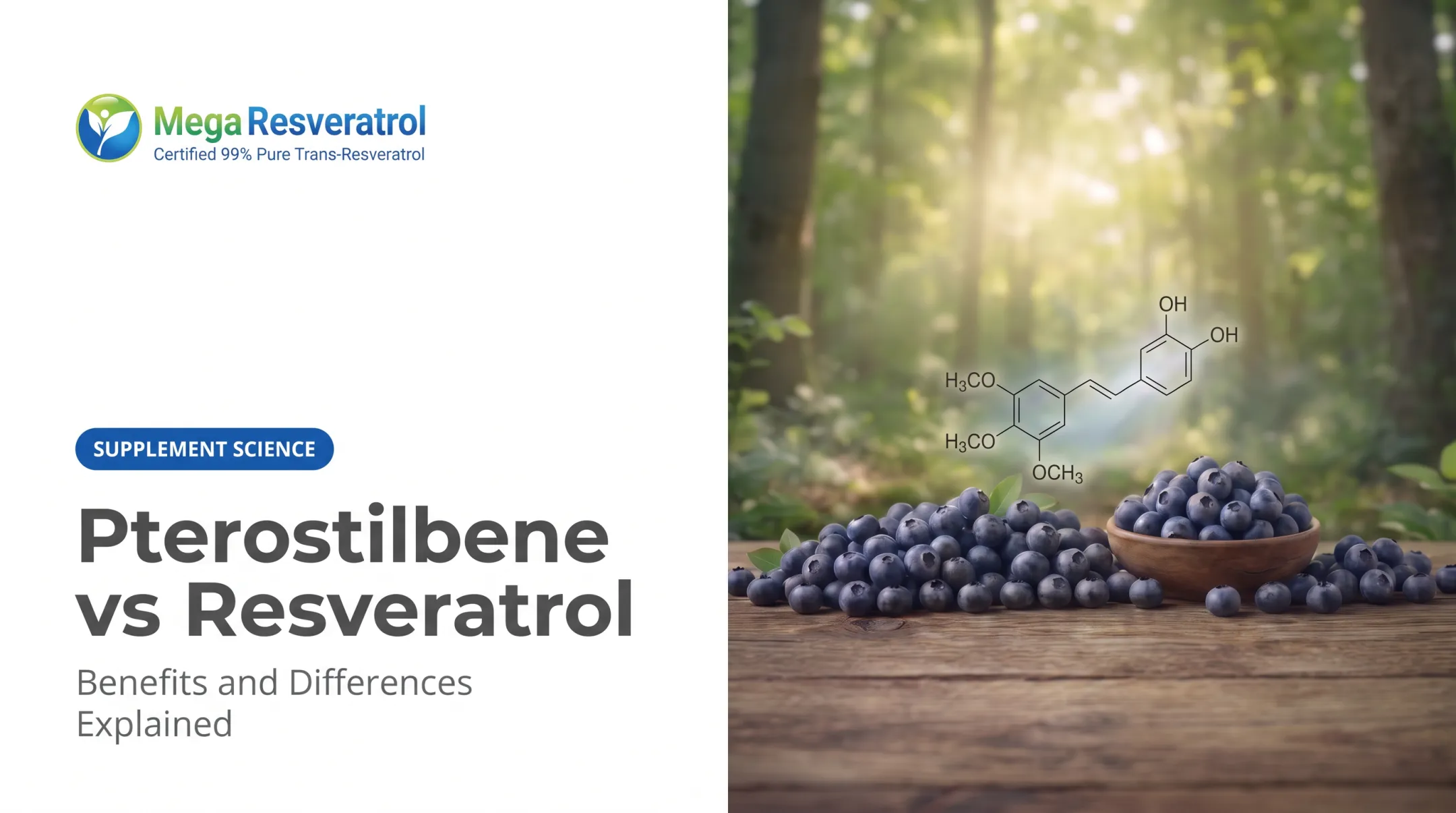

Here's why it matters: purity and isomer form determine bioavailability, dosage accuracy, and whether a supplement can plausibly activate the SIRT1 and AMPK pathways people buy resveratrol for in the first place. This article breaks down the chemical difference, compares the two head-to-head, and tells you exactly what to look for on a label.
TL;DR
- Resveratrol is the umbrella polyphenol; trans-resveratrol is its biologically active isomer
- Cis-resveratrol, the other natural form, is unstable and largely inactive
- Trans-resveratrol is the form used in nearly all clinical research on SIRT1/AMPK activation
- A label should state "trans-resveratrol" and a purity percentage, not just "resveratrol"
- Purity, micronization, and third-party testing determine what you actually absorb
Resveratrol vs Trans-Resveratrol: Quick Comparison
| Feature | Resveratrol (generic) | Trans-Resveratrol |
|---|---|---|
| Chemical structure | Umbrella term for both cis and trans isomers | Specific geometric isomer (hydroxyl groups on opposite sides of the double bond) |
| Bioactivity | Weak/unverified SIRT1, AMPK, NF-κB activity if cis-dominant | Documented activation of these pathways in cell and animal studies |
| Stability | Degrades quickly with light, heat, and digestion | More stable, especially micronized or lab-purified |
| Label transparency | May hide an unknown cis/trans ratio | 98%+ trans-resveratrol is a verifiable, standardized claim |
A 2012 lab analysis of 14 commercial resveratrol supplements found only 5 of 14 matched their label claim within a 95–105% accuracy range. Three products contained just 8% to 64% of the labeled trans-resveratrol, and two had no detectable trans-resveratrol at all (Rossi et al., 2012).

That's the practical risk of buying "resveratrol" without a specified isomer.
What Is Resveratrol?
Resveratrol is a stilbenoid polyphenol that plants like grapes, Japanese knotweed, and peanuts produce as a defense response to UV exposure, injury, or fungal attack.
Chemically, "resveratrol" isn't one molecule. It's an umbrella term covering more than 40 structurally related compounds, though only two occur naturally in meaningful amounts: cis-resveratrol and trans-resveratrol.
That distinction matters because the two isomers behave very differently once inside your body. A supplement label reading simply "resveratrol" tells you almost nothing about which one you're getting, or in what ratio.

Where Resveratrol Shows Up
- Red wine and grape skins
- Berries and peanuts
- Japanese knotweed extract (a common industrial source)
The catch: without an isomer specification, there's no way to verify how much active compound is in the bottle.
Dietary intake from food alone is tiny—around 100 micrograms per day—which is why people turn to supplements in the first place (Weiskirchen and Weiskirchen, 2016).
What Is Trans-Resveratrol?
Trans-resveratrol is the specific geometric isomer stable enough to survive digestion and get absorbed, which is why clinical trials on resveratrol's health effects almost always use this form.
It works through three main mechanisms:
- Activates SIRT1 (often called the "longevity gene"), supporting cellular stress resistance
- Activates AMPK, which regulates cellular energy metabolism
- Inhibits NF-κB, reducing inflammatory signaling
Those pathways only help if the compound reaches circulation. Trans-resveratrol is metabolized rapidly during first-pass digestion, so free resveratrol in the bloodstream is often measured below 10 ng/mL after standard doses, even when total metabolites reach 400–500 ng/mL. Purification and particle size directly affect how much is available to act.
Purity and Particle Size Make the Difference
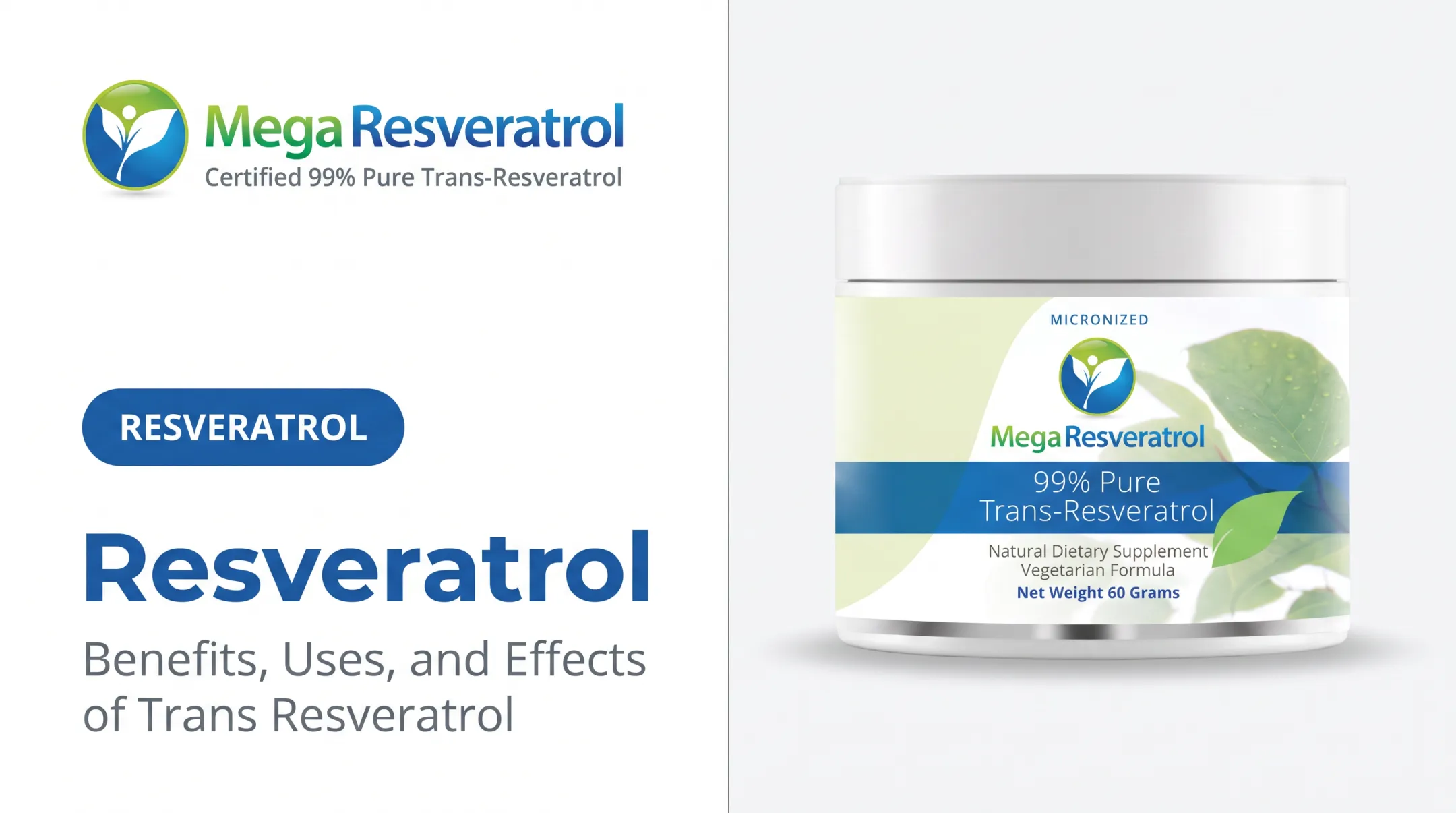
Mega Resveratrol's capsules are purified to greater than 99.5% pharmaceutical-grade trans-resveratrol, with a micronized particle size of D-50 under 1.90 µm, verified batch-by-batch by an independent US laboratory. Smaller particle size increases surface area, which supports faster dissolution and absorption compared to standard, coarser-ground resveratrol.

Some products add piperine (black pepper extract) to boost absorption further. Another approach is an excipient-free formula—no fillers, binders, or additives—so each capsule is only verified-purity trans-resveratrol. Mega Resveratrol uses this route.
Where Trans-Resveratrol Fits in a Routine
People most likely to benefit include those with:
- Elevated inflammatory markers (CRP, hs-CRP)
- Insulin resistance or metabolic syndrome
- Genetic cardiovascular risk factors, such as elevated Lp(a)
Clinical trials have tested doses ranging from 150 mg to 2 g daily. A meta-analysis of randomized controlled trials found resveratrol supplementation reduced TNF-alpha and hs-CRP, both inflammatory markers (Koushki et al., 2018).
Results aren't universal. A 2015 trial using 150 mg daily found no change in cardiovascular risk markers over four weeks, and a 2018 trial using 2 g daily didn't significantly improve insulin sensitivity in obese men with metabolic syndrome. Dose and individual response both matter.
For cardiovascular-specific support, some formulations pair trans-resveratrol with grape-skin polyphenols. Mega Resveratrol's Red Grape Skin, Piceid Resveratrol capsule, for example, delivers 50 mg of trans-resveratrol alongside 100 mg of total polyphenols per capsule, aimed at supporting nitric oxide production and blood flow.
Resveratrol vs Trans-Resveratrol: Which Should You Choose?
When comparing products, focus on four things:
- Purity percentage — is it stated, or just implied?
- Isomer specification — does the label say "trans-resveratrol," not just "resveratrol"?
- Particle size — is it micronized, and to what specification?
- Fillers and excipients — are there unnecessary additives diluting the active dose?

If a label only says "resveratrol" with no purity percentage, you can't verify the active dose. Choose a product labeled "trans-resveratrol, 98–99% pure," ideally micronized (particle size under 2 µm) and free of fillers. That is the standardized form worth buying.
Why the Founder's Story Backs This Choice
Doron Efrat, founder of Mega Resveratrol, survived a heart attack in 2003 and was diagnosed with LP(a), a genetic cardiovascular condition with no direct cure. Searching for a natural preventative option, he discovered resveratrol research in 2004.
The products he found were only 10-20% pure. To get a meaningful trans-resveratrol dose, he would have needed 30-40 capsules a day, which also caused gastrointestinal side effects. There was no way to know what he was actually consuming.
That gap led him to found Mega Resveratrol in 2007, focused exclusively on:
- 99%+ pure, micronized trans-resveratrol
- Independent third-party lab certification for every batch
- Zero excipients or fillers
Years later, Efrat's routine cardiovascular stress tests remain consistently excellent. The company now supplies over 100 universities and research institutes worldwide, and its products have been cited in more than 50 published studies.
Purity and isomer specificity determine whether a supplement can plausibly deliver the benefits associated with trans-resveratrol research.
Conclusion
Resveratrol and trans-resveratrol aren't interchangeable terms. Trans-resveratrol is the stable, bioactive isomer responsible for the benefits tied to SIRT1 and AMPK activation, while generic "resveratrol" may contain an unknown ratio of the largely inactive cis form.
When choosing a product, use these checks:
- Confirm a stated trans-resveratrol purity of 99% or higher, backed by independent lab testing
- Prefer micronized powder or capsules to support absorption
- Skip labels that only say "resveratrol" with no isomer or purity claim
If the label names trans-resveratrol, lists purity, and notes micronization, you're looking at the form the research actually uses.
Frequently Asked Questions
Which is better, resveratrol or trans-resveratrol?
Trans-resveratrol is the more bioactive, better-absorbed form. Generic resveratrol may contain a mix of the largely inactive cis isomer, making trans-resveratrol the preferred choice for anyone seeking research-backed effects.
Who should not take trans-resveratrol?
People on anticoagulants, antiplatelet medications, or drugs metabolized by cytochrome P450 enzymes should consult a doctor before use. Pregnant or breastfeeding women should also get medical advice first.
What are the benefits of trans-resveratrol?
Clinical research links it to cardiovascular support, anti-inflammatory and antioxidant effects, and improved metabolic markers like insulin sensitivity, though results vary by dose and population.
How much trans-resveratrol should I take daily?
Clinical trials commonly use 150 mg to 1,000 mg daily. A reasonable starting point is 250–500 mg; confirm with a healthcare provider first.
Does trans-resveratrol have side effects?
Studies using doses up to 4–5 grams daily reported no significant adverse effects in most participants. Very high doses aren't necessarily more beneficial and can cause digestive discomfort.
How can I tell if a supplement contains real trans-resveratrol?
Check the label for a specific stated percentage, such as 99% pure trans-resveratrol, plus independent third-party lab certification. A generic "resveratrol" listing without these details can't be verified.