This guide cuts through that noise. You'll find a breakdown of the core biology that longevity supplements target, which compounds have meaningful human evidence, a close look at resveratrol and why form and purity matter more than most people realize, how to evaluate product quality, and how to build a supplement routine grounded in evidence rather than enthusiasm.
One important baseline: the FDA does not require supplement manufacturers to prove safety or efficacy before products reach shelves. That regulatory gap means the burden of verification falls entirely on the consumer — a theme that runs through everything below.
Key Takeaways
- Vitamin D, magnesium, omega-3s, and CoQ10 have the strongest human evidence for supporting healthy aging
- Resveratrol's effectiveness depends on the trans-isomer form and purity; most commercial products don't meet that bar
- "Emerging" compounds like NMN and fisetin show promise but lack large, long-term human trials
- Third-party lab certification is the most reliable quality indicator when choosing any supplement
- No supplement replaces exercise, sleep, and diet — these are supportive tools, not substitutes
Why Your Cells Age: The Science Supplements Are Targeting
Understanding what supplements are actually doing requires a basic map of how aging works at the cellular level. Researchers have identified several core biological processes that drive aging — and these are the same pathways most longevity supplements aim to influence.
The Core Hallmarks
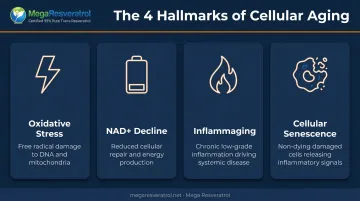
- Oxidative stress: Free radicals damage DNA, proteins, and cell membranes over time, creating a feedback loop with mitochondrial dysfunction that reduces energy production efficiency.
- NAD+ decline: NAD+ is essential for mitochondrial function and sirtuin activity; tissue-specific declines with age impair cellular repair.
- Inflammaging: Chronic low-grade inflammation — driven by accumulated cellular damage — underlies most age-related diseases, from cardiovascular disease to neurodegeneration.
- Cellular senescence: Senescent cells stop dividing but don't die when they should. According to the National Institute on Aging, these "zombie cells" may secrete inflammatory signals that accelerate damage in surrounding tissue.
Lifespan vs. Healthspan
Lifespan is simply how long you live. Healthspan is the period lived in good health — free from chronic disease and significant disability. Most longevity research today targets healthspan, not raw longevity.
No currently available supplement has demonstrated human lifespan extension in controlled trials.
Supplements are best understood as supportive tools within a broader lifestyle. They can address deficiencies, reduce modifiable risk, and support cellular function — but they aren't standalone anti-aging solutions.
Longevity Supplements With Strong Scientific Support
Vitamin D
Vitamin D is among the most studied supplements for healthy aging, influencing calcium absorption, bone density, immune regulation, and muscle function. Low 25(OH)D levels are observationally associated with increased risk of cardiovascular disease, and a 2025 meta-analysis found low vitamin D associated with a 49% higher dementia risk — though this is association, not causation.
The RDA is 600 IU/day through age 70 and 800 IU/day thereafter, with a 4,000 IU/day adult upper limit. The 2024 Endocrine Society guideline recommends healthy adults generally follow the RDA rather than routinely exceed it.
Best approach: Serum 25(OH)D testing is the most reliable way to determine whether you actually need supplementation. Routine screening of healthy, asymptomatic adults isn't universally recommended, but testing makes sense if you have risk factors for deficiency.
Magnesium
Magnesium acts as a cofactor in more than 300 enzyme systems, including energy production, DNA repair, protein synthesis, and blood pressure regulation. Roughly 48% of Americans consume less than the estimated average requirement — a gap that widens with age due to reduced dietary intake and medication interactions.
Proton pump inhibitors (PPIs) and loop diuretics both deplete magnesium — a real concern given how commonly these are prescribed to older adults.
On anti-inflammatory effects: The evidence is mixed. One meta-analysis of 17 RCTs found lower CRP with supplementation; another of 18 studies found no significant effect on inflammatory markers. Correcting a deficiency likely matters more than supplementing on top of adequate intake.
Omega-3 Fatty Acids
EPA and DHA are among the better-researched nutrients in the longevity space, partly because so many adults fall short. The American Heart Association recommends two 3-ounce servings of fatty fish weekly — a target most Americans don't consistently hit, which is where supplementation becomes relevant.
The cardiovascular picture from supplements is nuanced. A Cochrane review of 86 trials involving 162,796 participants found little or no effect on all-cause mortality or total cardiovascular events, though triglycerides fell about 15%.
More relevant to longevity: the DO-HEALTH trial tested 1g/day omega-3 for three years in adults over 70 and found a small but measurable effect across several DNA-methylation clocks — a biological aging biomarker. That's worth noting, though methylation clock changes don't yet translate directly to confirmed lifespan outcomes in humans.
Best approach: If you don't eat fatty fish twice a week, an omega-3 supplement is a reasonable addition — especially for triglyceride management and potential aging-related benefits.
CoQ10
CoQ10 is a naturally occurring antioxidant critical for mitochondrial electron transport. Levels may decline with age, and statin medications further reduce plasma CoQ10 by inhibiting the mevalonate pathway shared by cholesterol and CoQ10 synthesis.
Ubiquinone vs. ubiquinol: Ubiquinol is the reduced form of CoQ10, and some small studies in older adults suggest it may absorb better. They interconvert in the body, though, and solubilization quality may matter more than which form you choose.
Clinical trials typically use 100–300 mg/day. That's a research context range, not a general dosing recommendation for healthy adults.
Resveratrol and Healthy Aging: What the Research Shows
Resveratrol is one of the most researched polyphenols in longevity science. Found naturally in red grapes, berries, and red wine, it would take impractical quantities of food to reach the doses used in research — making supplementation the realistic option.
How Resveratrol Works at the Cellular Level
Resveratrol's primary mechanism involves activating SIRT1, a sirtuin protein that regulates cellular stress responses, DNA repair, and metabolic efficiency. These effects partially mimic caloric restriction pathways. It also acts as a direct antioxidant, scavenging free radicals and reducing oxidative damage — effects that are strongest in biochemical and preclinical models. SIRT1 activation is substrate-dependent and still debated in some contexts, so the mechanism is better established in certain models than others.
Trans-Resveratrol vs. Standard Resveratrol: Why Form and Purity Matter
Most consumers don't realize that resveratrol exists in two isomeric forms:
- Trans-resveratrol: The biologically active form studied in research
- Cis-resveratrol: Considerably less biologically active in most tested models
The form on the label matters — but so does purity. Independent audits of commercial resveratrol products reveal significant quality variability. One 14-brand audit found that only five products fell within 95–105% of their label claim, three contained just 8–64% of stated content, and two were effectively undetectable. A 2023 audit of 20 products found 95% differed from declared content, ranging from 5% to 234% of the labeled amount.
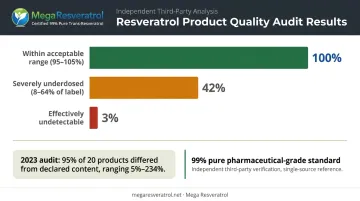
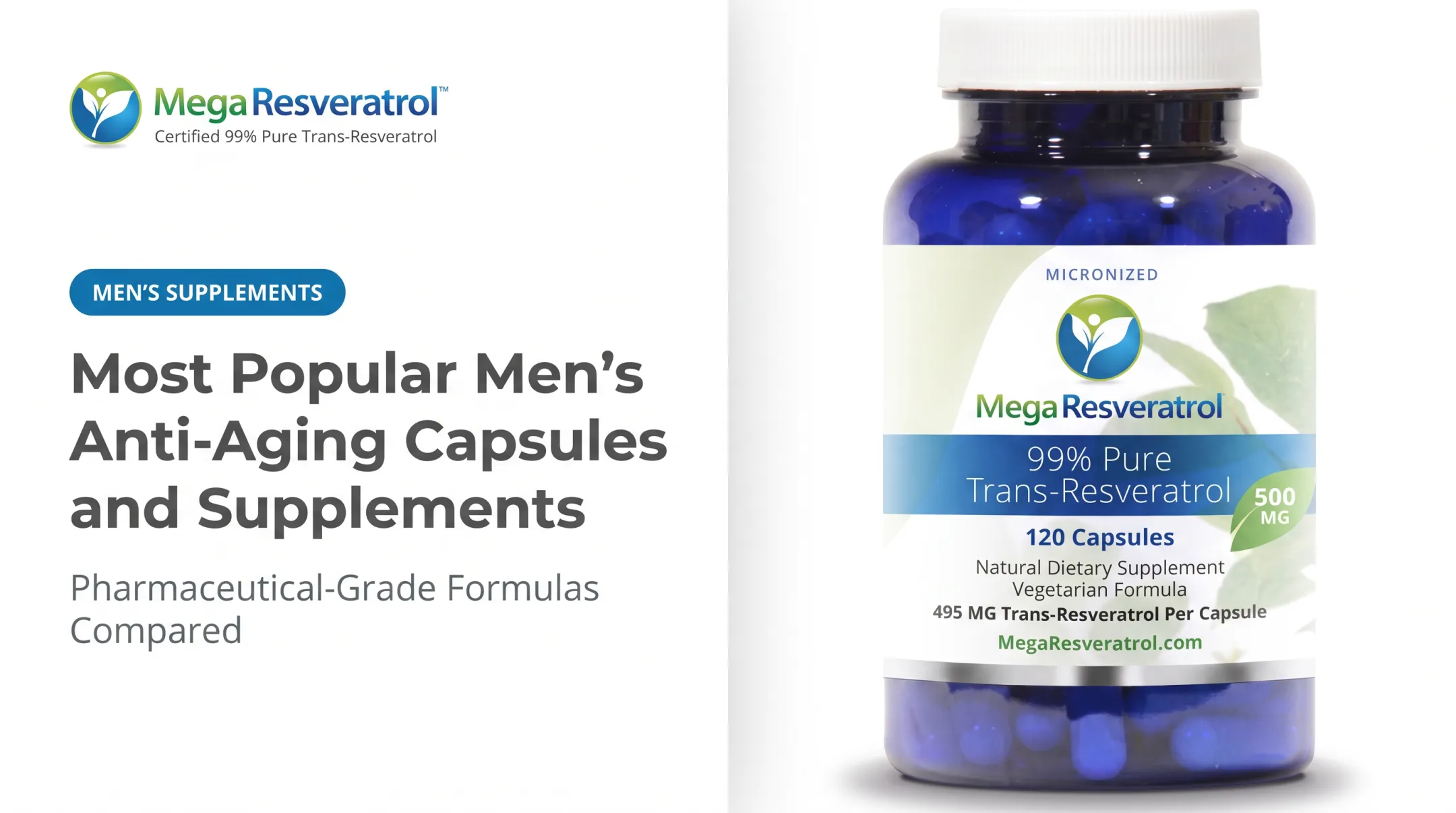
This variability is why pharmaceutical-grade trans-resveratrol with verified purity is meaningfully different from a generic supplement aisle product. Mega Resveratrol's formulation is certified at 99% pure trans-resveratrol by independent US laboratories, with batch-specific certifications. That's the standard research institutions require — and why the product has been used in over 50 published studies across more than 300 research institutes worldwide, including NYU, Columbia, Duke, and UCSF.
Purity is only part of the equation. Particle size matters too: micronization dramatically increases surface area and absorption. A micronized SRT501 formulation in one clinical study produced approximately 3.6-fold higher exposure than historical non-micronized data.
Resveratrol and Cardiovascular Health
The cardiovascular research on resveratrol shows promise alongside important caveats. A 2019 RCT meta-analysis reported improved flow-mediated dilation (a measure of endothelial function), but heterogeneity across studies was extreme (I²=96.5%), meaning results varied significantly by dose, population, and duration. A 2022 meta-analysis similarly reported FMD improvements with variable anti-inflammatory and lipid results.
Key points from the evidence:
- Endothelial function improvements are the most consistently reported finding
- Anti-inflammatory effects vary by population and dosing
- One 2020 pilot study found higher doses increased some cardiovascular risk biomarkers — more is not automatically better
- Results are most consistent when using clinically relevant doses from high-purity sources
For Mega Resveratrol's founder, Doron Efrat, these quality distinctions aren't academic. He started the company in 2007 after surviving a heart attack and being diagnosed with LP(a), a genetic cardiovascular condition. Finding only 10–20% pure resveratrol on the market at the time, he built the company around pharmaceutical-grade standards. His routine cardiac stress tests have been consistently excellent in the years since.
Emerging Supplements and the Ones That May Be Overhyped
Several compounds generate significant excitement in longevity circles but haven't yet cleared the bar of large, long-term human trials. That's not a reason to dismiss them outright — it's a reason to calibrate expectations to where the evidence actually stands.
| Compound | Evidence Stage | Key Finding | Main Gap |
|---|---|---|---|
| NMN | Short human RCTs | 250 mg/day raised blood NAD metabolites in older adults | Small studies; no longevity endpoints |
| NR | Human crossover (n=12) | 1g/day doubled blood NAD+ but not muscle NAD+ | 3 weeks; too small to generalize |
| Fisetin | Cells, mice, pilot human | Senolytic effects in mice; inconsistent human biological age results | No confirmed human senescent-cell clearance |
| Spermidine | Cohort + human RCT | Higher intake linked to lower mortality; 2022 trial didn't improve memory | Association ≠ causation |
| Berberine | Human metabolic RCTs | Improves glucose, lipid markers in metabolic syndrome | No long-term longevity data |
| Ashwagandha | Short human RCTs | May reduce perceived stress and sometimes cortisol | Rare liver-injury reports; long-term safety unknown |
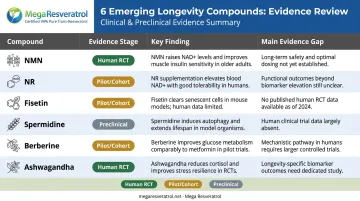
Practical framework: Supplements with strong human evidence, plausible mechanisms, and low risk profiles deserve priority. Vitamin D, magnesium, omega-3s, CoQ10, and pharmaceutical-grade resveratrol (99%+ purity) fit that profile. Emerging compounds may be reasonable additions with physician guidance, but not replacements for that foundation.
That foundation principle extends to every compound on this list: an underdosed or impure product — even of a well-studied supplement — may produce no measurable benefit. Bioavailability and purity matter as much as the compound itself.
What to Look for in a High-Quality Longevity Supplement
Three criteria separate genuinely high-quality longevity supplements from the rest: independent testing, formulation science, and what's not in the capsule.
Third-Party Testing
Because the FDA does not require manufacturers to prove purity or potency before sale, independent lab certification is the only reliable way to verify that a product contains what the label claims — at the stated dose, free from contaminants. Look for:
- NSF/ANSI 173 certification (label-claim testing, contaminant review, facility auditing)
- USP Verified mark (identity, amount, specified contaminant limits, dissolution)
- Brand-published Certificates of Analysis (COAs) — ideally batch-specific, not just one-time product-level certification
Mega Resveratrol publishes independent lab certifications going back to 2010, holds GMP certification, operates in an FDA-regulated facility, and carries a New York State Board of Pharmacy Drug Manufacturer license — a credential held to higher standards than typical supplement facilities.
Formulation and Bioavailability
Evaluate the form of the active ingredient, not just the label dose:
- Trans-resveratrol vs. mixed isomers
- Ubiquinol vs. ubiquinone (for CoQ10)
- Micronized vs. standard particle size
A higher-purity, better-absorbed product often delivers more per effective dose than a cheaper alternative, even when the label dose looks identical.
Excipients
Many supplements use fillers, binders, and flow agents to reduce manufacturing costs. Some additives carry unresolved safety questions at chronic doses — EFSA concluded titanium dioxide's genotoxicity concern could not be ruled out in 2021. When you're taking a supplement daily for years, that accumulation matters. An excipient-free formulation — where the capsule contains only the active compound — is worth prioritizing.
Building a Practical Longevity Supplement Routine
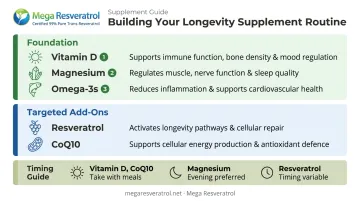
Start with the foundation:
- Vitamin D — especially if blood testing confirms deficiency
- Magnesium — addresses a widespread intake gap; supports energy, DNA repair, and sleep
- Omega-3s — if you don't consistently eat fatty fish twice weekly
Add targeted supplements once the foundation is in place:
- Resveratrol (99%+ pure trans form — purity and isomer matter here; generic blends vary widely) — cardiovascular and cellular support
- CoQ10 — particularly relevant for statin users or adults over 50
Timing notes:
- Fat-soluble supplements (vitamin D, CoQ10) absorb better with meals containing healthy fats
- Resveratrol absorption research is less straightforward — one crossover study found food delayed absorption, and high fat didn't improve total exposure
- Magnesium is often better tolerated in the evening
Before finalizing any routine, a few practical ground rules:
- Consult a physician before adding supplements, especially if you're on prescription medications. Omega-3s can inhibit platelet aggregation at high doses, and CoQ10 may interact with warfarin.
- Use blood work and objective health markers to assess whether your routine is working — subjective feeling alone isn't reliable
- Regular exercise, quality sleep, stress management, and a nutrient-dense diet remain the primary drivers of healthy aging. Supplements support that foundation, not the reverse.
Frequently Asked Questions
Do longevity supplements really work?
Some do, with meaningful evidence behind them. Resveratrol, NMN, NR, and pterostilbene have well-documented mechanisms in human and animal studies. Others carry promising early data not yet confirmed in large trials. Results depend on product purity, individual biology, and overall lifestyle.
What is the best longevity supplement on the market?
There's no single best option for everyone. Among targeted longevity compounds, trans-resveratrol, NMN, pterostilbene, and spermidine have the strongest mechanistic support. The right choice depends on your health status and specific goals — ideally reviewed with a physician.
What is the difference between trans-resveratrol and regular resveratrol?
Trans-resveratrol is the biologically active isomer shown to activate sirtuin pathways and provide antioxidant benefits. Cis-resveratrol has considerably less biological activity in most models. Product purity — specifically, what percentage is actually trans-resveratrol — is the key quality variable. Independent lab certification is the only reliable way to verify what a label claims.
When should you start taking longevity supplements?
Targeted longevity supplements like NMN and resveratrol are most commonly started around age 40, when NAD+ decline and mitochondrial efficiency loss become more pronounced. That said, individual health status matters more than a fixed age threshold.
Are longevity supplements safe to take with prescription medications?
Consult a physician before combining any supplement with prescription drugs. Resveratrol may interact with warfarin based on animal studies, and NMN's effects on certain metabolic pathways warrant review in medicated patients. Full disclosure to your healthcare provider is essential.
How long does it take to see results from anti-aging supplements?
Timelines vary. NMN's effects on energy and cellular repair may emerge within weeks for some users. Resveratrol's cardiovascular and sirtuin-related benefits typically require consistent use over several months. Some changes are only measurable through blood work, not subjective experience.