
But human data tells a more complicated story. Mouse longevity trials and human clinical trials don't always agree, and resveratrol is a textbook example of that gap. This article sets aside the rodent hype and looks at what actual human studies and trials show, warts and all.
Key Takeaways
- Human evidence is strongest for cardiovascular, metabolic, and joint markers, not lifespan extension itself
- NIA Interventional Testing Program: resveratrol did not extend mouse lifespan, unlike rapamycin or acarbose
- Poor bioavailability remains the biggest obstacle to translating lab results into real human benefit
- Purity, particle size, and trans-resveratrol form materially affect how much your body actually absorbs
What Is Resveratrol and Why Did It Become a Longevity Molecule?
Resveratrol is a stilbene polyphenol, a plant compound found in grape skins, blueberries, and peanuts. Plants produce it as a defense mechanism against fungal infection and UV stress.
The French Paradox story traces back to a 1992 Lancet paper by Renaud and de Lorgeril, which examined why French populations had lower coronary heart disease despite high saturated-fat diets.
Notably, that original 1992 paper focused on wine and platelet aggregation and didn't even mention resveratrol by name. The resveratrol connection came later, once researchers began measuring the compound in wine using HPLC methods.
Here's the catch: wine doesn't actually contain much of it.
- Red wine average: roughly 1.9 mg of trans-resveratrol per liter (2016 review)
- Human trial doses: as high as 500 mg a day
- Wine needed to match a trial dose: over 260 liters in one sitting

That mismatch is exactly why research attention shifted toward concentrated supplementation.
How Resveratrol Works in the Body
Three mechanisms get cited most often in the literature:
- Antioxidant activity — neutralizing free radicals
- Anti-inflammatory pathway modulation — suppressing NF-κB signaling and inflammatory markers like TNF-alpha and IL-6
- Sirtuin/AMPK interaction — the pathway once linked to caloric-restriction-like effects
That last mechanism carries real controversy. Early research suggested resveratrol directly activated SIRT1, a protein tied to cellular aging.
A 2010 study in the Journal of Biological Chemistry found that this "activation" only showed up when researchers used a fluorescent lab assay. When tested against native proteins, the effect largely disappeared.
This doesn't invalidate resveratrol's other mechanisms. Antioxidant and anti-inflammatory pathways remain independently supported. It just means the sirtuin story, once resveratrol's biggest selling point, needs an asterisk.
What Human Studies Actually Show: Evidence by Health Area
Cardiovascular and Blood Vessel Health
The cardiovascular data is encouraging, if narrow. A 2018 randomized crossover trial gave hypertensive adults a single 300mg dose of trans-resveratrol. Flow-mediated dilation (a marker of blood vessel function) improved significantly in women, from 4.2% to 7.1%, but not in men. Blood pressure itself didn't budge.
Separately, a 2020 trial of 60 heart failure patients taking 100mg/day for three months alongside standard therapy showed improved ejection fraction, better six-minute walk distance, and improved heart function measures.
A 2019 meta-analysis pooling 28 RCTs backs this pattern: flow-mediated dilation improved significantly across trials, but systolic and diastolic blood pressure showed no consistent change. In short: resveratrol seems to help blood vessels function better without necessarily lowering blood pressure numbers.

Joint, Muscle, and Metabolic Health
Joint health results are mixed depending on the trial:
- 2018 trial (n=110): 500mg/day for 90 days with standard medication reduced knee osteoarthritis pain and inflammation
- 2024 ARTHROL (n=142, six months): no significant difference in knee pain vs. placebo — larger trial, weaker signal
Metabolic markers show more consistency:
- Fasting glucose and insulin sensitivity improved across a 2017 meta-analysis of nine trials (283 participants)
- Total cholesterol dropped by roughly 7.65 mg/dL in a pooled analysis of 31 human studies
- No significant effect on weight or liver fat — a 2022 trial at 1,000mg/day for 8 weeks found zero impact on hepatic steatosis
An umbrella review reached the same conclusion: benefits exist for glycemic control and inflammation, but effect sizes are often small and evidence certainty is rated low.
Brain and Cognitive Health
The cognitive data is preliminary but interesting. A 2010 crossover trial gave healthy adults single doses of 250mg or 500mg trans-resveratrol and measured cerebral blood flow during mental tasks. Blood flow increased dose-dependently. Cognitive performance itself did not improve in that same session. Longer trials are still needed before anyone can claim a durable brain benefit.
Across these areas, the human record is consistent in shape: clearer signals for vessel function and some metabolic markers, mixed results for joints, and only preliminary work on cognition — useful, but still narrow.
The Bioavailability Problem: Why Purity and Absorption Matter
Here's the uncomfortable truth about resveratrol: your body absorbs it reasonably well through the gut, but metabolizes it almost immediately. A 2009 pharmacokinetic study found peak plasma levels occurring within 1-2 hours, with a half-life of just 1-3 hours. Even at multi-gram doses, only trace amounts of active, unmetabolized resveratrol circulate in your bloodstream.
Low-purity supplements make this worse. If a product is only 20-50% pure resveratrol (a common issue in cheaper formulations), you're paying for fillers and impurities that dilute your effective dose before absorption even becomes a factor.
Micronization is one documented fix. Reducing particle size increases surface area, which speeds and improves absorption. Standard resveratrol particles run 170-220 microns; formulations micronized below 2 microns have been associated with substantially higher uptake.

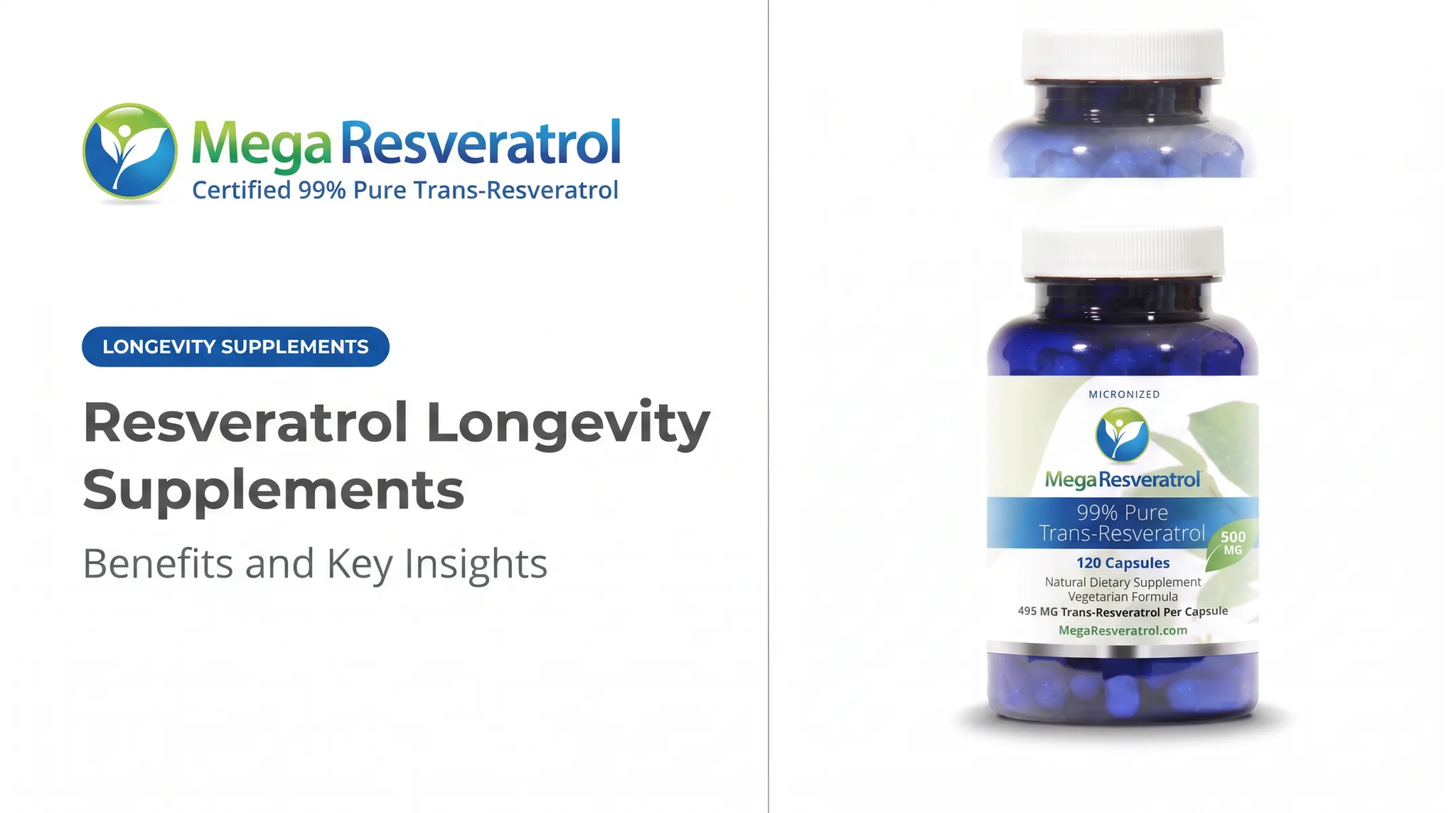
Mega Resveratrol formulates to that standard. Its trans-resveratrol capsules are:
- 99%+ pure, independently lab-tested by third-party U.S. laboratories on every batch
- Micronized below 2 microns (D-50 under 1.90 microns), versus 170-220 microns for standard resveratrol
- Excipient-free: no fillers, binders, or preservatives, just trans-resveratrol in a vegetarian capsule
Founded in 2007 by Doron Efrat after his own heart attack and LP(a) diagnosis, Mega Resveratrol built its reputation on closing this purity gap.
Its products have been cited in over 50 published human and lab studies and are supplied to research institutions including NYU, Duke, and UCSF, where verified purity is required for dependable trial data.
The Bigger Picture: Resveratrol vs. Other Longevity Compounds
The National Institute on Aging's Interventions Testing Program (ITP) is the gold standard for longevity compound testing in mice. Its verdict on resveratrol is sobering: fed at 300 or 1,200 ppm to genetically diverse mice starting at 9 months, resveratrol did not extend lifespan.
Compare that to the ITP's other findings:
| Compound | Mouse Lifespan Effect |
|---|---|
| Resveratrol | No extension |
| Rapamycin | +10% (males), +18% (females) median survival |
| Acarbose | +11-17% (males), 0-5% (females) median survival |

This doesn't disqualify resveratrol for humans. Mouse trials and human physiology diverge in plenty of ways, but expectations should shift.
Resveratrol looks less like a standalone anti-aging drug and more like a complementary compound supporting specific, measurable health markers: vascular function, glucose metabolism, and inflammation. That's still meaningful—just not the same claim as "extends life."
Safety, Interactions, and Practical Considerations
Resveratrol is generally well-tolerated at typical supplemental doses, with a few important caveats.
Key cautions:
- Blood thinners and antiplatelet medications (resveratrol may increase bleeding risk)
- Hormone-sensitive conditions (phytoestrogenic activity has been reported)
- Medications metabolized by CYP450 enzymes: one study found 1g/day for 4 weeks inhibited CYP3A4, CYP2D6, and CYP2C9
Common side effects at higher doses (2-5g/day) include GI upset, nausea, and diarrhea. Most human trials use far lower doses, typically in the 250-500mg/day range, which matches research protocols and tends to minimize side effects.
Practical tips:
- Take with a source of dietary fat to support absorption
- Start at the lower end of the dose range and monitor tolerance
- Talk to your doctor first if you're on blood thinners, hormone therapy, or any prescription medication metabolized by the liver
Frequently Asked Questions
What not to mix with resveratrol?
Use caution combining resveratrol with anticoagulant or antiplatelet medications, hormone therapies, and drugs metabolized by cytochrome P450 enzymes (liver enzyme pathways). Always consult a doctor before combining.
Is there anything better than resveratrol?
Rapamycin and acarbose showed more consistent lifespan extension in rigorous mouse trials, but both are pharmaceutical interventions, not natural supplements. Resveratrol remains a well-studied option for specific human health markers.
Does resveratrol really work for anti-aging?
Evidence supports benefits for specific markers like vascular function and glucose metabolism, not proven lifespan extension in humans. Use it for targeted metabolic and vascular support—not as proof of longer human lifespan.
What is the best form of resveratrol to take?
Trans-resveratrol is the biologically active form used in nearly all human trials. Purity and micronization both affect how much your body actually absorbs.
How much resveratrol should I take daily?
Most human studies use 250-500mg per day, though some trials go as high as 1,000mg. Talk to a doctor to determine what's appropriate for you.
Can I get enough resveratrol from food or wine alone?
No. Food and wine provide only trace amounts — far below the doses used in clinical research. Supplementation is the practical route to reach studied levels.