
The numbers back up the trend. In the CDC's most recent National Health and Nutrition Examination Survey, 75.9% of adults 60 and older reported taking at least one dietary supplement in the past 30 days, according to a 2021-2023 CDC data brief. This article breaks down the supplement categories with the strongest evidence behind them, realistic dosages, and how to spot a high-quality product versus marketing hype.
TL;DR
- Muscle mass, testosterone, and nutrient absorption naturally decline starting in your 40s and 50s
- Creatine plus resistance training has the strongest research support for preserving strength
- Vitamin D3, calcium, and omega-3s address bone and cardiovascular gaps common in this age group
- Resveratrol and saw palmetto show more mixed, population-specific evidence — quality and purity matter here
- Always check with a physician before adding anything new, especially alongside existing medications
Why Nutritional Needs Change for Men After 50
Testosterone doesn't crash overnight — it drifts downward gradually. A 2024 review in PMC found total testosterone declines about 0.4% per year and free testosterone 1.3% per year between ages 40 and 70. Muscle follows a similar path: research on sarcopenia estimates strength losses of 1.5% annually from age 50 to 60, accelerating to 3% per year after that.
Absorption changes too. Skin becomes less efficient at converting sunlight into vitamin D. One review found a 50% reduction in previtamin D3 formation with age. Calcium absorption often starts declining a decade or more before that. B12 absorption from food also weakens — enough that food alone often falls short after 50.
None of this means supplements are a substitute for the basics. They work best alongside:
- Regular resistance training
- Adequate protein and whole-food nutrition
- Consistent sleep
Those shifts are why the supplement categories below matter more after 50 than they did a decade earlier.
Top Supplements for Healthy Aging in Men Over 50
This list focuses on categories with clinical relevance to the concerns men 50+ raise most often: muscle, heart, bone, brain, cellular aging, and prostate health.
Resveratrol for Cellular Health and Cardiovascular Support
Resveratrol is a polyphenol antioxidant found in grape skins and a handful of other plants. It's been studied for cellular aging and vascular function, with mixed results across study populations.
A 2015 meta-analysis of 10 randomized trials found no significant effect on CRP, cholesterol, or blood pressure, per Sahebkar et al..
A 2024 randomized trial in adults with kidney disease and diabetes found that 400 mg/day for six weeks improved blood vessel flow-mediated dilation versus placebo. The result is promising, but it applies to a narrow, high-risk group.
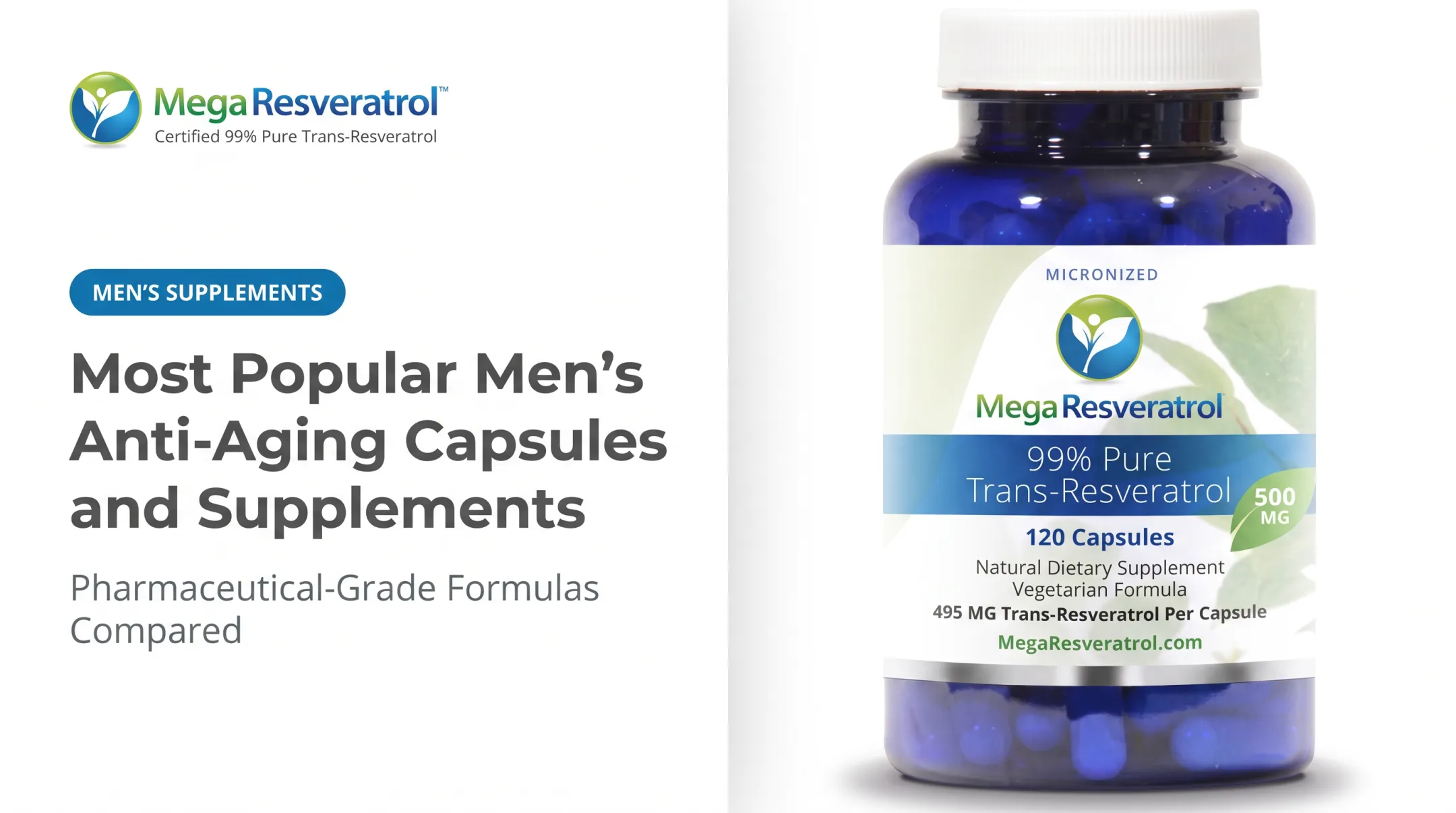
If you try resveratrol, purity is a practical buying factor. Doron Efrat, founder of Mega Resveratrol, started the company after surviving a heart attack in 2003 and being diagnosed with LP(a), a genetic cardiovascular condition. Unable to find anything purer than 10-20% trans-resveratrol on the market, he built a pharmaceutical-grade alternative from scratch.
| Feature | Detail |
|---|---|
| Purity | 99%+ pure trans-resveratrol, no fillers or excipients |
| Absorption Technology | Micronized particles under 2 µm (D-50 <1.90 µm) for enhanced bioavailability |
| Value | Four-month supply (120 capsules) at under $0.75/day, made in a GMP-certified, FDA-regulated US facility |

Creatine Monohydrate for Muscle Strength and Power
Sarcopenia, the age-related loss of muscle, is one of the most measurable changes men face after 50. Creatine helps by replenishing ATP, the molecule muscles burn for quick energy and strength output.
The evidence here is strong. A 2017 meta-analysis covering 22 studies and 721 older adults found that creatine combined with resistance training produced 1.37 kg more lean mass and measurably greater chest-press and leg-press strength compared to training alone.
| Feature | Detail |
|---|---|
| Typical Dosage | 3-5 grams daily |
| Best Paired With | Resistance training and adequate protein intake |
| Bonus Benefit | Emerging research suggests possible cognitive and brain-energy support |

Vitamin D3 and Calcium for Bone and Immune Health
As skin loses its vitamin D-synthesizing efficiency, deficiency risk climbs — and calcium absorption depends heavily on adequate D3 levels. Left unaddressed, this combination raises fracture risk and can affect immune function.
| Feature | Detail |
|---|---|
| Recommended D3 Dose | 600 IU (ages 51-70), 800 IU (71+) per NIH ODS |
| Recommended Calcium Dose | 1,000 mg (51-70) to 1,200 mg (71+) daily |
| Key Consideration | Get blood levels tested before supplementing at higher doses |
Omega-3 Fatty Acids (Fish Oil) for Heart and Brain Health
Omega-3s (EPA/DHA) are best supported for people with existing coronary heart disease, according to NIH's Office of Dietary Supplements. Evidence for healthy adults without risk factors is weaker. A large trial (VITAL) found no significant reduction in combined major cardiovascular events from supplementation in the general population.
| Feature | Detail |
|---|---|
| Recommended Dose | Approximately 1 gram/day combined EPA/DHA |
| Key Benefits | Supports heart, joint, and possibly cognitive function |
| Caution | Consult a doctor if on blood thinners or with a history of heart arrhythmia |

Saw Palmetto for Prostate and Urinary Health
Saw palmetto contains beta-sitosterol and has long been marketed for prostate support. The evidence, though, is mixed. A well-designed 2009 trial of 225 men using 320 mg/day for 12 months found no statistically significant difference from placebo in urinary flow or symptom scores. NCCIH's own science summary reaches a similar conclusion.
| Feature | Detail |
|---|---|
| Typical Dosage | 160-320 mg daily standardized extract |
| Primary Benefit | Marketed for prostate and urinary support, though clinical evidence is mixed |
| Additional Note | Discuss realistic expectations with a doctor before relying on it |
How to Choose High-Quality Supplements After 50
Quality gaps show up fast after 50, when absorption, drug interactions, and dose sensitivity matter more. Three mistakes come up again and again:
- Chasing megadoses: more isn't automatically better and can carry risk
- Skipping third-party testing: label claims aren't always accurate
- Self-prescribing without bloodwork: especially for vitamin D and B12
Avoid those traps by checking the product against a short quality bar:
- Independent lab certification (USP, NSF, or a named third-party US lab on the COA)
- GMP-certified manufacturing, ideally FDA-registered
- Transparent labeling with no unnecessary fillers or excipients
- Dosing that matches the population studied in actual research, not marketing copy

Before starting anything new, talk to a physician or pharmacist, particularly if you're on blood thinners, statins, or blood pressure medication.
Conclusion
Healthy aging after 50 rests on three pillars: targeted supplementation, consistent strength training, and solid nutrition. Creatine has the clearest research backing for muscle preservation. Vitamin D, calcium, and omega-3s fill common gaps. Resveratrol and saw palmetto need more nuance—and closer purity scrutiny. Whatever you choose, prioritize third-party tested, high-purity products over flashy marketing. Mega Resveratrol, founded in 2007 after its CEO's own cardiovascular health scare, built its reputation on that standard. Its products are used by more than 100 research institutions worldwide and appear in over 50 published studies indexed on Google Scholar. Use that level of independent testing and documented research use as your benchmark, no matter which brand you buy.
Frequently Asked Questions
What is the best energy supplement for men over 50?
There isn’t one best pick for every man. Creatine, B12, and NAD+ boosters are the most studied options for cellular energy and fatigue. Get bloodwork first so you treat real deficiencies, not guesses.
Do men over 50 need a multivitamin?
A well-formulated multivitamin can help fill common dietary gaps, particularly for vitamin D, B12, and magnesium. It's not a substitute for a balanced diet, but it can be a useful safety net.
How much vitamin D should a man over 50 take daily?
The NIH recommends 600 IU daily for men 51–70 and 800 IU for men over 70. Needs vary by blood level, so test before using higher doses.
Is resveratrol safe to take daily?
Resveratrol is generally well tolerated, especially in high-purity, third-party-tested, filler-free forms. Check with your doctor if you take blood thinners—it may have mild blood-thinning effects.
Can supplements replace a healthy diet and exercise for men over 50?
No. Supplements are meant to complement, not replace, a balanced diet, strength training, and healthy sleep habits. The research behind creatine, for example, only shows benefit when paired with resistance training.
What supplements should men over 50 avoid or take cautiously?
Use caution with high-dose vitamin E and unregulated testosterone boosters. Both can pose risks—bleeding risk or hormone disruption—and belong under medical guidance only.