
But real-world benefits depend on more than popularity. Purity, dosage, and how well your body actually absorbs the compound matter enormously. This article walks through what resveratrol does at the cellular level, what the research actually shows, and where quality makes or breaks results.
TL;DR
- Activates SIRT1 and AMPK pathways linked to slower cellular aging
- Strongest evidence: cardiovascular and metabolic markers; skin/cognitive data is still emerging
- Oral bioavailability is under 1% for standard forms—purity, particle size, and third-party testing matter
- Studied doses typically fall in the 150–500 mg daily range
- Works best as part of a broader healthy-aging approach, not a standalone fix
What Is Resveratrol?
Resveratrol is a natural polyphenol found in foods such as:
- Red grape skins
- Berries
- Peanuts
Interest grew after the 1992 "French Paradox" observation: French populations had relatively low rates of coronary heart disease despite a diet high in saturated fat. Moderate red wine consumption was proposed as one explanation (Catalgol et al., 2012).
Red wine contains more resveratrol than white wine because grape skins ferment along with the juice. Diet and wine alone rarely deliver steady amounts, so most people use concentrated capsules for consistent dosing.
Resveratrol supports cellular pathways tied to aging. Human evidence favors a measured role in healthy aging—not dramatic reversal claims.
Key Advantages of Resveratrol for Reversing Aging
The benefits below are grounded in measurable biological markers, not anecdotes. Outcomes vary based on dose, individual health status, and supplement quality.
Cardiovascular and Metabolic Support
Heart disease risk climbs sharply with age. Heart failure prevalence in one cardiovascular cohort study rose from 12% of men and 6% of women at age 65-69 to 18% and 14%, respectively, by age 85+ (Yazdanyar & Newman, 2009).
Resveratrol supports endothelial function through SIRT1/AMPK activation, a pathway linked to some caloric-restriction effects. In one trial, a single 270mg dose raised flow-mediated dilation from 4.1% to 7.7% in overweight adults with hypertension.
Other findings from a broader review:
- 150mg/day for 30 days lowered systolic blood pressure in obese men
- 250mg/day for 3 months improved systolic blood pressure in diabetes patients
- 100mg/day for 12 weeks may improve arterial stiffness

These cardiovascular gains are most relevant for adults who already carry risk factors such as elevated cholesterol or insulin resistance.
Cellular Aging and Sirtuin Activation
Resveratrol activates AMPK, sometimes indirectly. At lower concentrations, SIRT1 deacetylates LKB1, an upstream AMPK kinase; at higher levels, mitochondrial effects may raise the AMP-to-ATP ratio directly. This connects to DNA repair, mitochondrial efficiency, and epigenetic aging markers.
In a small 2024 study, 30 adults aged 40-80 with cardiovascular risk factors replaced their usual wine with resveratrol-enriched wine (150mg/L) for a median of 105 days. Epigenetic-age acceleration shifted by nearly 5 years on average.
The trial was uncontrolled and confounded by alcohol intake and diet changes, so it does not isolate resveratrol alone. It still underscores a practical point: sirtuin pathways respond reliably to genuine trans-resveratrol, not degraded or contaminated material. Independent lab testing and pharmaceutical-grade purity are how you verify that.

Cellular support from this pathway is a long-game strategy. It suits people building resilience over years, not anyone expecting overnight reversal of existing damage.
Skin, Brain, and Anti-Inflammatory Benefits
On skin and inflammation, resveratrol's antioxidant activity helps in several ways:
- Supports collagen preservation
- Inhibits matrix metalloproteinases (MMPs) that break down skin structure
- Counters aspects of "inflammaging," the chronic low-grade inflammation tied to age-related decline
On the cognitive side, a rat study found resveratrol (10mg/kg/day for 4 weeks) raised serum BDNF—a protein tied to memory and neuroplasticity—from 1.18 to 1.64 ng/mL. Human data is thinner but directionally positive: a 2014 study reported early signs of improved memory linked to better brain glucose metabolism.
Oral bioavailability is still the main hurdle for systemic benefits. Topical and oral routes likely diverge in outcome, and current research does not offer a clean head-to-head comparison.
What Happens When Resveratrol Quality Is Ignored
Not all resveratrol on the shelf is what it claims to be. A 2012 HPLC study tested 14 commercial resveratrol products and found wide gaps between labels and lab results:
- Only 5 met pharmaceutical-grade purity (95-105% of label claim)
- Three contained just 8-64% of labeled trans-resveratrol
- Two fell below detection entirely
An Amazon product marketed as "100% Pure" and "Extra Strength" tested at only 3% trans-resveratrol under independent lab analysis. The material reportedly resembled Japanese knotweed mixed with rice flour.

Common culprits behind underperforming products:
- Excipients and fillers like rice flour or magnesium stearate, sometimes making up 50-80%+ of a capsule
- Degraded resveratrol that's converted from the active trans-form to an inactive cis-form
- Undisclosed dosing, where labels don't specify actual trans-resveratrol content
You get minimal absorption, inconsistent results, and money spent on capsules that deliver almost no active trans-resveratrol.
How to Get the Most Value from Resveratrol Supplementation
Getting real benefit from resveratrol comes down to three factors: purity, particle size, and consistency.
Purity verification. Look for trans-resveratrol content verified at 99%+ purity through independent lab testing, not just a label claim. Mega Resveratrol tests every batch through independent U.S. laboratories and maintains a public archive of certifications dating back to 2010.
Particle size and absorption. Resveratrol is fat-soluble and poorly absorbed in its standard form. One study found a single 500mg dose resulted in less than 1% bioavailability for the unchanged compound, since it is rapidly metabolized in the gut and liver.
Micronization addresses this directly. Standard resveratrol particles measure 170-220 microns; Mega Resveratrol's micronized capsules average less than 2 microns, a change linked to absorption improvements of up to 1,000% in clinical studies.

Dosing and timing.
- Start conservatively at 150-300mg daily rather than jumping to high doses
- Take capsules with a moderate amount of dietary fat (avocado, olive oil, or nut butter) so fat can form micelles that carry resveratrol across the gut lining
- Avoid taking it on an empty stomach; absorption drops significantly without fat present
- Stick with it consistently rather than relying on occasional high-dose use
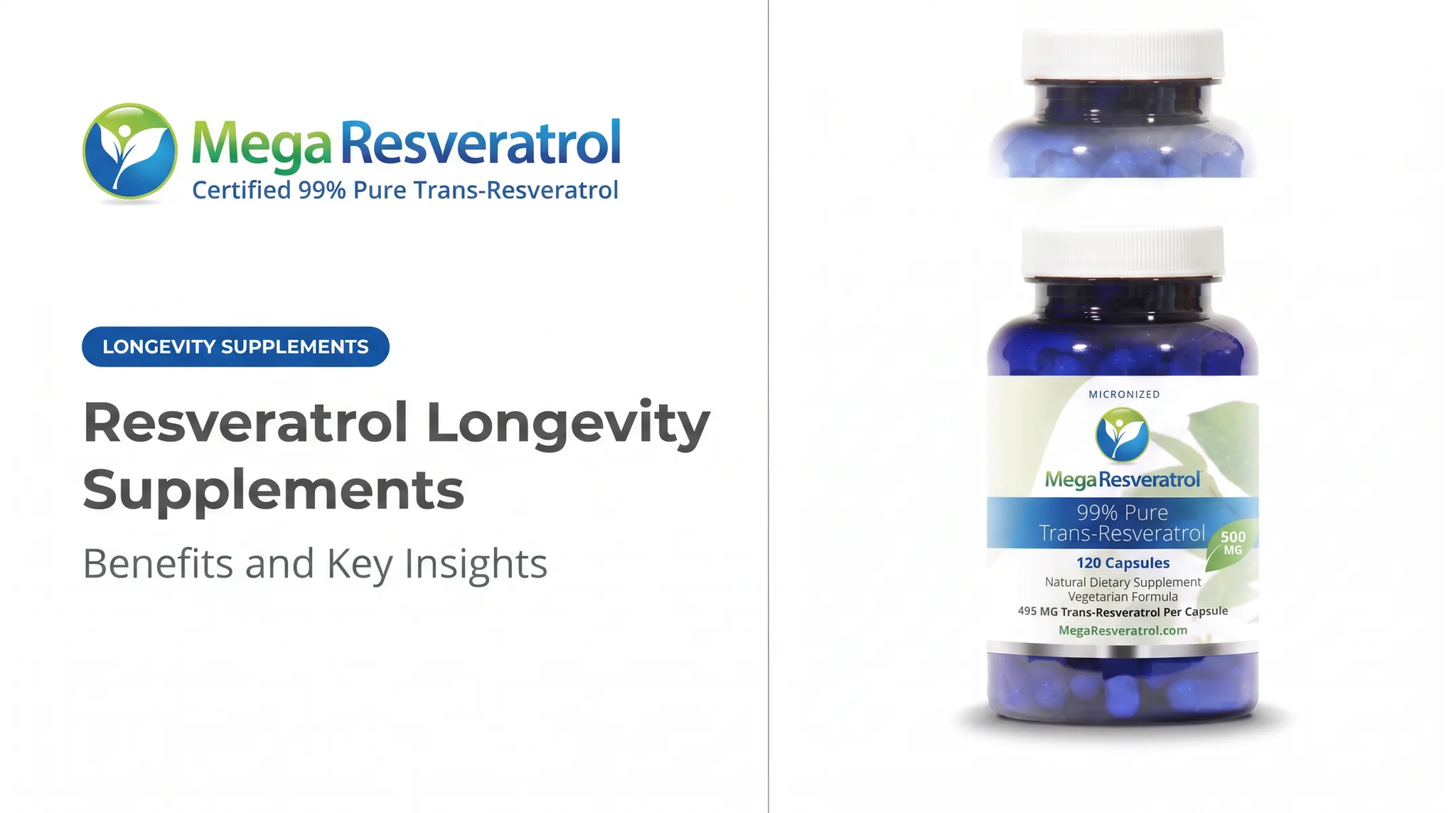
Mega Resveratrol's pharmaceutical-grade, micronized capsules contain no fillers or excipients, are used by more than 100 research institutions worldwide (including Duke, NYU, and UPenn), and cost less than $0.75 per day for a 120-capsule bottle of the 500mg formula.
Pair that daily habit with a solid diet and lifestyle, and you get more from each milligram than any occasional high-dose push can deliver.
Conclusion
Resveratrol's real value in aging lies at the cellular level: sirtuin activation, antioxidant defense, and metabolic support that compounds over time with consistent, quality-controlled use.
Those benefits build with steady use, not a single dose. Treat resveratrol as one part of an ongoing, evidence-based approach to healthy aging, alongside diet, exercise, and regular checkups. It is not a one-time fix or a replacement for medical care.
Frequently Asked Questions
Can resveratrol reverse skin aging?
Resveratrol supports collagen preservation and inhibits enzymes (MMPs) that break down skin structure. Evidence is stronger for antioxidant and anti-inflammatory support than for dramatic wrinkle reversal.
Is resveratrol hard on your liver?
At standard doses, resveratrol is generally well-tolerated, and NIH's LiverTox rates clinically apparent liver injury as unlikely. Very high doses (1.5-3.0g/day) have shown slight, reversible increases in liver enzymes in some studies.
How long does it take to see results from resveratrol supplementation?
Small trials have shown measurable changes in blood pressure and inflammatory markers within 4-12 weeks of consistent use. Individual results vary based on dose, quality, and health status.
What is the best dosage of resveratrol for anti-aging benefits?
Studied ranges span 150-500mg daily, with most cardiovascular research clustering around 150-250mg. Starting conservatively and adjusting based on tolerance is the safer approach.
Does resveratrol interact with any medications?
Yes. Resveratrol can affect drug-metabolizing liver enzymes and may enhance the effects of blood thinners like warfarin. Anyone on daily prescription medication should consult a doctor first.
What is the difference between resveratrol and NAD+ boosters like NMN?
Resveratrol acts as a signaling activator of SIRT1-related pathways, while NMN directly replenishes NAD+ as a precursor molecule. They work through different mechanisms and are often used complementarily.