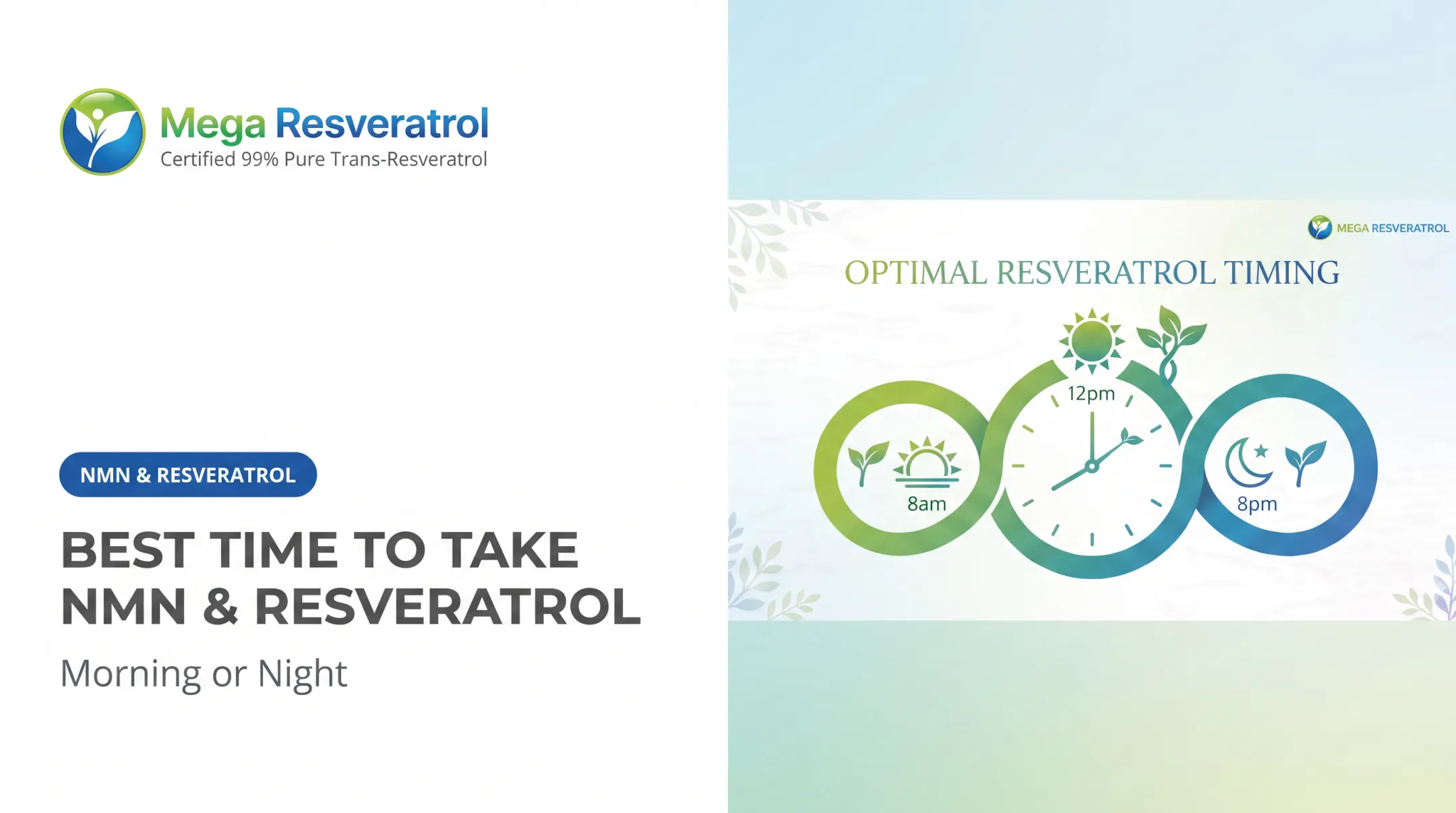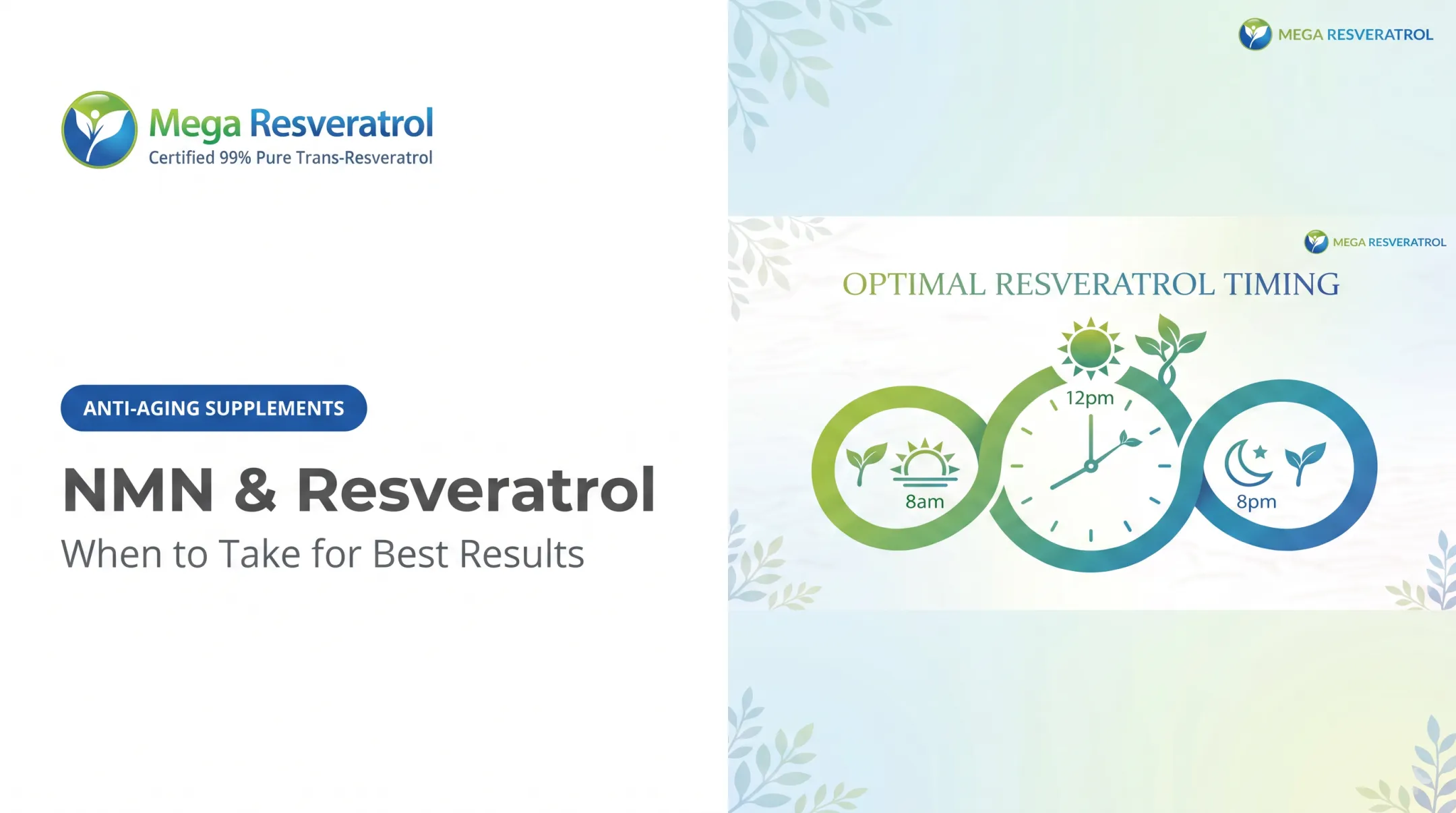

But here's something many users overlook: when you take NMN can matter almost as much as whether you take it at all. Timing affects how it lines up with your body's natural NAD+ rhythm, how well it's absorbed, and whether it interferes with sleep.
This guide breaks down the best time to take NMN, how that answer shifts based on your goals, dosage, and lifestyle, and the mistakes worth avoiding.
TL;DR
- Morning dosing before breakfast is the convention in most published NMN trials
- Evening dosing may increase alertness in sensitive individuals
- Consistency over 8–12 weeks matters more than perfect timing
- Doses above 500mg can be split between morning and early afternoon
- Pair NMN with trans-resveratrol and dietary fat at breakfast for a common stack
Why Timing Matters for NMN
NAD+ levels are tied to your body's circadian clock. Research in mice shows NAD+ helps activate SIRT1, which in turn interacts with the PER2 protein and the CLOCK/BMAL1 system that governs your internal clock.
In one study, NMN given to mice increased BMAL1 binding activity by roughly 25% (NMN–BMAL1 circadian study). The mechanism is compelling — but it was shown in mice and cells, not humans.
Human data on NMN's precise absorption timeline is thinner than most timing guides suggest. A 2020 study monitored 10 healthy men for five hours after a single dose but didn't establish a formal half-life (2020 human NMN dosing study).
What the evidence supports:
- Morning-before-breakfast is the dosing convention used in the majority of human NMN trials
- Inconsistent daily timing may blunt the steady NAD+ rise seen when trials used regular, compliant dosing
- Some users report increased alertness from evening doses, though no study has quantified this as a specific percentage
The takeaway: timing has a plausible biological basis, but the strongest evidence favors consistency over chasing a precise "optimal hour."

Best Time to Take NMN Based on Different Scenarios
Ideal NMN timing depends on your goals, dose, workout schedule, and sensitivity to its mildly energizing effect—there isn't one universal answer.
Based on Daily Goals
For general energy, focus, and metabolism support, morning dosing—within an hour or two of waking—is the most evidence-backed default. It mirrors the protocol used in the 60-day dose-dependent RCT, where participants took NMN before breakfast and showed measurably higher blood NAD+ at both day 30 and day 60 (source).
If afternoon drowsiness is your main concern, research points to a different window. A 12-week study in 108 older Japanese adults compared morning dosing (after waking to noon) with afternoon/evening dosing (6 PM to bedtime). The afternoon group showed a meaningfully larger improvement in daytime drowsiness (source).
Sleep quality scores improved in both groups, though the difference between them wasn't statistically significant.
Based on Exercise Routine
- Morning exercisers: Take NMN 30–60 minutes before training
- Evening exercisers: Keep a morning dose; don't shift NMN to pre-workout at night
No study has measured an acute NAD+ peak tied to workout timing. A six-week runner study with NMN at breakfast and lunch/afternoon found performance gains built over the full period, not from single-session timing (source).
Based on Dosage Level
Mega Resveratrol's Super NMN capsules contain 500mg each:
- 500mg (one capsule): Works well as a single morning dose
- 1,000mg (two capsules): Consider splitting into one capsule at breakfast and one in the early afternoon, before 2 PM, to avoid any risk of evening alertness
Based on Individual Sensitivity and Lifestyle
- Sleep-sensitive individuals: Dose immediately upon waking to maximize distance from bedtime
- Shift workers: Align NMN with the start of your active period, not the clock on the wall. If you wake at 3 PM for a night shift, that's your "morning"

Signs It's the Right Time (and When to Avoid Dosing)
Use this quick self-check to see if your current schedule is working:
- Good signs: Steady energy through the day, no afternoon crash, no trouble falling asleep
- Red flag: Dosing after 6 PM, especially if you notice increased alertness or unusually vivid dreams
- Stomach signal: Mild nausea on an empty stomach means it's time to pair your dose with a light meal, not push through it
Talk to your doctor first if you're on medications affecting the NAD+ pathway, pregnant or breastfeeding, or managing active cancer. Timing routines should come after that conversation, not before it.
What Happens If NMN Is Taken at the Wrong Time
Mistimed doses aren't dangerous, but they can undercut your results. Here's what tends to go wrong:
- Evening dosing may delay sleep onset or raise nighttime alertness in some users. No study has fixed a reliable rate, so treat it as individual sensitivity.
- Inconsistent daily timing can blunt the steady blood NAD+ rise seen in trials. RCTs that showed improvement used regular daily dosing, not sporadic use.
- Empty-stomach dosing can cause mild nausea if you're sensitive. That's a signal to add a light meal, not a reason to quit.
None of these outcomes are severe. They're more like friction that slows down your results than a real safety concern.
Best Practices for Timing NMN Correctly (and Pairing for Better Results)
- Anchor it to an existing habit. Take NMN with breakfast or your morning coffee so it becomes automatic rather than something you have to remember.
- Commit to 8-12 weeks before judging results. This mirrors the duration used in most human trials, including a 12-week sleep and fatigue study and a 10-week trial in postmenopausal women.
- Consider stacking with trans-resveratrol. Resveratrol activates sirtuins that consume NAD+, so some users pair the two. Mega Resveratrol suggests 250-500 mg NMN with 300-500 mg trans-resveratrol at breakfast, taken with dietary fat (avocado, olive oil, or eggs) for better absorption.
- Track your own data. Log energy, sleep quality, and recovery in a simple notebook or app instead of waiting for a dramatic single-day shift.
- Store it properly. Mega Resveratrol recommends refrigerating or freezing NMN after it arrives, since it's shipped at -20°C (-4°F) to preserve potency. A degraded product won't respond to even perfect timing.

Frequently Asked Questions
When is the best time of day to take NMN?
Morning, generally within an hour or two of waking and before breakfast, aligns with the natural NAD+ circadian peak and is the timing convention used in most published human trials.
How should I take NMN for best results?
Take it consistently every morning, pair it with a light meal if you're sensitive to it on an empty stomach, and stick with the routine for a full 8-12 weeks before evaluating.
How long does it take for NMN to start working?
Blood NAD+ increases have been measured as early as 30 days in controlled trials, though subjective energy changes vary by individual and aren't reliably timed in the research.
How do you know if NMN is working?
Common self-reported signs include steadier energy, improved exercise recovery, and better focus. Blood NAD+ testing offers a more objective measure if you want data over anecdote.
What happens if I take NMN every day?
Daily, continuous use is well-supported by human trials lasting 6 to 12 weeks, with no evidence that cycling on and off provides any added benefit.
Can NMN reverse skin aging?
No. NMN cannot reverse chronological aging, and human research on skin-specific benefits is still limited. It may support cellular repair processes tied to skin vitality, but that link isn't proven in human trials yet.
Conclusion
There's no single best time that works for everyone. If you need a default, take NMN in the morning with breakfast—the approach backed by most published NMN studies.
Consistency still beats perfect timing. Use this simple plan:
- Dose at the same time each day (morning with food is the easiest anchor)
- Stay on that routine for 8–12 weeks before judging results
- Choose pharmaceutical-grade NMN with 99%+ purity and independent lab testing
Mega Resveratrol makes pharmaceutical-grade, micronized NMN to that standard—so your schedule and your product are both working in your favor.