
Timing questions come up constantly, especially about night dosing. Taking NMN at the wrong time won't cause serious harm, but it might disrupt your sleep or blunt the energy benefits you're after. This guide breaks down whether night dosing works, how it stacks up against morning use, and what signs point to the right schedule for you.
TL;DR
- Night dosing works, but circadian science and most trials favor morning NMN
- Some users find evening NMN delays sleep onset via mild energizing effects
- Limited evidence links evening dosing to overnight recovery support
- Fatigue, brain fog, or poor recovery: try NMN—timing is secondary
- Consistency over 8-12 weeks beats chasing perfect timing
Why Timing Matters for NMN
NAD+ levels naturally rise in the morning and decline by evening. This is the core reason chronobiology research leans toward AM dosing. Taking NMN when your NAD+ is already trending upward may support the energy, focus, and metabolic benefits people want. Fighting against that natural decline late in the day could blunt those effects.
That said, the science isn't as airtight as some blogs suggest. A 2023 brain-imaging study found no statistically significant difference in NAD+ levels between morning and afternoon measurements. The researchers noted their two-time-point design couldn't capture a full 24-hour rhythm. Human circadian NAD+ data is still catching up to the theory.
You'll also see claims online about NMN's plasma half-life being roughly 30 minutes. Take those commonly cited numbers with a grain of salt:
- That figure comes from a mouse study using high injected doses, not humans
- No verified human oral half-life for NMN currently exists in published research
What we do know: some users report increased alertness with late-day dosing, which is why the morning-first approach remains the safer default.

Best Time to Take NMN Based on Different Scenarios
There's no one-size-fits-all answer. Your best timing depends on how your body responds, what you're trying to achieve, and how your day is structured.
Based on Individual Sensitivity to Energizing Effects
If you notice a distinct lift in alertness after taking NMN, keep it away from bedtime. This is the single biggest predictor of whether night dosing will work for you.
- Sensitive to energy lift: Take NMN in the morning or early afternoon only
- No noticeable stimulation: Evening or pre-bed dosing is usually fine to trial
- Unsure yet: Test a morning dose for several days, then try early evening and compare sleep
Based on Health and Wellness Goals
For energy, focus, and metabolic support, morning dosing aligns with the trial designs researchers have used. A 2023 study of 80 healthy middle-aged adults had participants take NMN before breakfast for 60 days, and blood NAD+ levels rose across all dosed groups by day 30.
A 2022 Nutrients study on adults 65 and older tested evening dosing directly, from 6 p.m. until bedtime, for 12 weeks. The evening group showed the largest improvement in a physical performance test (sit-to-stand) and the biggest reduction in daytime drowsiness.
The placebo group taking evening pills also improved on drowsiness, and sleep quality did not differ significantly between groups. Evening dosing does not appear harmful for most people, but it is not a proven sleep aid on its own.

Based on Daily Routine and Lifestyle
Shift workers should treat the start of their active period as their "morning," regardless of the clock. Pairing NMN with an existing habit makes consistency far easier than a standalone reminder.
Useful anchors include:
- First coffee or breakfast of your wake cycle
- Start of a work block or pre-workout routine
- Wind-down window only if NMN does not increase alertness for you
Is There a Case for Taking NMN at Night?
If you're leaning toward evening dosing, a few signals suggest it might actually work for you:
- You've tested it during the day and felt nothing. No jitteriness and no noticeable lift mean low risk of sleep interference.
- You're targeting overnight recovery. NMN research often focuses on sirtuin activity and DNA repair during rest cycles, though direct human evidence for night dosing is still limited.
- It fits your routine better. A supplement you'll actually take consistently beats a "perfect" morning dose you keep forgetting.
When You Should Avoid Taking NMN at Night
The primary risk with night dosing is straightforward: sleep disruption. A few situations increase that risk considerably.
- Known sensitivity to energizing supplements, or a history of trouble falling asleep
- Inability to dose consistently at night, which makes it hard to judge your response
- Concurrent use of sleep medications or antidepressants, where interaction data is limited
No reliable published data currently quantifies how many people experience insomnia or vivid dreams from late-day NMN. The Nutrients study on evening dosing also excluded people on sleeping pills or antidepressants, so evidence for those combinations is thin.
If you're on sleep medication or have a history of insomnia, talk to a healthcare provider before trying evening timing.
What Happens If NMN Is Taken at the Wrong Time
Mistimed NMN doesn't cause serious harm, but it can undercut your results.
- Evening dosing that fights your natural NAD+ decline may blunt the energy or focus effects you were hoping for
- Sleep issues from night dosing often push users to quit early, missing the 8-12 week window needed for measurable change
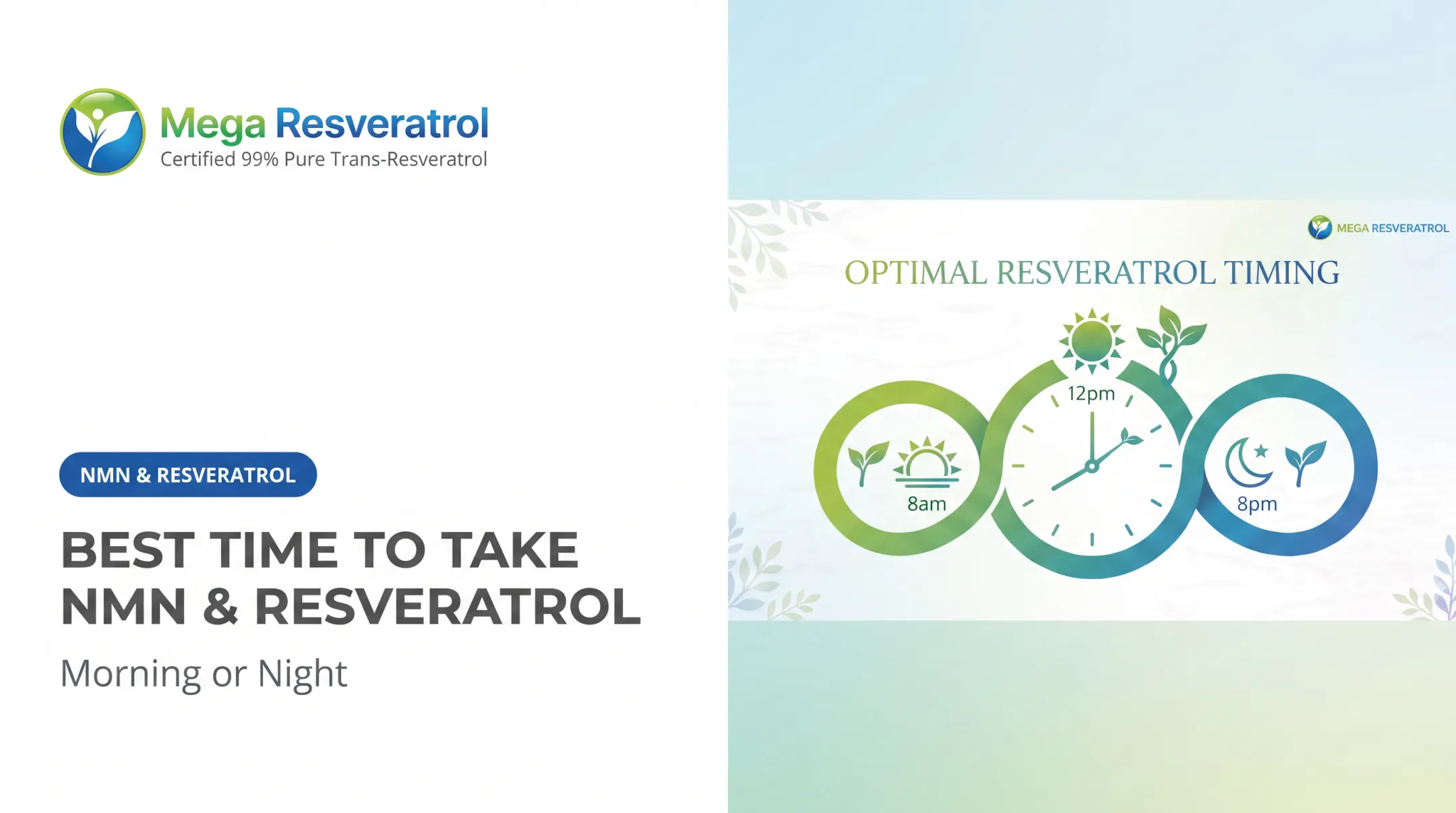
- Pairing NMN with trans-resveratrol works better as a morning dose with a fat-containing meal
That last point matters in practice. Resveratrol is fat-soluble, so pairing it with breakfast and a healthy fat source—eggs or avocado—supports absorption.
If you're building a structured NAD+ and sirtuin routine, Mega Resveratrol's 99% pure micronized trans-resveratrol pairs cleanly with a morning 500 mg NMN capsule.

Best Practices for Timing NMN Correctly
- Start with a consistent morning or early-afternoon dose. Track your energy, sleep, and recovery for at least 8-12 weeks before making changes.
- Experiment cautiously if curious about night dosing. Try a lower amount, such as 250 mg, first to monitor how it affects sleep quality.
- Anchor NMN to an existing habit. Take it with coffee, breakfast, or your bedtime routine so the dose becomes automatic.
One 500 mg capsule daily from a 90-count bottle lasts 90 days, which covers the full 8-12 week trial window most research protocols use.
Conclusion
There is no single best time to take NMN for everyone. Timing depends on your sensitivity, goals, and daily rhythm.
- Morning: Stronger backing from circadian NAD+ research for most users
- Evening: Better fit for recovery-focused users who do not feel energizing effects
Pick one window, stay consistent for one to two weeks, and adjust based on energy, sleep, and recovery. If night dosing leaves you wired, move your dose earlier in the day.
Frequently Asked Questions
Can NMN cause trouble sleeping?
A subset of users report mild energizing effects that can delay sleep onset when NMN is taken late in the day. Many others notice no impact on sleep at all, so individual response varies widely.
What is the best time to take NMN?
Morning, ideally with breakfast, has the strongest support from circadian science and published trials. That said, individual response still plays a large role in what works best.
Does NMN help with weight loss?
NMN supports metabolic and mitochondrial function rather than directly causing weight loss. Any effect is indirect, coming from improved energy levels that may support more physical activity.
Can I take NMN on an empty stomach at night?
NMN is water-soluble and generally absorbs regardless of food state. Some users prefer a small snack alongside it to avoid mild stomach discomfort.
Should I pair NMN with resveratrol if taking it at night?
Most resveratrol pairing research uses morning dosing with a fat-containing meal for better absorption. Shifting the whole stack to morning is likely more practical than pairing both at night.
How long does it take to notice results from NMN regardless of timing?
Subtle changes may appear within 2-4 weeks of consistent use. More measurable benefits typically require 8-12 weeks of daily supplementation.